What internal linking is and how we approach it
Internal linking is the SEO task with the worst ratio between how little it costs and how rarely it gets done. It needs no paid tools, doesn't depend on anyone else and can be done in an afternoon. Even so, on almost every website we audit it's only half done, and ours was no exception: a few weeks ago we reviewed our own site and found a gap that had been there for months. This article explains what internal linking is, how we measured it and exactly what we did, with our numbers.
What it is, in one sentence
They're the links that go from one page of your website to another page on that same website. They do three things at once: they show Google which pages are important, they explain what each one is about through the words you use as link text, and they take the visitor to the next step instead of leaving them at a dead end.
The third one is the most often forgotten. A good internal link isn't there for Google: it's there because at that point in the text the reader has a question, and you have the answer on another page.
The gap we found on our own website
We had 41 published articles, all with links to our service pages. The job looked done. Until we looked in the opposite direction.
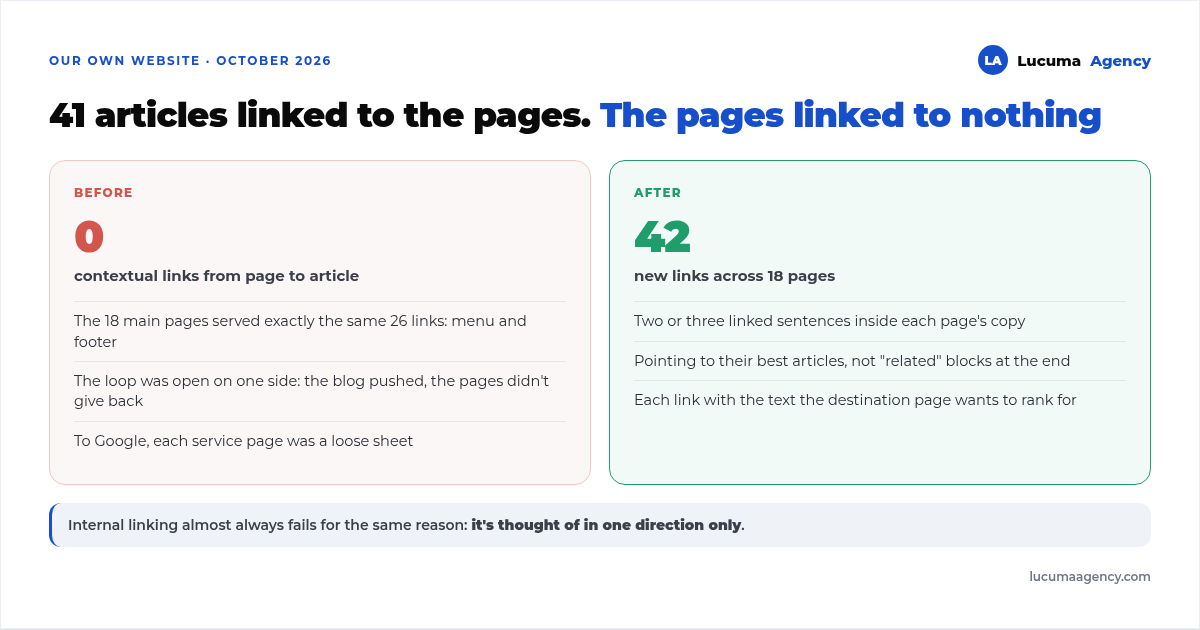
We reviewed the 18 main pages, one by one, live. They all had exactly the same 26 internal links: the menu and the footer. Not a single contextual link to an article. In other words, the blog pushed toward the service pages and the service pages gave nothing back. The loop was open on one side.
That has a concrete effect: to Google, a service page that only receives navigation links is a loose sheet. There's nothing on the site telling it what the page is about beyond its own text.
What we did: 42 links across 18 pages
The fix was to add two or three sentences with a link inside the text of each page, pointing to its best articles. Not “related articles” blocks at the end, which almost nobody reads and Google gives little weight to: sentences within the content, where the reader is already interested in that specific topic.
A verbatim example from our SEO page: “The timeline depends on the state of the website and how competitive the niche is: we explain it with cases in how long it takes for a website to rank on Google.”
The other side: the distribution was off
In the same review we found a second problem, this time in the articles. Our nine most recent posts each carried a single link to a service page, and seven of the nine pointed to the same one. The home page got one. The services page, none.
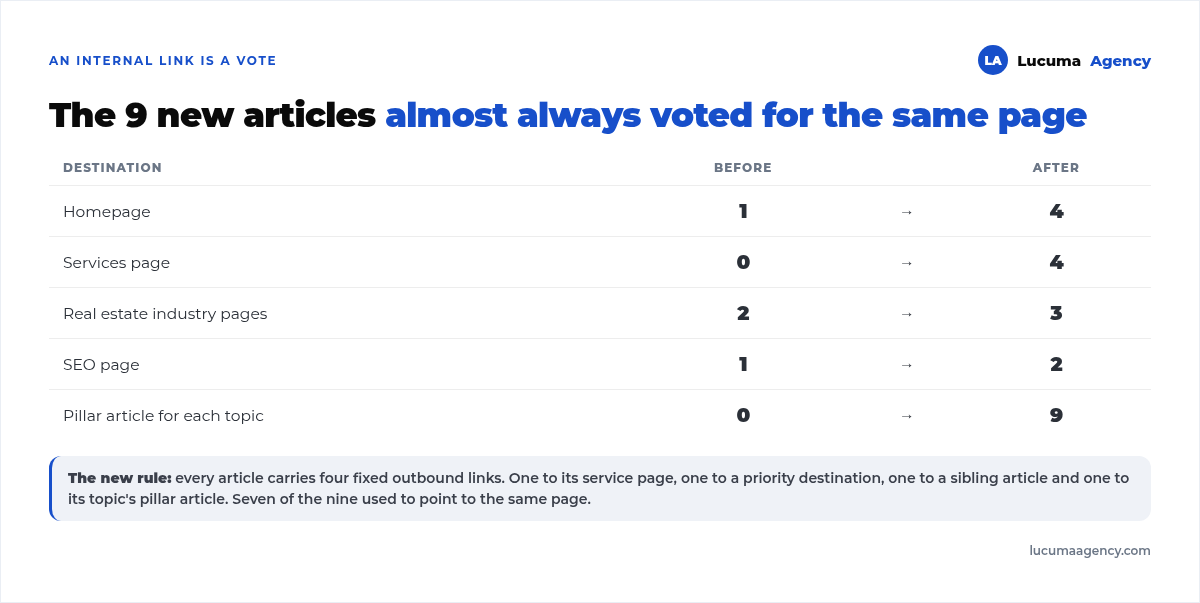
An internal link is a vote. If all your votes go to the same page, the rest of your site doesn't exist. We changed the rule: every article now carries four fixed outbound links, one to its service page, one to a priority destination, one to a sibling article and one to the main article on its topic.
How to do it on your website, in four steps
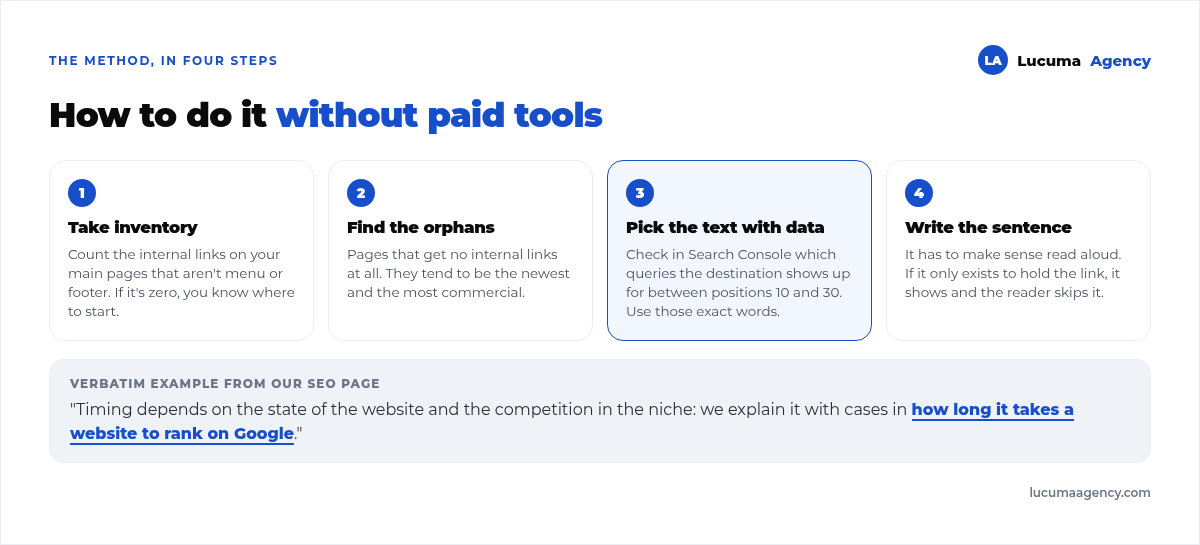
1. Take inventory of what you already have. Open your main pages and count how many internal links they have that aren't in the menu or footer. If the number is zero, you know where to start.
2. Find the orphans. These are pages that don't receive a single link from within your website. They tend to be the newest and, often, the most commercial ones.
3. Choose the link text based on data, not taste. This is the trick that pays off the most: look in Search Console at which queries the destination page appears for between positions 10 and 30, and use those exact words as link text. We did it with our SEO page, which got about 200 impressions a month for variations of SEO in Lima at position 67, and we started using that exact text from five articles. How to read that report is explained in how to measure SEO in Search Console.
4. Write the sentence, don't just paste the link. The link has to make sense read out loud. If the sentence only exists to hold the link, it shows, and the reader skips it.
What we're measuring
Honesty first: this work was done days ago and doesn't have results yet. What we'll look at on November 7 is the position of the destinations we reinforced, not total traffic, because traffic moves for too many reasons at once. If the page that went from receiving 1 link to receiving 5 moves up and the others don't, the linking worked. If not, we'll say so all the same.
Frequently asked questions about internal linking
How many internal links should an article have?
Between four and ten in a long article of a thousand words or more works well. What matters isn't the number, it's that each one has a different destination and a reason to be there. Twenty repeated links to the same page aren't worth more than one.
What text should I use in the link?
The words you want the destination page to rank for, written naturally within the sentence. Avoid “click here” and avoid always repeating exactly the same text to the same page: vary between two or three versions.
Do “related articles” blocks count?
They count, but not much, because they're the same on every page and Google knows it. A link inside a paragraph, surrounded by text on that topic, carries much more weight.
Is it worth linking from new pages, or only from the ones that already get traffic?
Pages that already have authority pass on more, so if you have to choose, start with your articles that get the most impressions. But a link from a new page doesn't hurt either: it adds context.
How often should you review your internal linking?
Every time you publish something, on the same day, plus a full review every three months. The typical mistake isn't linking badly: it's publishing and leaving the link “for later,” which never comes.
Conclusion
Internal linking isn't a technical detail, it's how you explain to Google which part of your website matters. And it's almost always done wrong for the same reason: people think in only one direction. We had 41 articles linking to our pages and no page linking back, and we didn't see it until we measured it page by page.
If you want us to review how yours is doing, at Lucuma Agency, digital marketing agency in Lima, it's part of any website & SEO audit. Book a free consultation and we'll go over it together in 30 minutes.
Other posts you might like
At almost every real estate developer we work with, the lead takes the same absurd trip: it comes in through the form...
Switching servers is scary for a sensible reason: you rarely do it, and when it goes wrong, it goes wrong in public....
The question always comes the same way: “which payment gateway do you recommend?” And the useful answer doesn't start with a name, because the...
There's a moment, in quite a few projects, when the search for the right plugin becomes the problem. You tried three,...
Almost every online complaints book we audit complies on the outside and fails on the inside. They have the notice,...
The message came in like this: “the complaints book is throwing an error.” The Proba Inmobiliaria website, a page required by law,...
“Top 50 plugins” lists don't help you decide. They help you install fifty plugins. This is ours,...
Almost every business we ask has backups. Almost none has ever restored one. Those two sentences together are...
Almost every hosting conversation starts with price and ends up in the wrong place. The useful question is...
When a business wants to sell outside its country, the conversation almost always starts off wrong: with translation. And the...
Structured data is the piece of code that explains to Google, in a language that leaves no room for interpretation,...
The question comes up in almost every meeting: “if I use AI to write, will Google penalize me?” The short answer...