AI generated content and SEO: what Google really penalizes
The question comes up in almost every meeting: “if I use artificial intelligence to write, will Google penalize me?” The short answer is no, and the useful answer is less comfortable: Google doesn't look at how the text was written, it looks at whether the text is worth anything. We have a case of our own that proves it with hard numbers, because we run a digital outlet that published 1,486 AI-generated articles and ended up with 366 clicks in sixteen months. This article explains exactly what went wrong, and it wasn't the tool.
What the policy says and what people get wrong
Google's policy has been explicit since 2023: what it penalizes is content created at scale with the main goal of manipulating rankings, whether a person or a machine produces it. Automation isn't the problem; the lack of original value is.
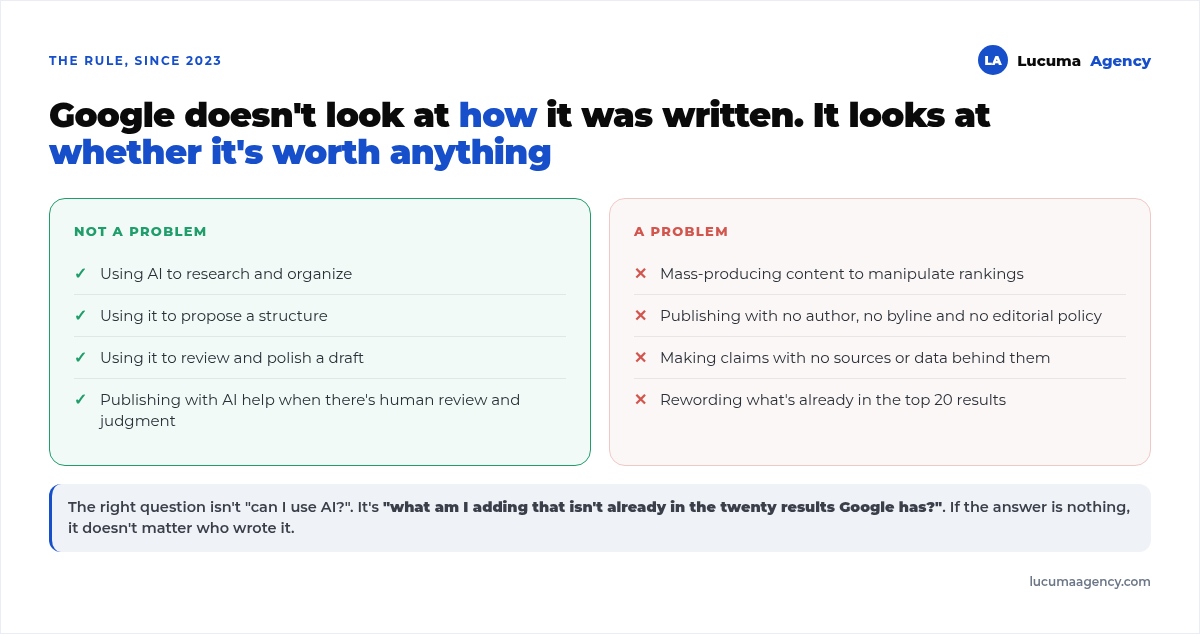
The nuance matters because it changes the question. It's not “can I use AI?”, it's “what am I adding that isn't already in the twenty results Google has?” If the answer is “nothing, I'm just saying it in other words,” it doesn't matter who wrote it.
The case: 1,486 articles and 366 clicks
Diario 3K is a digital outlet we own. Between July 2024 and February 2025 it published 1,486 articles generated with artificial intelligence, hit 347 in a single month and was then abandoned. Sixteen months later, these were the Search Console numbers.
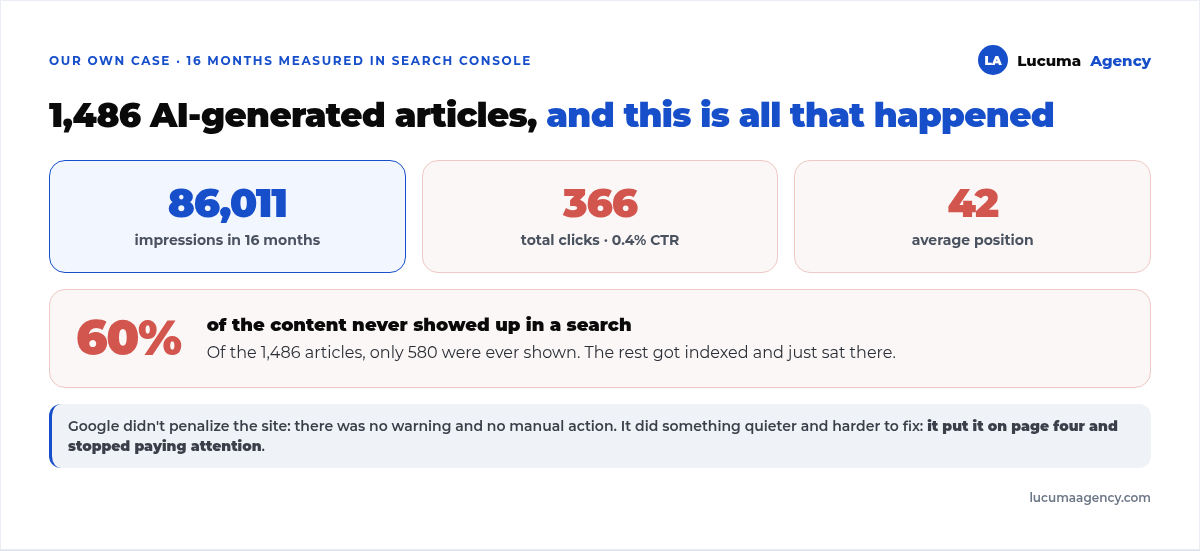
366 clicks against 86,011 impressions. A CTR of 0.4% and an average position of 42. And the most telling figure: of the 1,486 articles, only 580 had ever appeared in a search. 60% of the content was never seen by anyone.
Google didn't penalize it. It did something quieter and harder to fix: it indexed it, placed it on page four and stopped paying attention. There's no warning in Search Console, no manual action. Simply nothing happens, month after month.
What exactly went wrong
Reviewing it article by article, the problems weren't about the writing. They were about judgment:
- No focus. The site covered business, sports, phones, politics and anniversaries. Google couldn't tell what it was about.
- No real authors. No bylines, no author pages, no editorial policy.
- No sources. Claims without a link, a figure or a document behind them.
- No angle of its own. The two pages with the most impressions, 5,548 and 4,385, competed against Peru's big newspapers with exactly the same information.
- Volume for volume's sake. 347 articles in one month isn't a content strategy, it's a sign that nobody read them before publishing.
Take AI off that list and all five problems are still there. That's the point. None of the five gets fixed by switching tools: they get fixed with the usual work, the same work we do in any SEO in Lima.
So how do we use AI?
We use it every day, with rules that come precisely from having seen the case above from the inside.
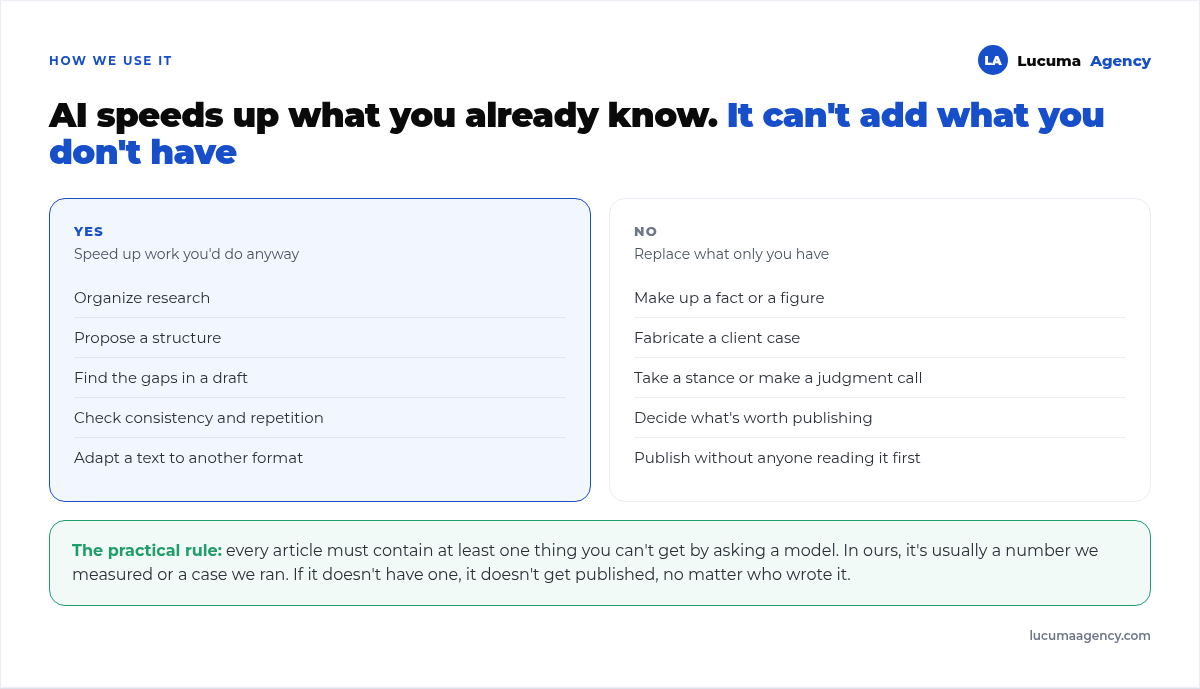
It's useful for speeding up what you already know: organizing research, proposing a structure, finding gaps in a draft, checking consistency, adapting a text to another format. It's not useful for adding what you don't have: your own data, a real case, judgment, an opinion you can defend.
Our rule of thumb is simple: every article has to contain at least one thing you can't get by asking a model. In ours, that's usually a number we measured or a case we executed. If an article doesn't have that, it doesn't get published, no matter who wrote it.
And there's a second reason to take care of this that didn't exist a year ago: Google's AI-generated answers are now a source of visibility in their own right. On our website they went from 25 to 71 impressions in 28 days, and referral traffic from ChatGPT is already our fourth channel. What those systems cite are texts with data and a clear structure, not rehashes. How to track that metric is covered in how to measure SEO in Search Console.
Frequently asked questions
Does Google penalize content made with artificial intelligence?
Not for being made with AI. It penalizes mass-produced content whose main goal is to manipulate rankings without adding any value of its own. An article written with AI assistance, reviewed, with data and judgment, is perfectly fine.
How does Google detect generated content?
Nobody knows for sure and, in practice, it matters less than it seems. What it does measure precisely is behavior: whether you show up, whether people click, whether they stay. Content with no value drops because of that, not because of a detector.
Do I have to disclose that I used AI?
It's not required for SEO. In media outlets and on sensitive topics, being transparent about authorship and editorial process does help build trust, which is a different factor and also counts.
What do I do if I already published hundreds of articles like that?
Sort them using Search Console data and prune. In the case we describe, 1,181 URLs were removed and 305 were kept. The full process is in how we relaunched a media outlet with 1,486 posts and zero traffic.
Is it better to publish a lot or to publish well?
Publish well, at a pace you can sustain. We're measuring this on our own website, going from 3 to 10 articles per week, and we'll compare the results before recommending that pace to any client.
Conclusion
The fear that Google penalizes AI content is misplaced. The real risk isn't a penalty: it's silence, which is what happened to an outlet with 1,486 articles and 366 clicks. The tool wasn't the problem; the problem was mass publishing with no focus, no author, no sources and nothing of its own to say.
In Lucuma Agency we use AI every day in our work on AI and automation, and we also use it to produce content, always with our own data behind it. If you want to check whether your content is adding something or just taking up space, that can be seen in one session: book a free consultation 30-minute call.
Other posts you might like
At almost every real estate developer we work with, the lead takes the same absurd trip: it comes in through the form...
Switching servers is scary for a sensible reason: you rarely do it, and when it goes wrong, it goes wrong in public....
The question always comes the same way: “which payment gateway do you recommend?” And the useful answer doesn't start with a name, because the...
There's a moment, in quite a few projects, when the search for the right plugin becomes the problem. You tried three,...
Almost every online complaints book we audit complies on the outside and fails on the inside. They have the notice,...
The message came in like this: “the complaints book is throwing an error.” The Proba Inmobiliaria website, a page required by law,...
“Top 50 plugins” lists don't help you decide. They help you install fifty plugins. This is ours,...
Almost every business we ask has backups. Almost none has ever restored one. Those two sentences together are...
Almost every hosting conversation starts with price and ends up in the wrong place. The useful question is...
When a business wants to sell outside its country, the conversation almost always starts off wrong: with translation. And the...
Structured data is the piece of code that explains to Google, in a language that leaves no room for interpretation,...
The question comes up in almost every meeting: “if I use AI to write, will Google penalize me?” The short answer...