How we relaunched a media site with 1,486 posts and zero traffic
Diario 3K is our own digital media outlet. Between July 2024 and February 2025 it published 1,486 articles generated with artificial intelligence, hit 347 in a single month, and was then abandoned. Sixteen months later Google was sending it between 0 and 2 clicks a month. In October 2026 we relaunched it from scratch, and this article covers what we found, what we decided to delete and what we're measuring. We're publishing it because the case mirrors that of so many Peruvian websites: lots of content, zero results, and nobody knows why.
The diagnosis: Google knew the site, but didn't trust it
The first step was exporting the last 16 months of Search Console data. The numbers sum up the problem better than any theory:
- 366 total clicks against 86,011 impressions. A CTR of 0.4% and an average position of 42.
- A peak of 124 clicks in June 2025. Since December, fewer than 7 a month.
- Of 1,486 articles, only 580 had ever appeared in a search. 60% of the content was never seen by anyone.
- The two pages with the most impressions, 5,548 and 4,385, had zero clicks. They showed up on page 5 for searches won by Infobae, Gestión and RPP.
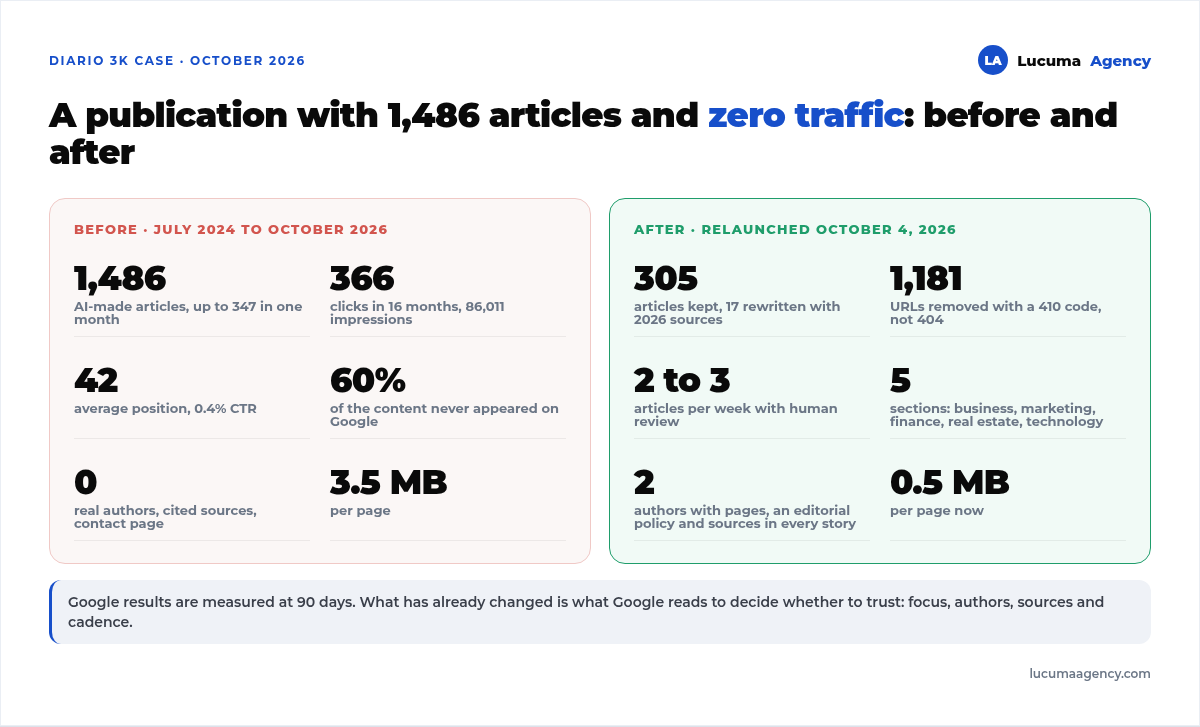
That combination, lots of impressions and position 42, has a clear reading: Google was indexing the site but not rewarding it. It's the pattern of a domain hit by the scaled content policies, which punish sites that publish in bulk without adding anything of their own. It wasn't a technical problem. The server responded in half a second, the sitemap was fine and HTTPS worked. The problem was trust, and trust can't be fixed with a plugin.
What gave away the AI-generated content
Reviewing the articles one by one turned up the signals any audit finds on this kind of site:
- No real author. A generic user with no page, no bio and no photo. The author page returned a 404 error.
- No “about us” page, no contact, no editorial policy. Just a privacy policy.
- Zero links to external sources across 1,486 articles. No SUNAT, no BCRP, no INEI, nothing.
- All built on the same template: 15 subheadings, 8 to 14 stock images, about 20 internal links. The HTML had technical attributes from the ChatGPT editor embedded in it, pasted as is.
- Massive cannibalization: 89 articles about artificial intelligence, 47 about WhatsApp, 33 about investing, 23 about the iPhone. Three different categories for real estate.
- 1,300 of 1,386 titles were over 60 characters and got cut off in Google.
None of this is illegal or unusual. It's simply what happens when success is measured in articles published instead of readers who come back.
The clue hidden in the little that worked
Amid all the noise there was a signal. The only articles that had brought in real clicks were all of the same kind: the 18% IGV on Facebook ads in Peru, with 70 clicks; the chocolate brands that dominate the Peruvian market, 43; loans with no credit history, 30; snack consumption trends, 29; how to find out who owns a house, 14.
They all had something in common: they were questions from business owners in Peru, with a local angle and a concrete data point. Google wasn't punishing the whole domain. It was ignoring the generic and letting the useful through. That became the editorial decision behind the relaunch: a business, marketing and finance outlet for Peruvian small businesses, and nothing else.
The cleanup: from 1,486 articles to 305
Relaunching wasn't about improving what was there. It was about deciding what deserved to keep existing. We classified all 1,486 URLs using the Search Console and Analytics exports, one by one:
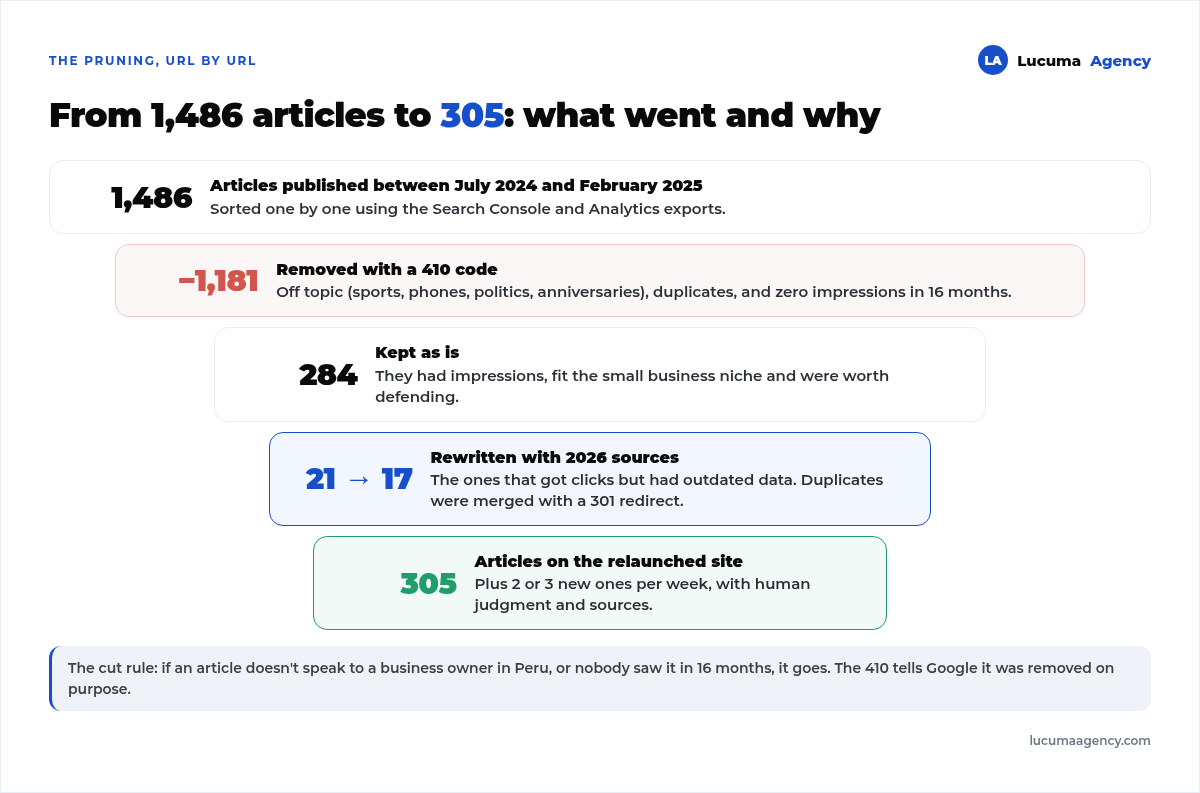
- 1,181 articles removed: sports, video games, phones, politics, anniversaries and everything that didn't speak to a business owner. Also the duplicates and the ones that never got a single impression.
- 284 kept: they had impressions, fit the niche and could be defended.
- 21 flagged for rewriting: the ones that brought clicks but had outdated data. They became 17 new articles with 2026 sources, merging the repeats.
The 1,181 removed URLs weren't simply deleted. They return a 410 status code, which tells Google “this was removed on purpose”, instead of a 404 that leaves it guessing. That's the difference between an orderly cleanup and a broken website. If you're planning something similar, how to migrate your website without losing rankings explains the redirect work that holds everything else together.
What we built on top
With the content decided, the site was rebuilt on a clean WordPress install with Bricks, importing only the 305 surviving articles with their original date, their featured image and their title trimmed to under 60 characters. Pages went from weighing 3.5 to 3.9 MB to between 0.5 and 1 MB.
And we added everything that was missing so Google could trust it:
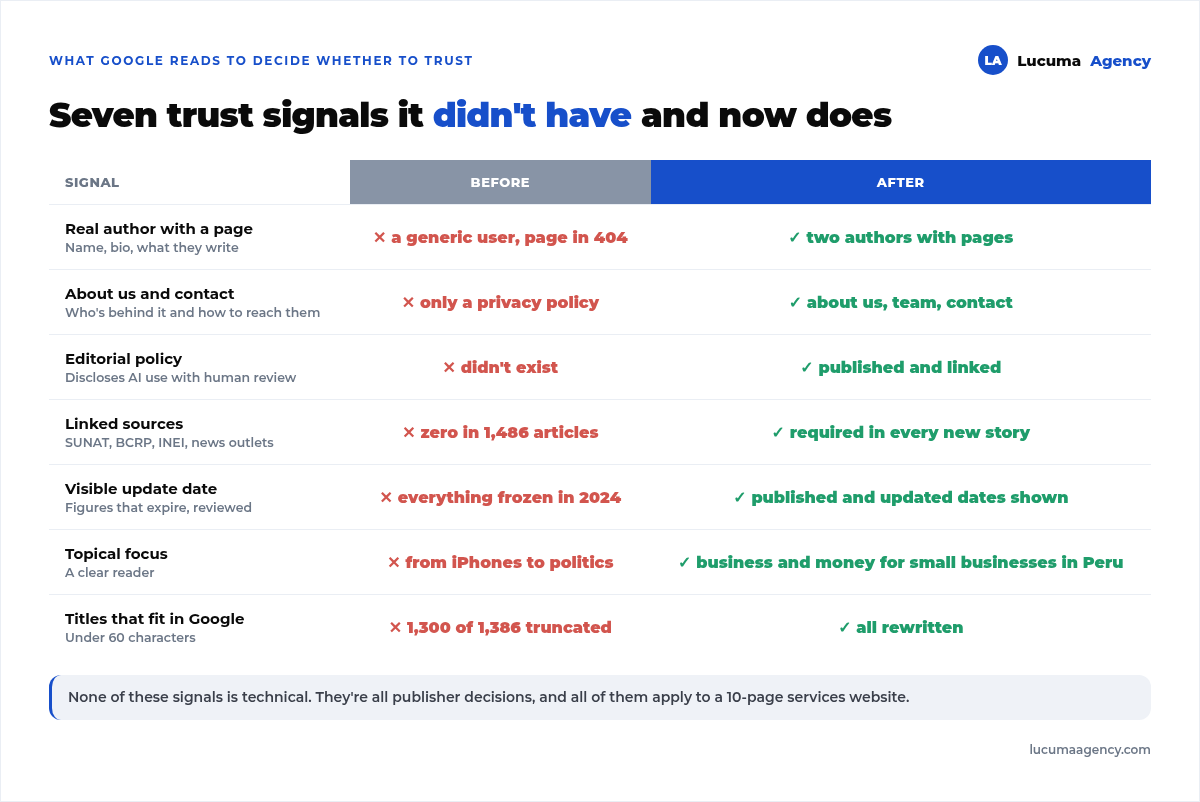
- Two authors with their own pages: one signs analysis and guides, the other the news.
- About us, team and contact pages, plus an editorial policy stating that artificial intelligence is used with human review. Hiding it gets you nowhere; disclosing it does.
- Every new article ends with a list of linked, dated sources. No source, no publishing.
- Visible publication and update dates.
- A news workflow with human judgment: sources are read, figures are verified, the piece is saved as pending and a person approves it. Two or three articles a week, not 347 a month.
If you want to check your own website against that same list, the 15-point checklist covers the essentials.
What we don't know yet
The relaunch went live on October 4, 2026. As of this article, days have passed, not months, so it would be dishonest to talk about results. What is defined is what gets measured and when:
- Every week: clicks, impressions and position in Search Console, and checking that the 1,181 removed URLs show up as removed and not as errors.
- Every month: articles with lots of impressions and few clicks, to rewrite their title and meta.
- At 90 days: if average positions drop below 42 and clicks beat the previous peak of 124 a month, the relaunch worked. If not, more pruning will be needed.
There's a risk worth saying out loud: a domain Google has already labeled as low quality can take months to regain trust, even if the new content is good. That's why how long it takes for a website to rank talks about timelines of 6 to 12 months, not weeks. We'll publish the follow-up.
What you can apply to your website even if you're not a media outlet
- Export Search Console before you touch anything. What has impressions tells you what Google wants from you; what doesn't is dead weight.
- A few good pages are worth more than many mediocre ones. A services website with 10 well-crafted pages beats one with 60 cloned ones.
- Show a face, a name and contact details. Google and people alike distrust anonymity.
- If you use AI to write, disclose how you use it and that a person reviews it. The problem was never the tool, it was publishing without reading.
- When you remove pages, use a 410 or redirects, never leave them as a 404.
Frequently asked questions
Is it worth deleting articles to improve SEO?
Yes, when they have no impressions, are off topic or duplicate others. Google evaluates the site as a whole, and weak content drags down the good stuff. Remove them with a 410 or redirect them to their equivalent.
What's the difference between a 404 and a 410?
A 404 says “not found” and Google keeps trying for months. A 410 says “removed on purpose” and drops it from the index faster. For a planned cleanup, use 410.
Does Google penalize content made with artificial intelligence?
It penalizes mass-produced content with no value of its own, with or without AI. What it looks at are signals: a real author, sources, original data, updates. A well-edited, fact-checked AI article is fine; 347 a month that nobody reads is not. We cover it in depth in AI-generated content and SEO: what Google really penalizes.
How long does a domain take to recover after a cleanup like this?
Between three and twelve months, depending on how far trust has fallen. The first signs are usually new impressions on niche queries, before clicks.
What if my website is small, does it still apply?
It applies even more. A 15-page website can't afford a single weak page. Check which ones show up in Search Console, improve those, and merge or remove the ones nobody sees.
Conclusion
Relaunching a media site with 1,486 articles and zero traffic wasn't about writing more, but about deciding what deserved to exist and giving Google reasons to trust it: real authors, sources, focus and a human pace. The results will be known in months, and we'll share them with numbers, however they turn out.
A cleanup like this is half the job: the other half is deciding which searches you want to show up for. That's exactly what we do when we're hired for SEO in Lima, and the full framework is in what SEO is and how it works.
At Lucuma Agency we do website & SEO audits that start exactly like this: with your Search Console data on the table. If your website has lots of content and few clients, book a free consultation and we'll review it in 30 minutes.
Other posts you might like
At almost every real estate developer we work with, the lead takes the same absurd trip: it comes in through the form...
Switching servers is scary for a sensible reason: you rarely do it, and when it goes wrong, it goes wrong in public....
The question always comes the same way: “which payment gateway do you recommend?” And the useful answer doesn't start with a name, because the...
There's a moment, in quite a few projects, when the search for the right plugin becomes the problem. You tried three,...
Almost every online complaints book we audit complies on the outside and fails on the inside. They have the notice,...
The message came in like this: “the complaints book is throwing an error.” The Proba Inmobiliaria website, a page required by law,...
“Top 50 plugins” lists don't help you decide. They help you install fifty plugins. This is ours,...
Almost every business we ask has backups. Almost none has ever restored one. Those two sentences together are...
Almost every hosting conversation starts with price and ends up in the wrong place. The useful question is...
When a business wants to sell outside its country, the conversation almost always starts off wrong: with translation. And the...
Structured data is the piece of code that explains to Google, in a language that leaves no room for interpretation,...
The question comes up in almost every meeting: “if I use AI to write, will Google penalize me?” The short answer...