What SEO is and how it works: the guide for business owners
Picture two dental clinics in Miraflores, four blocks apart, with similar prices and the same service. When someone in the area searches “dentista en Miraflores” (dentist in Miraflores), the first one shows up in the top three results and gets calls every day. The second one sits on page three, and its phone rings when someone recommends it. It's not that one is better than the other: one worked on its rankings and the other didn't.
If your website doesn't show up on Google, for most of your customers it might as well not exist. SEO is precisely the work of getting it to show up, at the top, without paying for every click. In this guide we explain what it is, how Google works under the hood, the pillars of SEO, how long it takes to deliver results and how to get started. All in plain language, no fluff.
What is SEO?
SEO stands for Search Engine Optimization. In plain words: it's the set of actions that make your website show up organic, meaning without paying per click, when someone searches Google for what you offer.
The difference from advertising is fundamental. An ad is a rental: while you pay, you show up; the day you cut the budget, you disappear. SEO is a purchase: it takes work to build and time to mature, but once you rank, it keeps bringing you visits and customers month after month without paying for each visit. Exactly how long it takes, with timelines by type of website, is covered in how long it takes for a website to rank.
Think of it this way. If a veterinary clinic in San Isidro manages to rank its page “vacunas para gatos en San Isidro” (cat vaccines in San Isidro), that page will get inquiries from people already searching for exactly that, every month, for years. That's the asset SEO builds. It's exactly the work we do in our SEO in Lima.
How Google works: crawling, indexing and ranking
To understand SEO, you first need to understand how Google works. Everything goes through three stages, and your website has to clear all three.
1. Crawling. Google browses the web with automated programs called robots or spiders, which jump from link to link discovering pages and reading their content. If a page isn't linked from anywhere, or is blocked by a setting, the robot never gets there. And if it doesn't get there, that page doesn't exist for Google.
2. Indexing. What the robot reads gets stored and classified in Google's index, a giant database. Here Google works out what each page is about, what language it's in, whether it's original or duplicate and whether it adds anything. A crawled page isn't always indexed: if Google decides it adds no value, it discards it.
3. Ranking. When someone runs a search, Google sorts all the indexed pages that could answer it and shows first the ones it considers most relevant and trustworthy. Hundreds of signals come into play here: how well the content answers the query, speed, the mobile experience, the site's authority and, for local searches, where the person searching is.
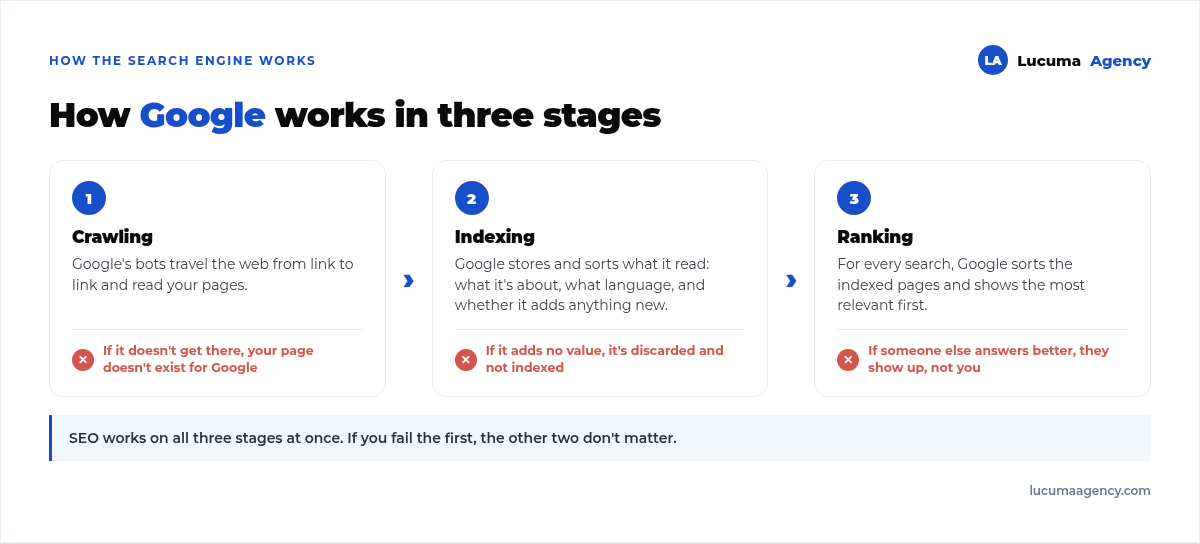
SEO works on all three stages at once: making sure Google can crawl your website, understands it well and considers it the best answer. If you fail at the first, the other two don't matter. It's the most common mistake and the most expensive one: businesses investing in excellent content on a website Google can barely read.
What your customer is looking for: search intent
All of SEO revolves around keywords, which are simply what your customer types into Google. But the classic mistake is chasing the words with the most search volume. A heavily searched word usually brings lots of people who will never buy from you.
What really matters is the intent behind each search. Someone who wants to learn is not the same as someone who already has their card in hand.
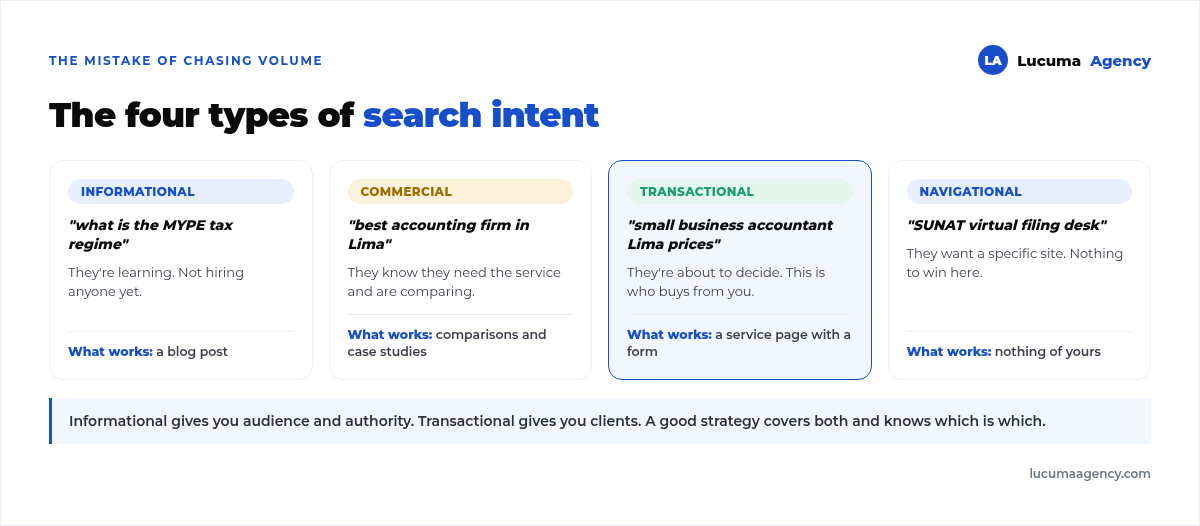
Take an accounting firm in Lima. The search “qué es el régimen MYPE tributario” (what is the MYPE tax regime) is informational: the person searching is learning and isn't hiring anyone yet. It calls for a blog article. On the other hand, “contador para MYPE en Lima precios” (accountant for small businesses in Lima, prices) is transactional: that person is comparing and about to decide. It calls for a service page with clear prices and a form.
Both searches are valuable, but for different things. Informational searches give you audience and authority; transactional ones give you customers. A serious SEO strategy covers both, and knows which is which.
The pillars of SEO
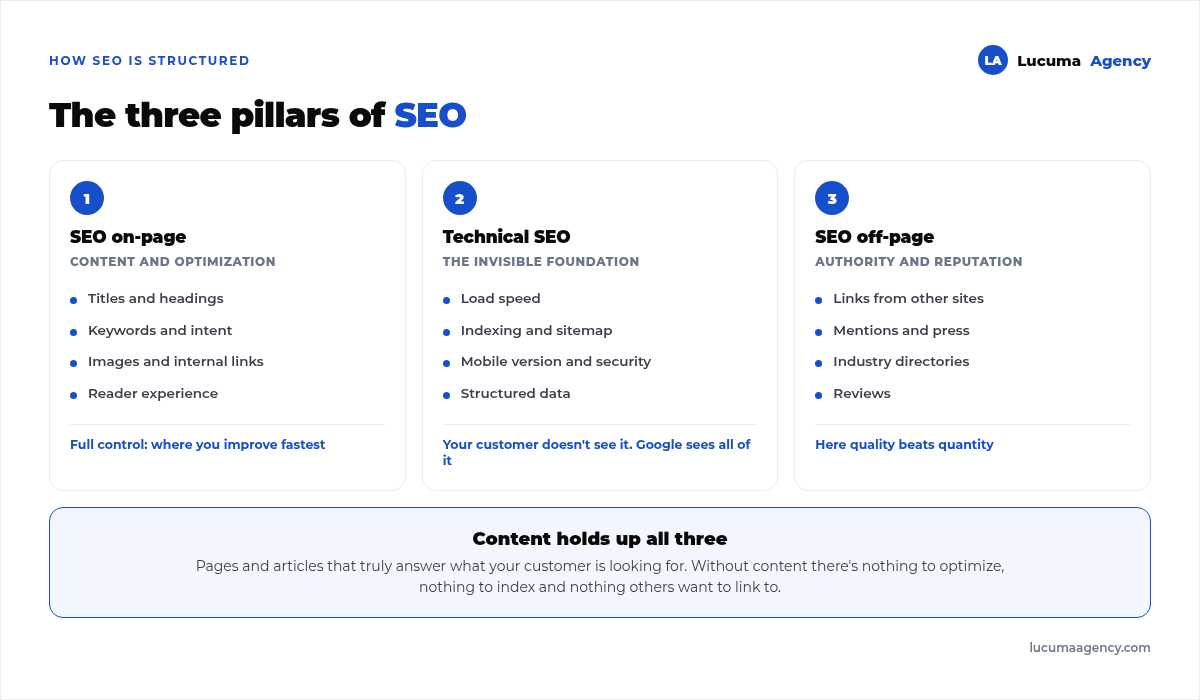
SEO rests on three big areas plus content, which fuels all of them. None of them works alone.
1. On-page SEO (content and optimization)
It's everything that happens inside your pages: the copy, the titles, the keywords, the headings, the images, the internal links and the user experience. It's where you tell Google, and your customer too, what each page is about.
It's the part of SEO you fully control, so it's where improvements show up fastest, and we go through it point by point in how to optimize your pages so they rank. A typical example: a page titled “Servicios” (Services) tells Google nothing. The same page titled “Servicios de contabilidad para PYMES en Lima” (Accounting services for SMEs in Lima) is already competing for something specific. We cover it in depth in our on-page SEO guide.
2. Technical SEO (the foundations)
It's the invisible base: page speed, indexing, site structure, sitemap, mobile version, security certificate and structured data. Your customer sees none of this, but Google sees all of it.
Without solid foundations, even the best content won't take off. If your website takes six seconds to load on a phone using mobile data, a good share of your visitors leave before seeing anything, and Google notices. We go deeper in our technical SEO guide.
3. Off-page SEO (authority)
It's what happens outside your website and builds your reputation: links from other sites that mention you, media coverage, industry directories and reviews. They work like recommendations. If several well-known websites in your sector link to yours, Google understands you're a trustworthy source.
Here quality beats quantity. One link from a serious outlet in your sector is worth more than hundreds of links from junk directories, which can also hurt you.
4. Content, which holds it all up
Useful pages and articles that truly answer what your customer is looking for. Content is what makes the other three areas make sense: without it, there's nothing to optimize, nothing to index and nothing others want to link to. And if you're wondering whether AI-made content works, we answer with data in AI-generated content and SEO: what Google really penalizes.
Local SEO: win your city first
If you serve customers in a specific area, there's one branch of SEO that matters to you more than any other: local SEO, which ranks you on Google Maps and in searches with geographic intent.
The logic changes. In traditional SEO you compete against the whole internet; in local SEO you compete only against businesses in your area, and different factors carry weight, such as your Google Business Profile, reviews, consistency of your address and phone number across the web, and distance from the person searching.
For a locksmith, a restaurant or a clinic, winning the three-result map pack usually brings more customers than ranking first in the regular results. We explain it in detail in how local SEO and city-by-city rankings work.
How SEO is measured
SEO is optimized with data, and the data is free. The core tool is Google Search Console, the only place where you see how the search engine really perceives you: which searches you show up for, how many times you're shown, how many clicks you get and which pages are indexed.
Four numbers worth checking every month:
Impressions: how many times you appeared in results. If they go up, your visibility is growing even if clicks haven't arrived yet.
Clicks: how many people came in. If you have lots of impressions and few clicks, the problem is usually the title and description you show on Google.
Average position: where you appear on average for each search. Going from position 18 to 9 doesn't bring traffic yet, but it's a sign you're on the right track.
Indexed pages: how many of your pages are actually on Google. If you published thirty and eight are indexed, you have a technical problem before a content one.
What matters is comparing yourself against yourself month over month, not against an ideal. We explain it step by step in our Google Search Console guide.
How long does SEO take to deliver results?
SEO is a medium-term investment. The first gains usually show up within 3 to 6 months, and they keep growing steadily over time. In highly competitive sectors it can take longer; in local niches nobody has worked much, quite a bit less.
The usual order is this: impressions move first, then average position, and only at the end do clicks and inquiries arrive. That's why the first months seem like nothing is happening even when it is, and why it pays to look at Search Console and not just the phone.
It's not magic and it's not instant: it's strategy, content and consistency measured with data. If you need results from day one, you complement it with Google Ads, which brings immediate traffic while your SEO matures.
SEO and advertising: it's not one or the other
Many people see them as rivals, but they complement each other and solve different problems.
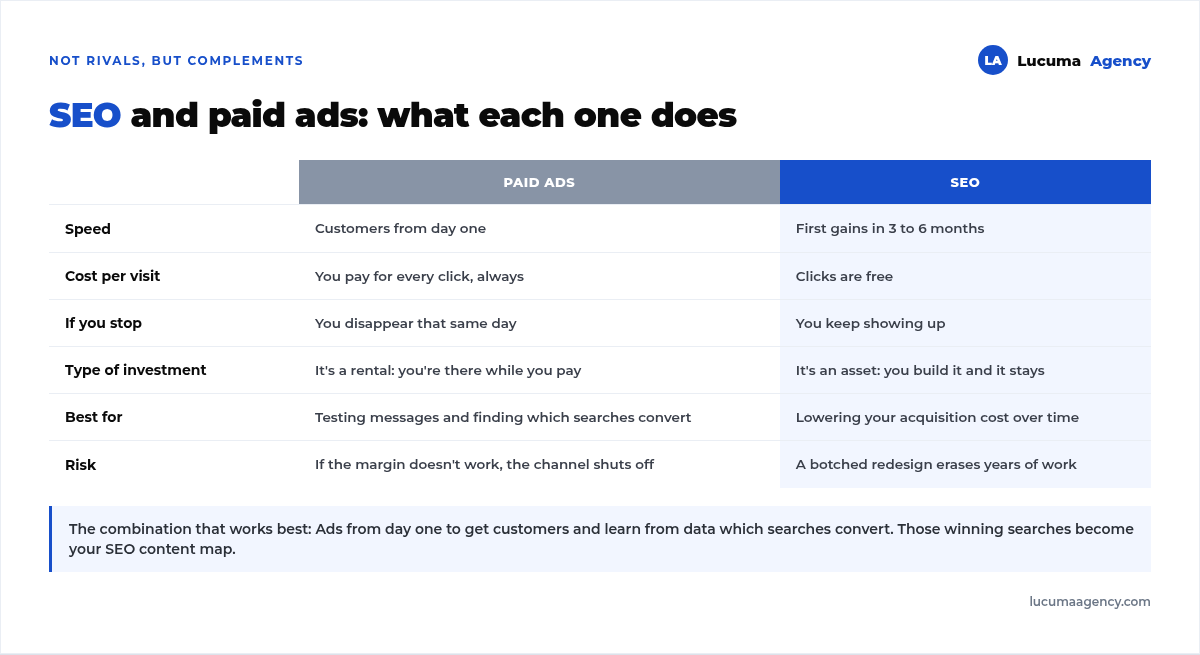
Advertising gives you immediate results, lets you test messages within days and stops when you stop paying. SEO takes longer, but it builds an asset that works for you over the long term and lowers your acquisition cost over time.
The combination that works best in practice: Ads from day one to bring in customers and, above all, to find out with real data which searches convert. Those winning searches then become the SEO content map. Businesses that really grow use both, and use one to inform the other. That way of working, testing fast and keeping what the numbers back up, is what underpins growth marketing, and it works for any channel, not just search.
Mistakes that hold back a business's SEO
Writing for Google instead of for people. Repeating the keyword twenty times no longer works and reads terribly. Google has understood synonyms and context for years.
Having a single page for everything. If you offer five services in three districts and everything sits on one “Servicios” (Services) page, you aren't competing for anything specific. Every important service deserves its own page.
Changing the website without taking care of the URLs. A redesign that changes every address without redirecting the old ones can wipe out years of rankings in one afternoon. It's one of the most frequent and most avoidable kinds of damage: we go through it step by step in our guide to SEO migration.
Giving up after three months. That's exactly when things start to move. Stopping there means losing your entire previous investment.
Buying cheap link packages. Mass links from sites unrelated to your industry won't lift you up, but they can sink you.
How to get started with SEO step by step
1. Have a fast, well-built website. SEO is built on a good base. What matters here is having web development optimized from the start, not patched up later.
2. Set up Google Search Console. It's free, and without it you're working blind. Submit your sitemap on day one.
3. Research your keywords and their intent. List what your customer searches for and separate the informational from the transactional.
4. Organize your service pages. One page for each thing you sell, with its own title and its own keyword.
5. If you're a local business, work on your Google profile. It's usually what delivers results the fastest.
6. Create useful content consistently. Articles that answer your customer's informational searches.
7. Work on technical SEO and authority. Solid foundations and reputation, in that order.
8. Measure and adjust every month. SEO is optimized with data, not hunches.
Frequently asked questions about SEO
Is SEO free?
Organic traffic isn't paid per click, but SEO work (strategy, content, technical optimization) does require an investment of time or a team. What's free is the click, not the work that earns it.
Can I do SEO myself?
You can, and you should, start with the basics: set up Search Console, organize your pages, write good titles and complete your Google Business Profile. Competitive SEO takes knowledge, tools and consistency, which is why many businesses hand it off at some point. If you reach that point, in how much SEO costs in Lima we explain what each plan includes.
Does Google guarantee the top spot?
No one serious can guarantee the number one spot, because Google decides the order using hundreds of signals that keep changing. What can be guaranteed is technical and content work that improves your rankings in a way you can measure and verify in Search Console.
How many articles do I need to publish per month?
There's no magic number. Publishing two articles a month that truly answer a search beats eight written just to publish something. Consistency matters more than volume.
Does SEO work if my business is only local?
Especially so. You compete against fewer websites, and local searches have very high purchase intent: someone searching “gasfitero en Surco” (plumber in Surco) has a problem right now, they're not researching.
What happens to my SEO if I redesign my website?
It can stay intact or be almost entirely lost, and it depends on how it's done. The rule is to keep the URLs that already rank, or redirect them one by one to their new equivalent, and to check indexing after the change.
Conclusion
SEO is one of the best investments a business can make: it puts you in front of customers who are already looking for what you offer, at the exact moment they're looking, and it builds an asset that grows over time instead of burning through your budget.
The key is understanding how Google works, working on all three pillars together and keeping the effort going long enough for it to mature. There are no shortcuts, but there's no mystery either.
In Lucuma Agency we do SEO with a focus on measurable results, no fluff. Want your website to show up on Google? Book your free 30-minute consultation.
Other posts you might like
At almost every real estate developer we work with, the lead takes the same absurd trip: it comes in through the form...
Switching servers is scary for a sensible reason: you rarely do it, and when it goes wrong, it goes wrong in public....
The question always comes the same way: “which payment gateway do you recommend?” And the useful answer doesn't start with a name, because the...
There's a moment, in quite a few projects, when the search for the right plugin becomes the problem. You tried three,...
Almost every online complaints book we audit complies on the outside and fails on the inside. They have the notice,...
The message came in like this: “the complaints book is throwing an error.” The Proba Inmobiliaria website, a page required by law,...
“Top 50 plugins” lists don't help you decide. They help you install fifty plugins. This is ours,...
Almost every business we ask has backups. Almost none has ever restored one. Those two sentences together are...
Almost every hosting conversation starts with price and ends up in the wrong place. The useful question is...
When a business wants to sell outside its country, the conversation almost always starts off wrong: with translation. And the...
Structured data is the piece of code that explains to Google, in a language that leaves no room for interpretation,...
The question comes up in almost every meeting: “if I use AI to write, will Google penalize me?” The short answer...