What growth marketing is and how to apply it to your business
Picture two businesses with the same budget. The first puts everything into one big campaign, launches it, gets plenty of likes and starts from scratch the next month. The second launches four small tests a month, drops the three that don't work, keeps the one that does and keeps improving it. Six months later, the second business knows exactly what brings in customers and how much each one costs. The first is still guessing.
That difference has a name: growth marketing. In this guide we explain what it is, how it differs from traditional marketing and, above all, how it works in practice, with the concrete process that teams who grow measurably actually use.
What is growth marketing?
The growth marketing is a way of doing marketing based on constant, measurable experiments across the entire customer journey, not just the part where you attract people.
Instead of betting everything on one big campaign and waiting to see what happens, growth marketing works like this: you form hypotheses, test them quickly and cheaply, measure what happened using your business numbers, and scale what works. What doesn't work gets dropped without drama, because it cost very little.
Two core ideas define it:
The whole funnel, not just the top. Traditional marketing focuses on attracting people. Growth marketing also makes sure those people become customers, buy again and recommend you. Winning a new customer is usually much more expensive than keeping one you already have, so ignoring the bottom half of the funnel means leaving money on the table.
Data decides, not opinions. In a typical meeting, the winning idea belongs to whoever ranks highest or talks loudest. In growth, that idea becomes a hypothesis and gets tested. If the numbers back it up, it stays. If not, it goes, no matter how good it sounded.
Growth marketing is not “growth hacking”
It's worth clearing this up early, because the two terms get mixed up and they don't mean the same thing.
The growth hacking became famous for the idea of the brilliant trick: that one isolated hack that makes growth skyrocket overnight. It's an appealing story, which is why it gets repeated so much, but it's the exception, not the method.
The growth marketing is the opposite of a trick: it's a boring, repeatable system. It doesn't depend on one brilliant idea, but on running experiments every week for months. The advantage doesn't come from a single experiment; it comes from the sum of many, and above all from the learning that builds up. If someone promises you a hack that multiplies your sales in two weeks, be wary. If someone offers you a weekly process of measurable tests, now there's something real.
Growth marketing vs. traditional marketing
It's not that one is good and the other is bad. It's about what each one is for. Traditional marketing builds brand and awareness, and that matters. But if what you need is new customers coming in and knowing how much each one costs you, the approach changes quite a bit.
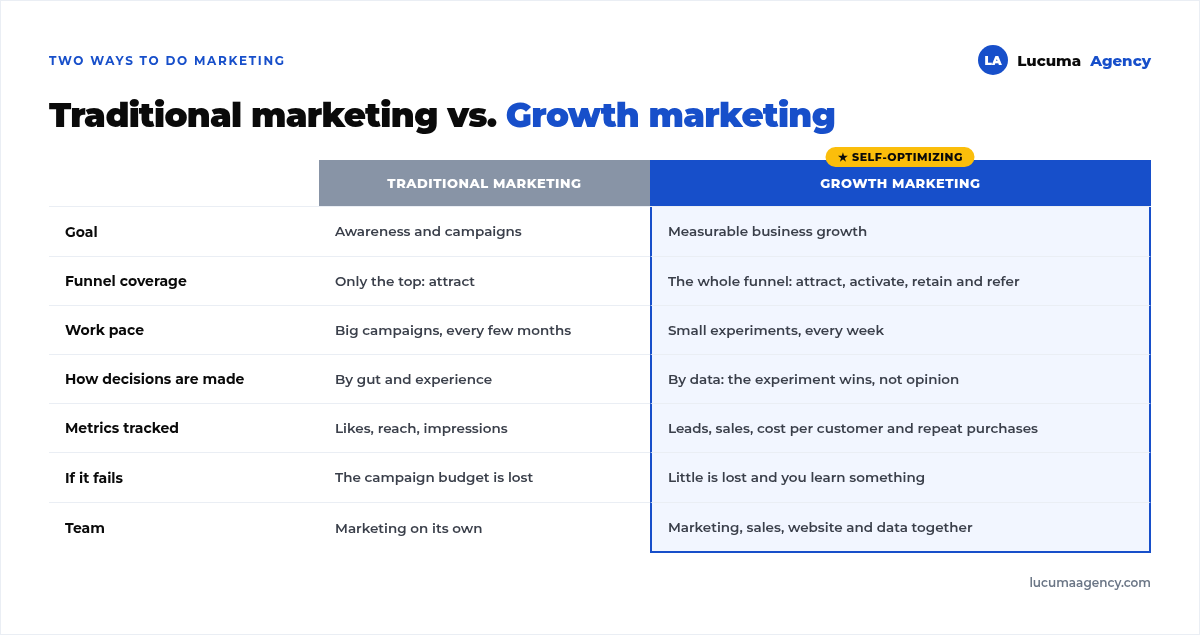
The most practical difference is the size of the bet. In the traditional model, if the campaign fails, the quarter's budget is gone and you're left with little more than a vague lesson. In growth, every test is small: if it fails, you lost little and gained a data point that makes the next test better. It's the difference between betting everything on one roulette number and playing many hands while adjusting your strategy.
The second difference is who's involved. Growth marketing doesn't live only in the marketing department: it needs sales (who know why a customer drops off), whoever runs the website (so things can change quickly) and whoever looks at the data. When marketing works in isolation, it optimizes reach. When it works with sales, it optimizes sales.
The concrete benefits, no fluff
Put another way, this is what changes in a business that works this way:
You risk less money per decision. If a two-week test fails, you lost the cost of two weeks, not the quarter's budget.
You stop arguing about taste. When every idea becomes a hypothesis with a number at the end, the meeting is no longer about who's right.
You find the real bottleneck. Almost every business thinks it needs more traffic. Looking at the whole funnel usually reveals that traffic is fine and the problem sits further down.
You know what a customer costs you. And therefore how much you can spend to win the next one, which is the figure that lets you invest wisely.
Learning compounds. Six months in, you're not starting from zero: you have a record of what you tested, what won and what didn't, and that makes the next test better.
The benefit that doesn't show up on the lists, and in practice is the biggest one: it stops mattering who guesses best. The system works even if no one on the team has brilliant instincts, because it doesn't depend on them.
The growth funnel: the 5 stages (AARRR)
The most widely used framework in growth is known as AARRR, after the initials of its five stages. It serves one very specific purpose: forcing you to look at where your problem really is, instead of assuming it's always “I need more traffic”.
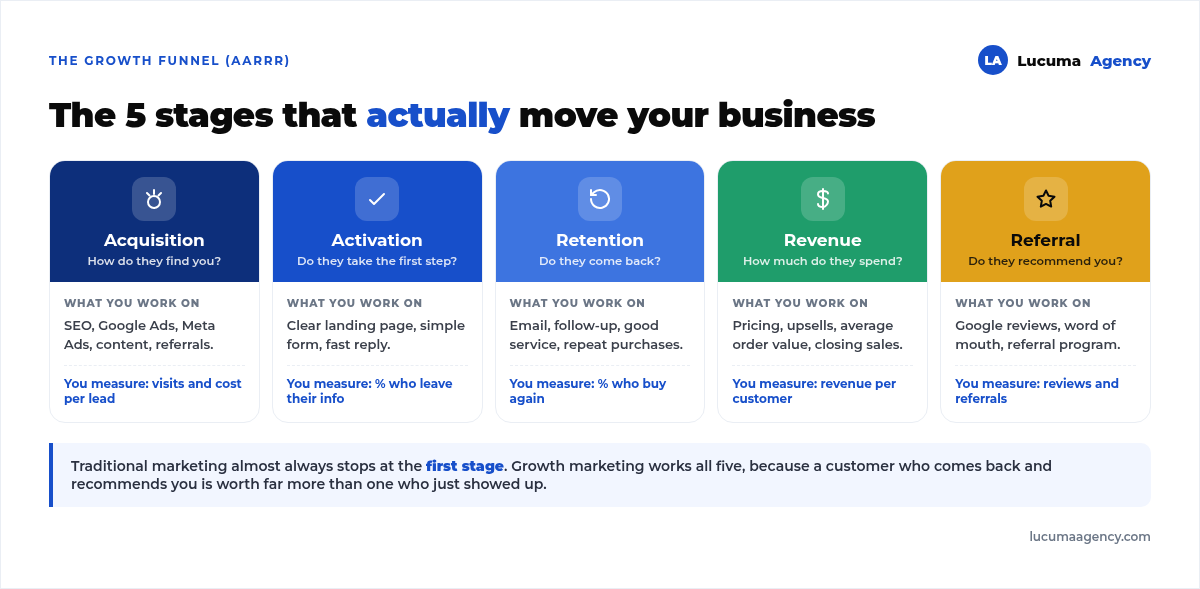
Acquisition: how people find you. This is where SEO, Google Ads, Meta Ads and your content strategy.
Activation: whether that person takes the first valuable step. Leaving their details, booking an appointment, messaging you on WhatsApp. This is where you find out whether your traffic is worth anything.
Retention: whether they come back. It's the most overlooked stage and often the most profitable.
Revenue: how much they bring in. Price, average ticket, closing the sale.
Referral: whether they recommend you. Google reviews, word of mouth, referrals.
Here's the interesting part, and it's the most common mistake we see: almost every business assumes its problem is in acquisition (“I need more people on the website”), and pours more budget in at the top. But very often traffic is fine and what's failing is activation: people arrive, don't understand what you offer or the form is a nightmare, and they leave. Pushing more traffic into a broken funnel is pouring more water into a leaky bucket. It costs more and fixes nothing.
That's why the first question in growth marketing is never “how do I get more visits?” but “at what stage am I losing people?”.
The growth engine: the experimentation cycle
This is the core, and what separates growth marketing from a list of good intentions. Growth is a four-step cycle that repeats over and over, ideally every week.
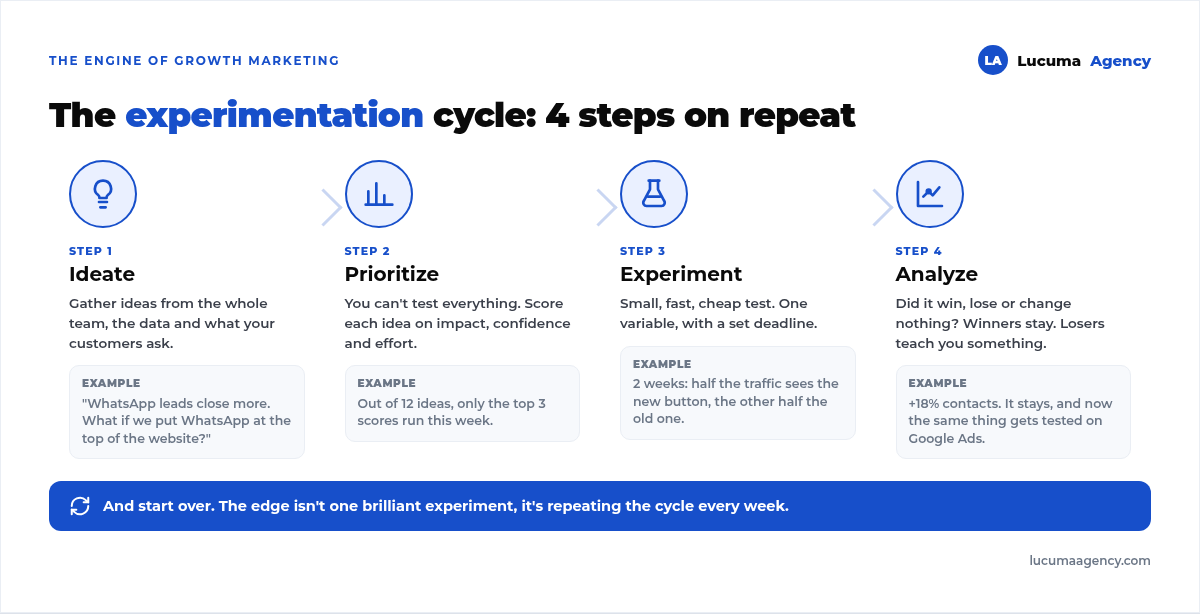
1. Ideate: gather hypotheses from everywhere
The best ideas almost never come from a marketing brainstorm. They come from three sources: the data (Google Search Console tells you which searches you show up for without getting clicks), the sales team (who hear the customer's real objection every day) and the customers themselves (what they ask over and over before buying).
An idea is useful when it's written as a hypothesis, that is, with a cause and an expected effect. “Improve the website” doesn't count. This does: “we believe that if we add a sticky WhatsApp button, contacts will go up, because the leads that come in through WhatsApp are the ones that close the most”.
2. Prioritize: you can't test everything
You'll have more ideas than time. To choose without fighting with anyone, you use a simple method called ICE: you score each idea from 1 to 10 on three things. Impact (if it works, how much does it move the needle?), Trust (how sure are you that it will work?) and Ease (how easy is it to do? where 10 is very easy). You average the three and sort from highest to lowest.
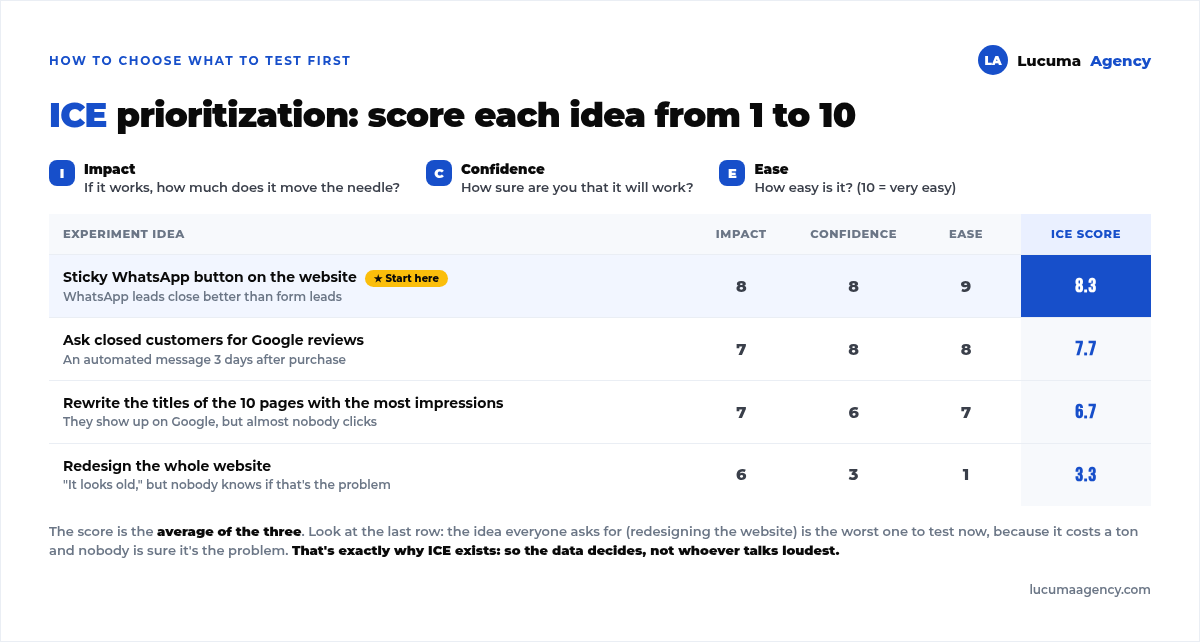
Look at the example in the image, because it illustrates the whole point: the idea almost everyone asks for, redesigning the entire website, is the one that scores worst. Not because it's bad, but because it costs a lot and nobody is sure the design is the problem. Meanwhile, adding a WhatsApp button takes an afternoon and hits exactly the stage where people drop off.
ICE isn't a magic formula and doesn't pretend to be exact. Its value is something else: it puts the ideas in a table and stops the conversation from being about taste.
3. Experiment: small, fast and with a single variable
A good experiment has three traits. It's cheap (if it goes wrong, it doesn't hurt). It has an end date (two weeks, not “let's see how it goes”). And it changes only one thing at a time, because if you change the headline, the photo and the button at the same time and contacts go up, you won't know which of the three did it, and you won't be able to repeat it.
When you have enough traffic, the ideal is an A/B test: half of your visitors see the current version and the other half see the new one. When you don't have that much traffic (which is the case for most businesses), you compare one period against another and accept that the data is less clean. An imperfect but real experiment beats a perfect discussion with no data.
This is where your website stops being decoration and becomes a tool. If every small change means waiting two weeks for a developer, you won't be able to experiment. That's why a good web development that gives you the freedom to edit and measure is, in practice, a requirement for growth marketing.
4. Analyze: what wins stays, what loses teaches you
When the deadline arrives, the experiment lands in one of three buckets: won (it gets implemented and you look for where else to apply it), lost (it gets rolled back, but you note why you thought it would work and it didn't) or nothing happened (which usually means you touched something the customer doesn't care about, and that's valuable information too).
This is the step almost everyone skips, and it's what makes the system work. A lost experiment isn't wasted money: it's one fewer hypothesis on the list and a clue about where to look instead. Teams that keep a log of their experiments (what they tested, what they expected, what happened) make better decisions six months later, because they no longer start from zero every time.
The metric that rules: your North Star
You can't optimize what you don't measure, but you can't chase twenty metrics at once either. Growth marketing insists on choosing one main metric, what's known in English as the North Star Metric: the one that best sums up whether the business is really growing.
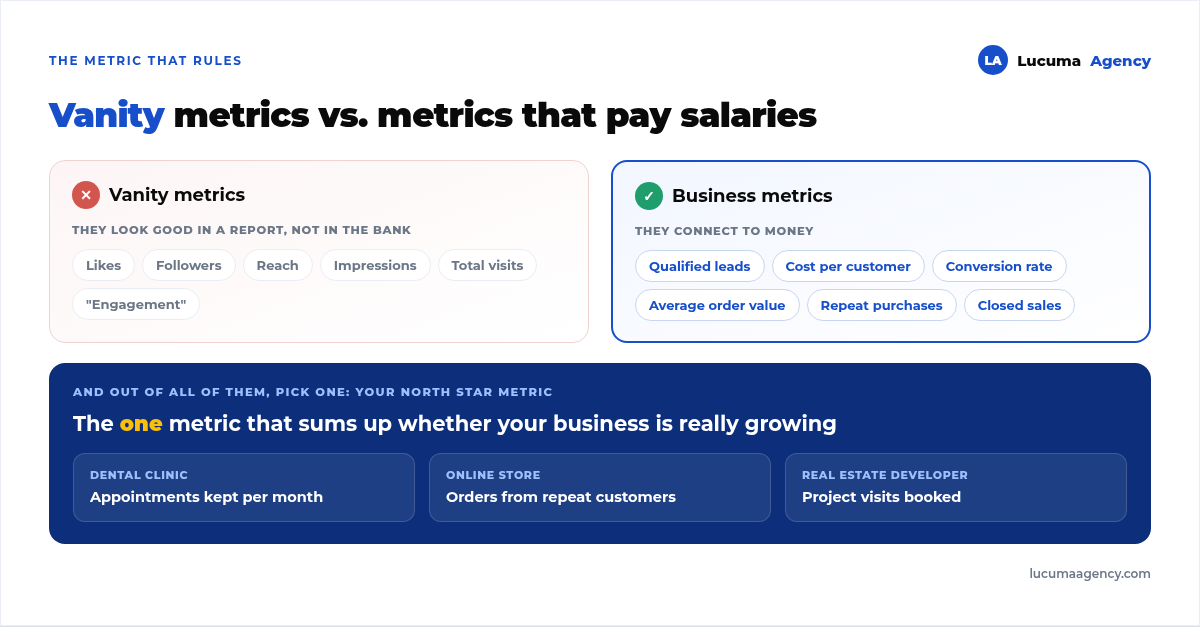
The key is telling apart the metrics that look good in a report from the ones that pay salaries. Followers, reach and impressions are vanity metrics: they're not useless (they give you context), but nobody has ever paid payroll with likes. The metrics that matter are the ones tied to money: qualified leads, conversion rate, cost per customer, average ticket, repeat purchases.
A good North Star is usually close to the moment the customer gets real value. For a dental clinic it's not website visits, it's appointments actually attended. For an online store it's not followers, it's orders from repeat customers. For a real estate developer it's not form submissions, it's booked project visits. Choose yours and make every experiment justify itself against it.
And where does the brand fit in? Growth branding
A reasonable objection to all this: if you only optimize what's measurable, you end up with an efficient business with no personality. It's a fair criticism, and it's where the term growth brandingcomes from: working on brand and growth at the same time, instead of treating them as departments that ignore each other.
The idea is simple. Pure growth marketing optimizes the conversion of what already exists. Branding builds the reason someone chooses you before comparing prices. If you only do the first, you're always competing for the cheapest click. If you only do the second, you have a pretty brand and no idea whether it sells.
In practice, they meet at two specific points:
Your brand is a testable hypothesis. Your message, your promise and the way you present yourself can be tested just like a button. Swapping the headline on your service page for one that says the same thing in the customer's words is a brand experiment, and it's measured with the same numbers.
Your brand changes acquisition cost. When people already know you, the same ad performs better and the same content converts better. That shows up in the metrics, even if brand work can't be attributed to any specific campaign.
The honest version: branding is harder to measure in the short term, and that's why growth tends to leave it out. The sensible move is not to choose. You test what can be tested, and you build your brand knowing its effect shows up in the cost per customer over the following months, not in this week's experiment. If that work is missing, start with your brand identity.
What this looks like in a real business
Let's bring all this down to earth with an example. Picture a dental clinic in Lima that invests in Google Ads and gets visits every day, but complains that “too few patients come in”.
The traditional reflex would be to raise the ad budget. The growth marketing reflex is different: first, look at which stage people drop off. Reviewing the numbers shows that the website gets plenty of visits (acquisition is fine) but very few end in a booked appointment. The problem isn't at the top of the funnel, it's in activation.
With that clear, the ideas sort themselves out and concrete experiments emerge: making the WhatsApp button visible on mobile instead of an eight-field form; replying within minutes instead of the next day; showing the Google reviews on the specialty page; testing one landing page per treatment instead of sending all the traffic to the homepage. Each one is cheap, gets tested in two weeks and is measured against a single metric: booked appointments.
Maybe two of those experiments don't move anything and one does. That's already a double win: you know what works and, on top of that, you stopped spending more ad budget to cover up a problem that wasn't in the ads.
What you need to get started
You don't need a huge team or expensive tools. You need this:
1. The ability to measure. Without properly set up analytics (web analytics, conversion events, Search Console and a log of your leads), there's no growth: just opinions. This is step zero, and the one most often neglected.
2. The ability to change things quickly. A website you can edit yourself, without relying on a third party to move a button.
3. A fixed rhythm. A short weekly meeting to review what happened with open experiments and launch the next ones. Without a rhythm, growth turns into a good intention.
4. A living list of ideas. A simple document where anyone on the team (especially sales) can jot down hypotheses.
5. Patience with the process, impatience with each test. Experiments are short; the accumulated results take months to show. Both things are true at once.
Doing it in-house or with a partner
You can do it on your own, and for many businesses that's the right call. If you have someone to look at the data, someone who can change the website the same day and half an hour a week to review, you don't need anyone: you need to get started.
Where people get stuck is almost never the ideas. It's two things: set up tracking properly (which is step zero and the one most often neglected) and keeping up the rhythm when the week fills up with emergencies. The system stops working as soon as the weekly meeting gets canceled three times in a row.
That's why there's the role of the growth partner, which is how we work in our Growth Partnership: instead of hiring a standalone channel, a team comes in that runs the full cycle every week, with the whole funnel in view and the data in your name. The practical difference from buying SEO or Ads separately is that a standalone service optimizes its own channel, and sometimes the right answer is not to bring in more people, but to fix the page where they drop off.
What doesn't change in either case: no serious professional will guarantee you the result of an experiment that hasn't run yet.
Common mistakes when applying growth marketing
Looking for the hack instead of the system. We already said it, but it's mistake number one: chasing the miracle trick instead of building the weekly routine.
Testing everything at once. If you change five things at the same time, you learn nothing, even if the number goes up.
Giving up after three weeks. It's normal for the first experiments to fail. The system pays off over time, not on the first try.
Optimizing vanity metrics. Increasing reach by 40% is worthless if sales stay the same.
Leaving sales out. The team that talks to customers is your best source of hypotheses. Ignoring it is throwing free information in the trash.
Frequently asked questions about growth marketing
Is growth marketing only for startups and tech?
No. It was born in the startup world, but the method (measure, prioritize, experiment, learn) works just as well for a clinic, a real estate developer, a store or a service business. What changes are the channels and the main metric, not the process.
How is it different from traditional digital marketing?
Digital marketing is the set of channels (SEO, Ads, social media, email). Growth marketing is the way you work them: with measurable experiments and looking at the whole funnel, not just the attraction part. You can do digital marketing without growth, but not growth without data.
How long does it take to see results?
Your first winning experiments can show up within weeks, because they're small changes. But the compound effect (the one that truly changes the business) shows up over months of steady cycles. If a channel like SEO is part of the plan, the timelines there are SEO's own.
Do I need a lot of traffic to experiment?
It helps, but it's not a requirement. With little traffic you run fewer pure A/B tests and more period-over-period comparisons, and you focus on higher-impact experiments. With little traffic, the activation and retention stages are also usually exactly where you have the most to gain.
Can I do growth marketing on my own?
You can get started: choose your main metric, look at where people drop off and run your first experiment. What gets hard without a team is keeping up the rhythm and setting up measurement properly, which is where people get stuck the most, and it's exactly what's solved by a growth partnership.
Conclusion
Growth marketing isn't a trick or a fad: it's changing the question. You stop asking yourself “what campaign do I launch this month?” and start asking “at what stage am I losing people, and what can I test this week to fix it?”. It's less glamorous, but it's what turns marketing into a system that learns, instead of a series of one-off bets.
And the best part is that you can start tomorrow, with one small experiment and one clear metric.
In Lucuma Agency we work this way: we measure, prioritize and test, combining SEO, Google Ads, Meta Ads and content on a website built to convert and measure. If you want that cycle running every week for your business, that's our Growth Partnership. Want to know at which stage your funnel is leaking? Book your free 30-minute consultation.
Other posts you might like
At almost every real estate developer we work with, the lead takes the same absurd trip: it comes in through the form...
Switching servers is scary for a sensible reason: you rarely do it, and when it goes wrong, it goes wrong in public....
The question always comes the same way: “which payment gateway do you recommend?” And the useful answer doesn't start with a name, because the...
There's a moment, in quite a few projects, when the search for the right plugin becomes the problem. You tried three,...
Almost every online complaints book we audit complies on the outside and fails on the inside. They have the notice,...
The message came in like this: “the complaints book is throwing an error.” The Proba Inmobiliaria website, a page required by law,...
“Top 50 plugins” lists don't help you decide. They help you install fifty plugins. This is ours,...
Almost every business we ask has backups. Almost none has ever restored one. Those two sentences together are...
Almost every hosting conversation starts with price and ends up in the wrong place. The useful question is...
When a business wants to sell outside its country, the conversation almost always starts off wrong: with translation. And the...
Structured data is the piece of code that explains to Google, in a language that leaves no room for interpretation,...
The question comes up in almost every meeting: “if I use AI to write, will Google penalize me?” The short answer...