Growth marketing agency: what it does and how to choose yours
Imagine a business paying three vendors at once: an agency handling its SEO, someone running its ads and a community manager. All three send their report at the end of the month and all three show numbers going up. And still, when the owner asks how many customers came in and how much each one cost, nobody has the full answer, because each one only looks at their own piece.
That gap is what a growth marketing agency fills. It isn't one more channel: it's the one that looks at the full funnel and decides where the next effort should go. In this guide we explain exactly what it does, what its proposal should include, what's a red flag and the questions worth asking before you sign.
What a growth marketing agency does
If what you're looking for is another agency executing behind the scenes under your brand, that's white-label marketing and it works differently: you keep the client and we provide the team.
A growth marketing agency works using the method of growth marketing: it sets hypotheses, tests them quickly and cheaply, measures with business numbers and scales only what works. The difference from a traditional agency isn't in the tools, it's in what it optimizes for and what it's accountable for.
A channel agency is accountable for its channel. If you hire SEO, its job is to raise your rankings, and it will do that well. But if your business's problem is that people land on the website and can't figure out how to contact you, that work won't fix it, and it's not their fault either: it's not what you asked for.
A growth agency is accountable for the funnel's results. That changes three things in practice.
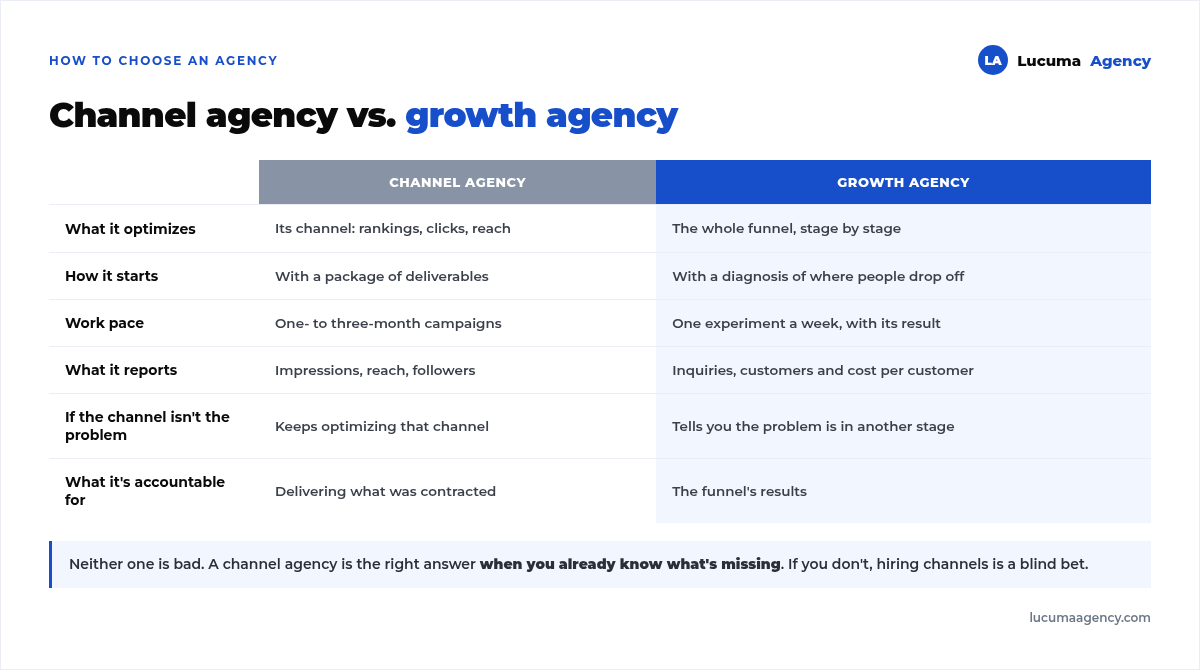
First, the scope of the diagnosis. Before proposing any work, it looks at where people are dropping off. Sometimes the conclusion is that you don't need more traffic, you need to fix the page where people get lost, and that's a recommendation an SEO agency has no incentive to give you.
Second, the pace. It doesn't work in three-month campaigns, but in short cycles: every week a test goes in and a result comes out. That pace is what makes learning compound instead of starting from zero every quarter.
Third, the metric. It reports inquiries, customers and cost per customer, not reach or impressions. If a metric doesn't change a decision, it shouldn't be in the report.
What the proposal should include and what's a red flag
Rather than comparing prices, compare what's inside. A serious proposal promises work and method, never specific results, because you can't promise the result of an experiment that hasn't been run yet.
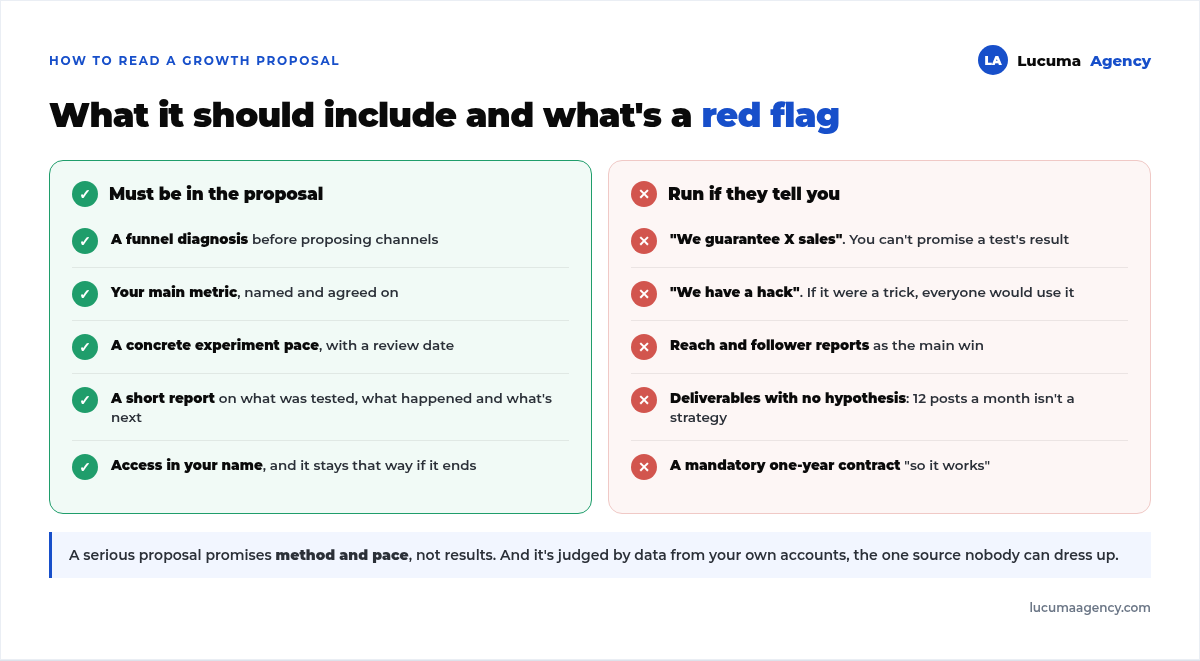
Of everything on the left, the point that causes the most problems and that nobody checks in time is the logins. Your analytics, your Search Console and your ad accounts need to be in your name, with the agency invited as a user. If they're in the agency's name and one day you switch vendors, you lose your entire history and start blind. It's the equivalent of your website's domain not being yours.
And from the right, the most common one in Peru: the results guarantee. It sounds like security and it's the opposite. When payment depends on climbing fast, the incentive pushes toward shortcuts, and the one who takes on the risk of a penalty is you, not whoever proposed it.
The seven questions to ask before you sign
None of these are technical and all of them can be answered in a call. They're the ones that prevent month-four problems, when backing out is already awkward.
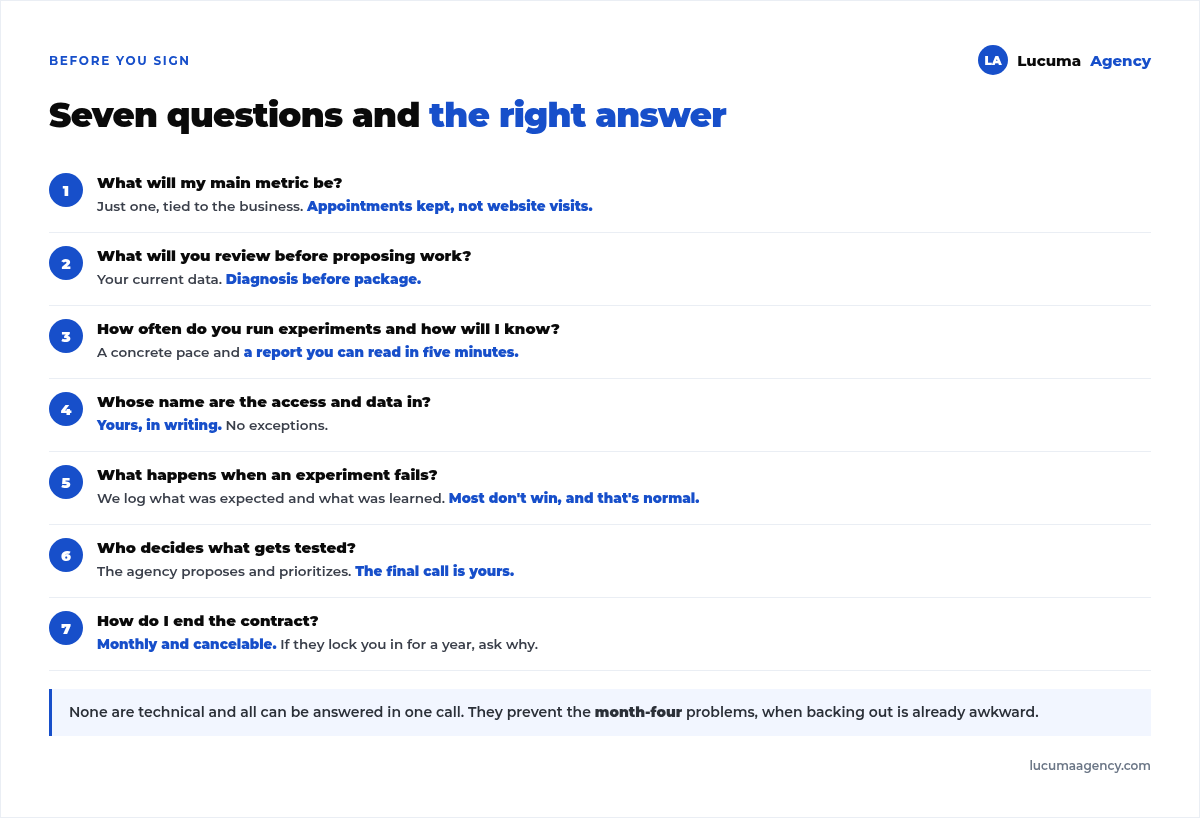
1. What will my main metric be? If they can't name it in the first conversation, they haven't understood your business yet. For a dental clinic in Lima it's appointments actually attended, not website visits.
2. What will you review before proposing work? The right answer includes looking at your current data. Whoever sends you a channel proposal without having seen your analytics is selling a package, not solving your problem.
3. How often do you run experiments and how will I find out? Look for a concrete pace and a report you can read in five minutes. A forty-page report nobody opens isn't transparency.
4. Whose name will the logins and data be under? Yours. No exceptions and in writing.
5. What happens when an experiment fails? If the answer makes them uncomfortable, that's a bad sign. Most experiments don't win, and that's normal: what matters is that there's a record of why it was expected to work and what was learned.
6. Who decides what gets tested? The healthy setup is for the agency to propose and prioritize, and for the final decision to be yours. It's your budget and your brand.
7. How do we end it? A cancelable monthly contract says more about an agency's confidence than any promise. If they need to lock you in for a year for the work to be worth it, ask why.
When you don't need a growth agency
It's worth saying, because it isn't always the answer.
If you can't measure anything yet. Without analytics installed and without a log of your inquiries, growth isn't possible: only opinions. That's a prior job, shorter and cheaper, and sometimes you can solve it with whoever already handles your website.
If you have someone in-house who can do it. If someone on your team looks at the data, can change the website the same day and has half an hour a week to review, you don't need to hire anyone. You need to get started.
If the problem is the product or the price. No marketing experiment fixes a service that doesn't convince or a price the market won't accept. Growth will reveal it quickly, though, and that information is valuable too.
If you're looking for results in three weeks. Experiments are short, but the compound effect takes months. If you need sales by Monday, that's Google Ads, not a partnership.
How this service is billed
The usual model is a monthly fee, because the work is ongoing: every month new hypotheses come in and the pace is sustained. There's also the fixed-scope project, which works well for an initial diagnosis or for setting up tracking, and hourly billing, which works for consulting but not for sustaining a system.
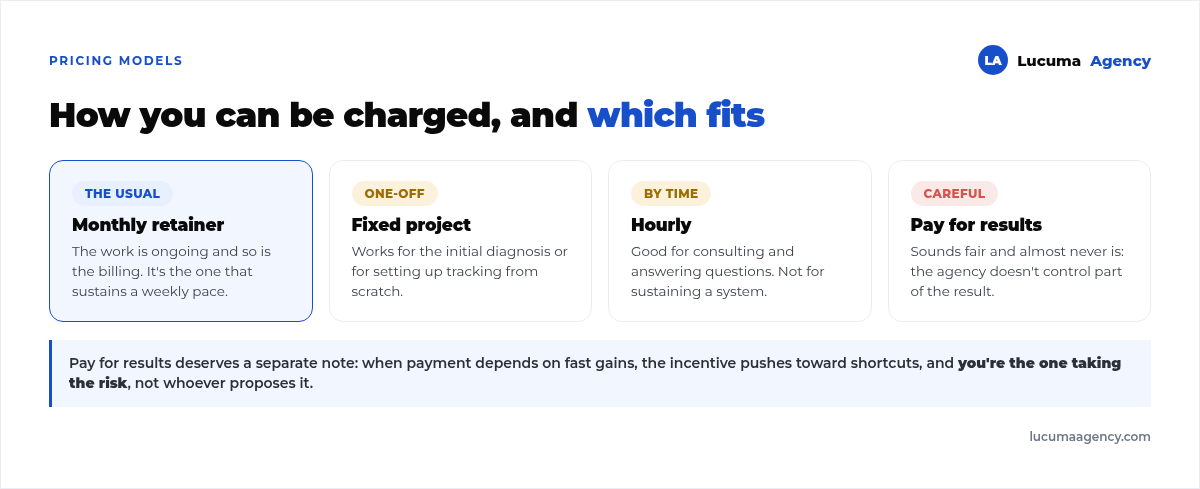
The one worth a close look is pay-for-results model. It sounds like the fairest option and it almost never is, for the same reason as with the cost of SEO: part of the result depends on variables the agency doesn't control, and the incentive ends up pushing toward short-term decisions.
And a note on the minimum: a small, steady plan always beats a big one that never starts. It's better to run two experiments a month for a year than to plan the perfect quarter that never arrives.
Frequently asked questions about growth marketing agencies
How is it different from a regular digital marketing agency?
A digital marketing agency executes channels: SEO, Ads, social media, email. A growth agency decides which channel and which funnel stage deserve the next effort, and it decides based on data. You can have digital marketing without growth, but not growth without measurement.
Do I need an agency or can I hire individual services?
It depends on where your bottleneck is. If you know exactly what you're missing and it's just one thing, an individual service is cheaper and more direct. If you don't know why customers aren't coming in, hiring channels is a blind bet and the diagnosis comes first.
How long does it take to see results?
The first winning experiments can show up within weeks, because they're small changes. The cumulative effect shows over months of steady cycles. And if the plan includes SEO, that channel runs on SEO's own timelines, which are three to six months.
Does it work for a small business?
Yes, and it often pays off more, because the bottleneck shows up after just a few tests. What you need isn't size, it's the ability to measure and to change things without waiting weeks.
What will you need from me?
Three things: access to your data, a bit of time each week to review results and the final decision on what gets tested. The agency proposes and executes, but the business judgment is yours.
Conclusion
Choosing a growth marketing agency has little to do with comparing prices and a lot to do with reviewing method. What separates a good one from one that only sounds good comes down to concrete things: whether it names your main metric, whether it looks at your data before proposing work, whether the logins stay in your name and whether it explains what happens when an experiment fails.
And the clearest sign is the one people look for least: an agency that tells you when you do not need to hire it yet.
In Lucuma Agency we work this way, with the full funnel in view and the data in your name, in what we call our Growth Partnership. Want to know at which stage your funnel is leaking? Book your free 30-minute consultation.
Other posts you might like
At almost every real estate developer we work with, the lead takes the same absurd trip: it comes in through the form...
Switching servers is scary for a sensible reason: you rarely do it, and when it goes wrong, it goes wrong in public....
The question always comes the same way: “which payment gateway do you recommend?” And the useful answer doesn't start with a name, because the...
There's a moment, in quite a few projects, when the search for the right plugin becomes the problem. You tried three,...
Almost every online complaints book we audit complies on the outside and fails on the inside. They have the notice,...
The message came in like this: “the complaints book is throwing an error.” The Proba Inmobiliaria website, a page required by law,...
“Top 50 plugins” lists don't help you decide. They help you install fifty plugins. This is ours,...
Almost every business we ask has backups. Almost none has ever restored one. Those two sentences together are...
Almost every hosting conversation starts with price and ends up in the wrong place. The useful question is...
When a business wants to sell outside its country, the conversation almost always starts off wrong: with translation. And the...
Structured data is the piece of code that explains to Google, in a language that leaves no room for interpretation,...
The question comes up in almost every meeting: “if I use AI to write, will Google penalize me?” The short answer...