WordPress hosting in Peru: shared, VPS or Plesk
Almost every conversation about hosting starts with price and ends up in the wrong place. The useful question is a different one: who is going to manage the server. That's where the real cost comes from, not the soles on the plan. Here's what we use for client websites in Peru, with the numbers we've measured.
The decision that comes first: who patches, who backs up, who answers at 2 a.m.
There are two routes, and the difference isn't technical but about responsibility:
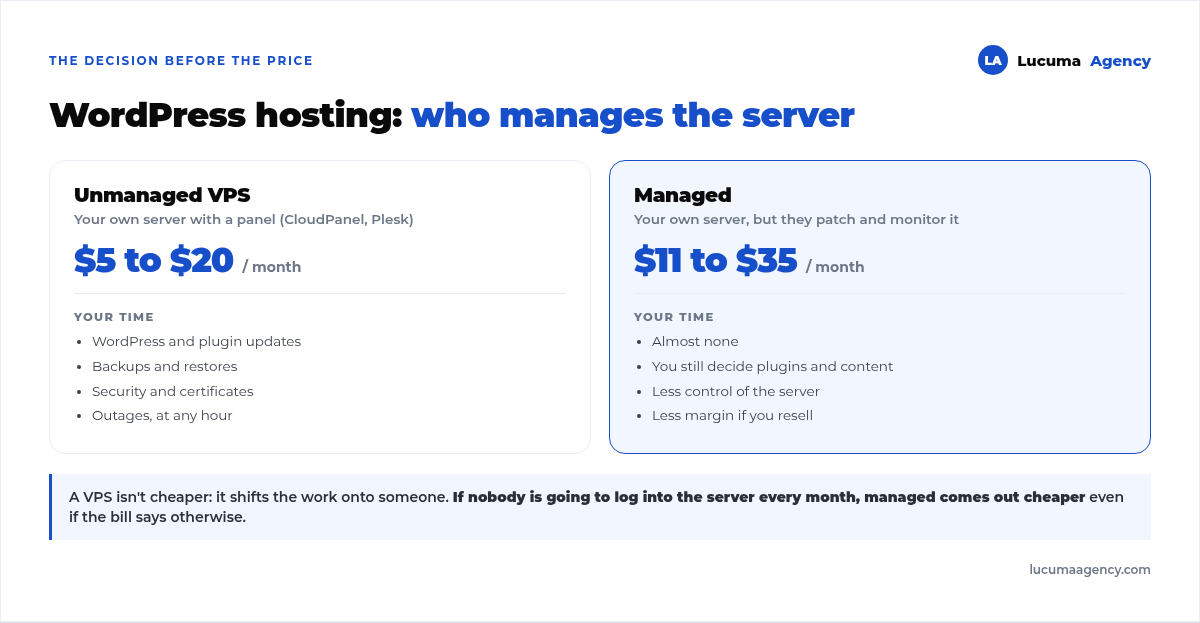
Unmanaged VPS (your own server with a panel like CloudPanel or Plesk) costs between 5 and 20 dollars a month. Updates, backups, security and outages are on you. That isn't free: it's work someone bills for, and in our case it's included in our website maintenance.
Managed (Cloudways, Kinsta and the like) costs between 11 and 35 dollars, and they handle patching and monitoring. You pay more for the server and much less in time.
If you have nobody checking the server every month, managed hosting ends up cheaper even if the bill says otherwise. If you do, a VPS gives you control and headroom.
What we choose and why
Our default choice is a Vultr VPS in São Paulo, the closest data center to Lima among the serious providers. With Cloudflare in front and a page cache on top, the latency difference between São Paulo, Miami and New York isn't noticeable on a corporate website.
We compared it with the two alternatives everyone mentions:
- DigitalOcean: just as stable and at the same price, but its closest data center is in New York. In practice, Vultr is DigitalOcean with São Paulo.
- Contabo: four or five times more resources for the same price, with uneven performance, shared CPU and some IPs with a bad reputation. It's fine for testing or very tight budgets. Never underneath a store that sells.
Two Vultr details that matter when budgeting: billing is hourly with a monthly cap, and a powered-off server still gets billed, because the disk stays reserved. To stop paying you have to destroy it; if you want to keep it, you save a snapshot for a few cents a month and spin it back up in a minute.
How much a 10-dollar server can really handle
The plan we use as our standard is 1 vCPU and 2 GB of RAM, 55 GB of disk, 10 dollars a month. Traffic isn't the bottleneck: 1,000 visits a month is 33 a day, and with caching anything can serve that. What limits you is each site's baseline memory and the work that can't be cached: the admin dashboard, updates, the cart.
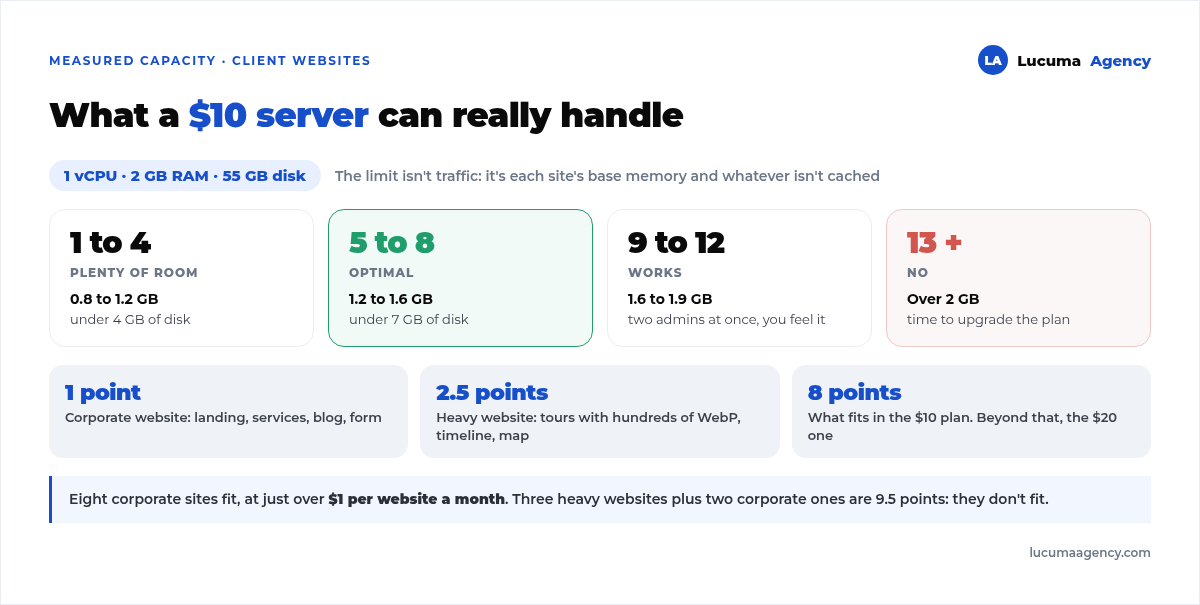
For a typical corporate website (landing page, services, blog, form, about ten plugins) the comfortable range is between five and eight sites, using 1.2 to 1.6 GB of RAM and under 7 GB of disk. From nine on it works, but you'll notice two people editing at the same time. Past the limit, the next plan is 20 dollars and doubles the headroom.
With heavy websites the math changes. A real estate site with scroll tours (hundreds of WebP images per tour), a timeline with its own content and a map weighs mostly on disk, and is equivalent to two and a half corporate sites. The limit there is three.
We handle it with points: corporate website = 1 point, heavy website = 2.5 points, and the 10-dollar plan holds 8 points. Eight corporate websites fit. Three heavy websites plus two corporate ones don't.
What we never mix on the same server
- A store that sells, with anything else. If the site next door goes down or gets attacked, the store goes down with it. The day the store starts making real money, it moves to its own server.
- Clients with active maintenance, with clients who never update anything. A compromised plugin on a site nobody touches spreads to the others.
That's why, with more than one site, you need a panel that truly isolates them: system user, PHP version, database and certificate per site. CloudPanel is free and is our default option for 2 to 10 sites. Plesk costs about 12 dollars a month and is only worth it if the time it saves is worth more than that.
The uncomfortable truth: hosting won't make your website fast
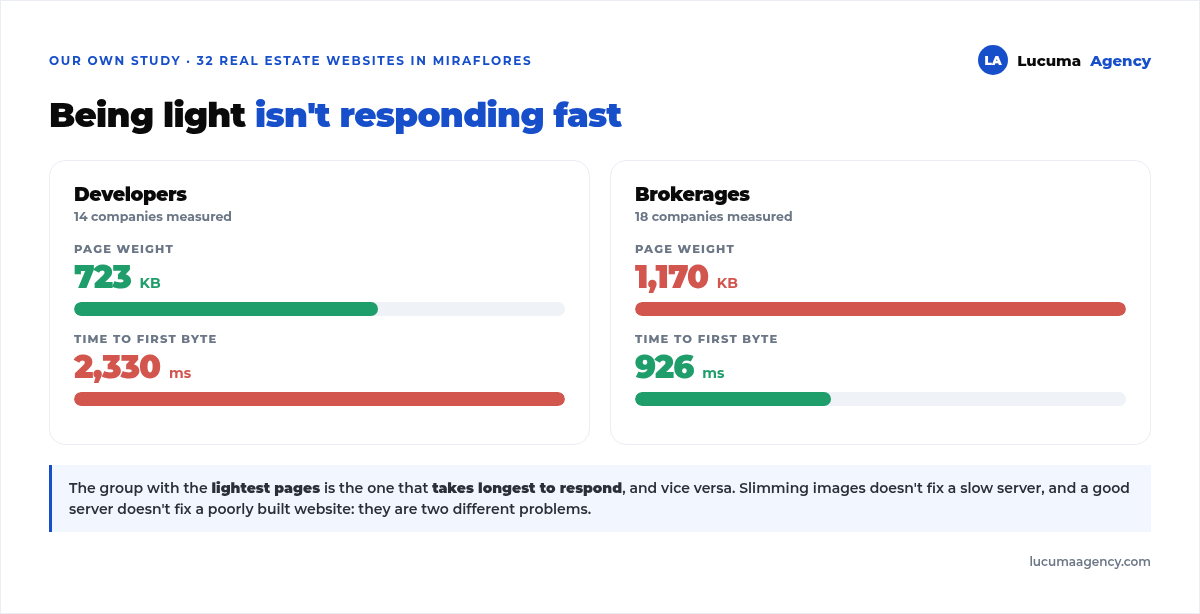
In our study of 32 real estate websites in Miraflores we measured the two things separately, and the result was the opposite of what everyone assumes. The developers group has the lightest pages (723 KB on average) and is the one that takes the longest to respond: 2,330 milliseconds. The brokerages group weighs 1,170 KB, 60% more, and responds in 926 milliseconds.
In other words: slimming down images doesn't fix a slow server, and a good server doesn't fix a badly built website. They're two different problems and they're measured differently, which we explain in depth in how to speed up your WordPress website.
Our own clearest case: a client's store took 8 seconds to add to cart and dropped to 1.5. Almost none of that improvement came from the server: it was object caching, plugin code, and no longer loading a megabyte of unused JavaScript. The details are in how we sped up a slow WooCommerce store. A VPS gives you stability and control; it doesn't multiply speed.
What we turn on for every server, no exceptions
- Cloudflare in front, on its free plan. It caches images and filters bots, which on small sites are more than half of all requests.
- Automatic provider backups: on Vultr they cost 20% of the plan (2 dollars on top of the 10-dollar one) and copy the entire server. That's better than a backup plugin per site, which doubles disk usage.
- Email through an external service, never from the server. WordPress emails go out unauthenticated and land in spam. With an authenticated relay, the server's IP stops mattering.
That third point is the one that breaks the most forms in Peru, and it has its own article: how to connect your domain email to Gmail.
Frequently asked questions about WordPress hosting in Peru
Is a Peruvian shared hosting plan good enough to start?
It works for a company website with no store and no traffic, as long as you can install a page cache and put Cloudflare in front. The limits show up when you need different PHP versions per site, real server access, or backups that don't depend on the provider's panel.
Does the server have to be in Peru?
No. What matters is network distance, not borders, and with a cache in front nobody notices a 100 or 200 millisecond difference. Today São Paulo offers the best balance of proximity and infrastructure quality for a Peruvian project.
How many websites can I put on a 10-dollar VPS?
Five to eight corporate websites is the comfortable range, which works out to just over a dollar per website per month. If any of them has large galleries or image tours, count each one as two and a half.
Is managed hosting worth paying for?
Yes, when nobody on the team is going to log into the server. The price difference is about 15 dollars a month; a single badly handled outage costs more than that in time and lost sales.
What happens to my website if I stop paying the agency?
That gets defined in writing before you start. In our case the server is in the agency's name as part of maintenance, and if the client leaves, the server is transferred or shut down with notice. It's one of the points we always recommend asking for, along with the rest of what to ask for in a website quote.
Conclusion
The right hosting is the one someone manages. Decide that first; the plan almost picks itself after that. For most Peruvian projects, a 10-dollar VPS in São Paulo with CloudPanel, Cloudflare, provider backups and email through an external relay comfortably covers five to eight websites, and costs less than any "unlimited" plan. What it won't do, no matter how much you upgrade, is fix a badly built website.
In Lucuma Agency, digital marketing agency in Lima, the server and its management are included in the service, and before moving anything we measure how much of the slowness comes from the hosting and how much from the site. If you want to know which of the two your problem is in, check out all our services or book a free consultation 30-minute call.
Other posts you might like
At almost every real estate developer we work with, the lead takes the same absurd trip: it comes in through the form...
Switching servers is scary for a sensible reason: you rarely do it, and when it goes wrong, it goes wrong in public....
The question always comes the same way: “which payment gateway do you recommend?” And the useful answer doesn't start with a name, because the...
There's a moment, in quite a few projects, when the search for the right plugin becomes the problem. You tried three,...
Almost every online complaints book we audit complies on the outside and fails on the inside. They have the notice,...
The message came in like this: “the complaints book is throwing an error.” The Proba Inmobiliaria website, a page required by law,...
“Top 50 plugins” lists don't help you decide. They help you install fifty plugins. This is ours,...
Almost every business we ask has backups. Almost none has ever restored one. Those two sentences together are...
Almost every hosting conversation starts with price and ends up in the wrong place. The useful question is...
When a business wants to sell outside its country, the conversation almost always starts off wrong: with translation. And the...
Structured data is the piece of code that explains to Google, in a language that leaves no room for interpretation,...
The question comes up in almost every meeting: “if I use AI to write, will Google penalize me?” The short answer...