What to ask for in a website quote so you don't get sold hype
You ask for three quotes for your website and get three numbers back: S/ 1,200, S/ 4,500 and S/ 9,000. All three say “professional website, modern design, responsive”. You can't compare them because none of them tells you what you're buying. This article is the list of what a serious quote has to put in writing, drawn from how we write ours and from what we've most often seen go wrong in the quotes clients bring us from other vendors. Take it to your next meeting.
Why three quotes can't be compared
The problem isn't the price. It's that “website” isn't a defined product. That one word can cover a single-section landing page, a ten-page website with a blog, and an online store with a payment gateway. When a quote doesn't spell out the scope, the cheap vendor may be selling you less than you need and the expensive one, more. And whatever isn't in writing ends up billed as an extra or never delivered. In how much a website costs in Peru you'll find the real price ranges; here's what the paper has to say.
The nine lines it must include
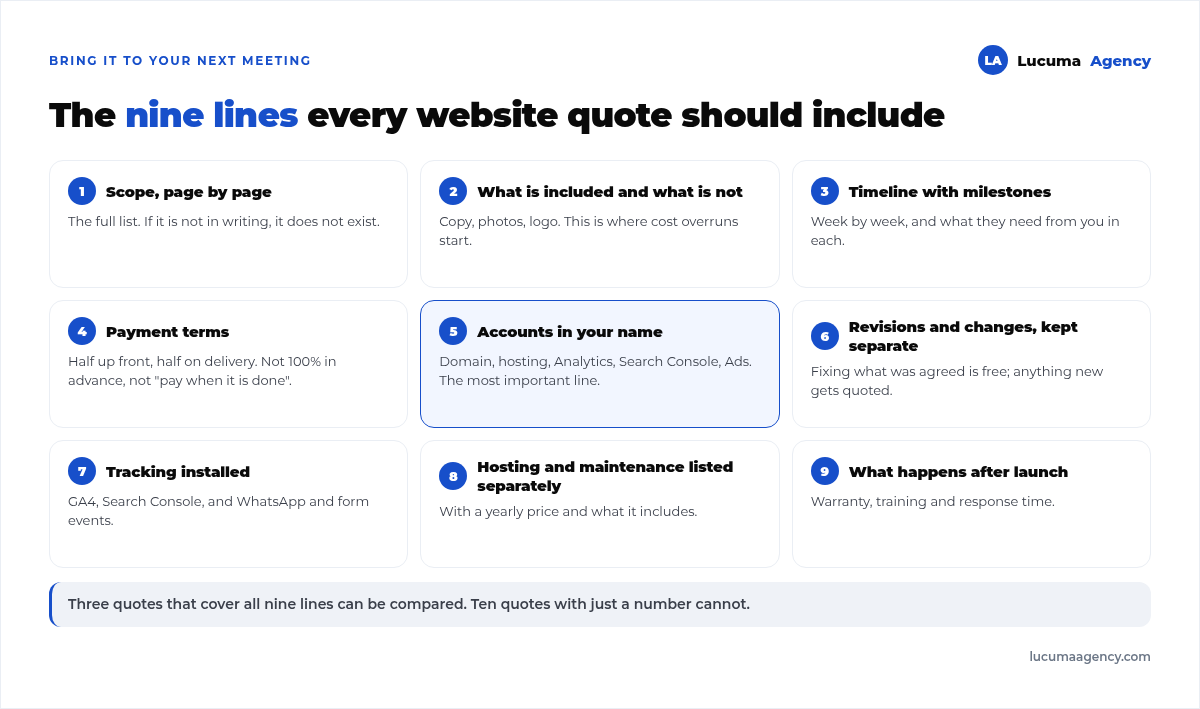
- 1. Scope, page by page. Not “5-section website” but the actual list: home, services with one page per service, about us, contact, blog. If they're not listed, they don't exist.
- 2. What's included and what isn't. Both columns. Copy: does the vendor write it or do you? Photos: stock, your own, or a separate shoot? Logo: do they use your current one or design a new one? Most cost overruns start on this line.
- 3. A timeline with milestones, not a date. “Four weeks” means nothing if week one depends on you delivering the copy. A serious quote says: weeks 1 and 2 design, weeks 3 and 4 development, and what they need from you in each one.
- 4. Payment terms. The usual, healthy setup is half upfront and half on delivery. Be wary of 100% upfront, and also of “pay when it's done”, which tends to end in never-ending projects.
- 5. Access in your name. Domain, hosting, Google Analytics, Search Console and ad accounts registered under your email, not the agency's. It's the most important line and the one almost nobody asks for. If you ever switch vendors, you take your history with you. If not, you start from scratch.
- 6. Revisions and changes, kept separate. A revision is fixing something that didn't turn out as agreed: it's not billed. A change is asking for something new that wasn't in the scope: it gets quoted. If the quote doesn't make that distinction, every conversation will turn into an argument.
- 7. Tracking installed. GA4 and Search Console set up and, if you're going to advertise, Tag Manager with WhatsApp and form events. A website without tracking is a website you talk about, not one you measure. We explain it in how to track your website's conversions.
- 8. Hosting and maintenance, listed separately with a price. They're recurring costs and have to be kept separate from the project. Ask how much they cost per year and what maintenance includes: updates, backups, support.
- 9. What happens after delivery. How many days of warranty for bugs, who trains you to edit the website, and how quickly they respond if something breaks.
Five signs you're being sold hype
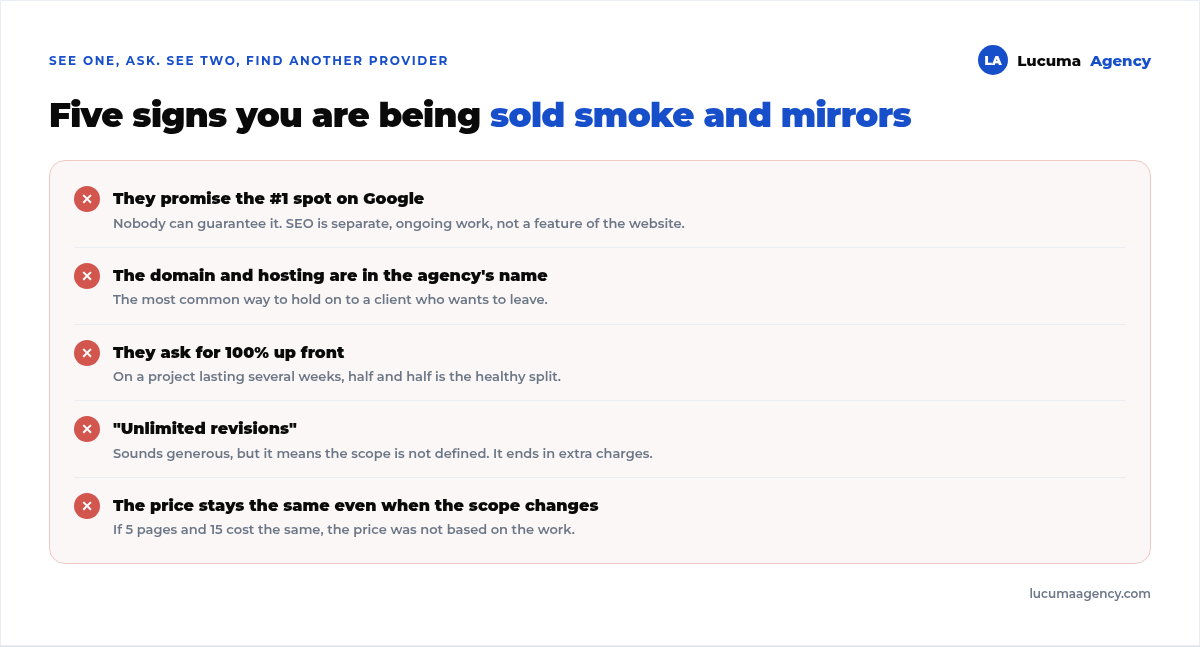
- It promises the top spot on Google. Nobody can guarantee that. A well-built website launches ready to rank, but ranking is separate, ongoing work. We cover it in how long it takes for a website to rank.
- The domain and hosting are registered in the agency's name. It's the most common way to hold on to a client who wants to leave.
- It asks for 100% upfront on a project that runs several weeks.
- Everything is “unlimited revisions”. It sounds generous, but it means the scope isn't defined: it will end with a burned-out vendor or with you paying for “extras”.
- The price doesn't change even when the scope does. If a 5-page website and a 15-page one cost the same, the price didn't come from the work but from what they think you can pay.
Questions to ask in the meeting
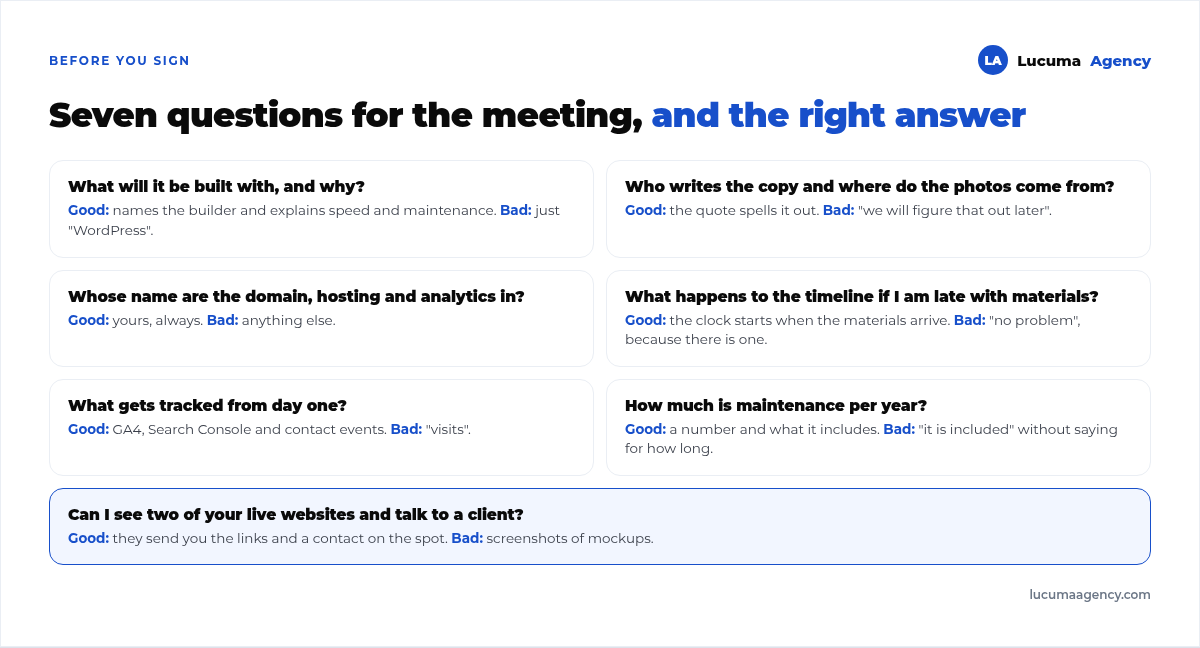
- What tool will it be built with, and why? If the answer is just “WordPress”, ask which builder. It matters for speed and for who will be able to maintain it later. We have a comparison in Bricks vs Elementor vs Gutenberg.
- Who writes the copy and where do the photos come from?
- Whose name will the domain, hosting and analytics be under?
- What happens to the timeline if I'm late delivering material? The honest answer is that the clock starts when the material arrives.
- What gets tracked from day one?
- How much does maintenance cost per year and what does it include?
- Can I see two of your websites live and talk to a client?
How we write it
Our proposals have a fixed section called service policies, and it says, in those exact words, what you just read: half upfront and half on delivery; the clock starts when the material arrives; the access is yours, and if you ever leave, you take your history with you; ad spend is separate and paid from your own account; revisions aren't billed and changes get quoted. We don't present this as a virtue but as the bare minimum: it's what any quote should say, and if the one in your hand doesn't, ask for it in writing before you sign.
Frequently asked questions
How many quotes should I ask for?
Three is enough if all three cover the nine lines. Ten one-line quotes are useless.
Is it normal to pay 50% upfront?
Yes, it's standard for projects that run several weeks, and it protects both sides. What isn't normal is paying 100% before you see anything.
What if the quote doesn't include copy or photos?
That doesn't make it a bad quote, but you need to know up front: either you produce them yourself or you hire someone separately. It's the number one reason projects run months late.
Can I ask for the domain to be put in my name if the agency already bought it?
Yes, and you should. A domain can be transferred between accounts in a few days. If the vendor refuses, that tells you everything you need to know.
Is the most expensive quote the best one?
Not necessarily. The best one is the one that best explains what's included and what isn't. Between two quotes that spell out the same things, the price difference usually comes down to the team's experience and the maintenance afterward. You check experience by looking at live websites; the ones we've built are in our portfolio.
Conclusion
A website quote that doesn't spell out the scope, a timeline with milestones, payment terms, access in your name and the difference between a revision and a change isn't a quote: it's a number. Ask for the nine lines in writing, compare what each one includes, and be wary of promises of the top spot on Google. And if you sell to the public in Peru, make sure it includes the virtual complaints book, which is mandatory.
Asking for a quote the right way lets you compare apples to apples. To see what goes into each line item, our digital marketing services are broken down one by one, and the underlying technical criteria are in why we build websites on WordPress.
At Lucuma Agency we do WordPress web development with public prices and written policies. If you want a quote you can compare with the other two, book a free consultation and we'll put it together for you after a 30-minute conversation.
Other posts you might like
At almost every real estate developer we work with, the lead takes the same absurd trip: it comes in through the form...
Switching servers is scary for a sensible reason: you rarely do it, and when it goes wrong, it goes wrong in public....
The question always comes the same way: “which payment gateway do you recommend?” And the useful answer doesn't start with a name, because the...
There's a moment, in quite a few projects, when the search for the right plugin becomes the problem. You tried three,...
Almost every online complaints book we audit complies on the outside and fails on the inside. They have the notice,...
The message came in like this: “the complaints book is throwing an error.” The Proba Inmobiliaria website, a page required by law,...
“Top 50 plugins” lists don't help you decide. They help you install fifty plugins. This is ours,...
Almost every business we ask has backups. Almost none has ever restored one. Those two sentences together are...
Almost every hosting conversation starts with price and ends up in the wrong place. The useful question is...
When a business wants to sell outside its country, the conversation almost always starts off wrong: with translation. And the...
Structured data is the piece of code that explains to Google, in a language that leaves no room for interpretation,...
The question comes up in almost every meeting: “if I use AI to write, will Google penalize me?” The short answer...