How much it costs to build a website in Peru
It's the first question we get, and almost nobody answers it with numbers. You search “cuánto cuesta una página web” (how much does a website cost), find ten articles that say “it depends” and end up right where you started, requesting quotes blindly only to find that one says S/ 800 and another S/ 12,000 for what you thought was the same thing.
So let's look at real numbers. At Lucuma we've built landing pages from S/ 500 and systems costing up to S/ 30,000, and both figures were fair prices for what was delivered. In this guide we explain what separates one end from the other, what pushes a quote up and which costs almost nobody mentions until you've already signed.
The ranges, specifically
A website doesn't have a price: it has a range, and where you fall in that range depends on how much your website has to do, not how many pages it has.
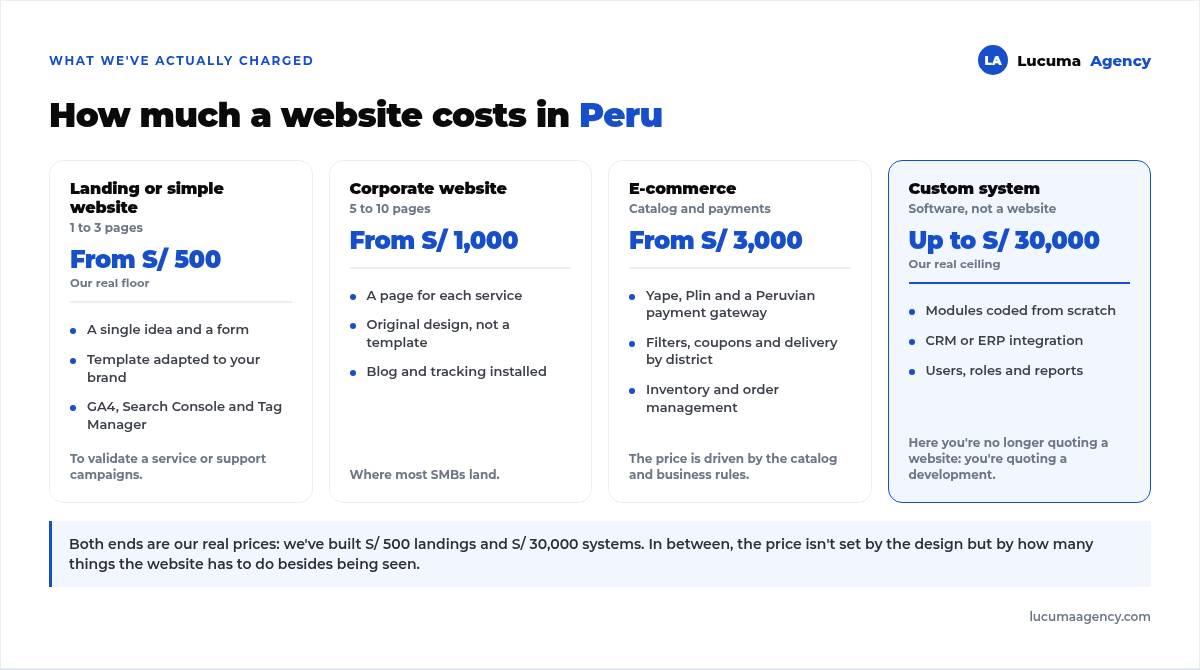
Landing page or simple website: from S/ 500
One to three pages, a single idea and a form. It's useful for validating a service, supporting a Google Ads campaign or having a decent presence while the business gets going. It's built on a template adjusted to your brand, launches in one or two weeks and comes already tracked with GA4, Search Console and Tag Manager. If you're torn between this and the next one, landing page or full website settles it with two real cases.
It's an honest price as long as you know what you're buying: a small website, not a cheap website. The smallest page worth paying for is your bio link on your own domain; we explain why in your own link in bio vs Linktree.
Corporate website: from S/ 1,000
Five to ten pages, one for each service you sell, with an original design rather than a recognizable template. This tier adds a blog, a dashboard so your team can edit without code, tracking with conversion events and a structure designed so each page competes for something different on Google.
This is where most Peruvian SMBs land, and it's the range where a website stops being a brochure and starts bringing in clients.
E-commerce: from S/ 3,000
A catalog with search and filters, a Peruvian payment gateway with Yape and Plin, inventory and order management, coupons and delivery fees by district. What drives the price up isn't the store itself: it's the products and your own business rules, like wholesale pricing or subscriptions. And what drives sales afterward is cart speed, which almost nobody measures: see how we cut a WooCommerce store's cart from 8 to 1.5 seconds. Loading 400 items with their photos, variants and prices is real work, and it's the part everyone underestimates when quoting.
Custom system: up to S/ 30,000
When the website has to do something that doesn't exist yet: bookings, quote calculators, dashboards with users and roles, integration with your CRM or ERP. At this point you're no longer pricing a website, you're pricing software development that happens to have a website in front. A common case in Lima is the website for a real estate project, with a page per unit type and leads flowing into the CRM: what it includes and what it costs is covered in web design for real estate developers.
What pushes a quote up
If two agencies quote you the same thing with a S/ 4,000 difference, it's almost never because of the design. To compare them properly, first make sure both are saying the same thing: what to ask for in a website quote. These are the factors that really move the number:
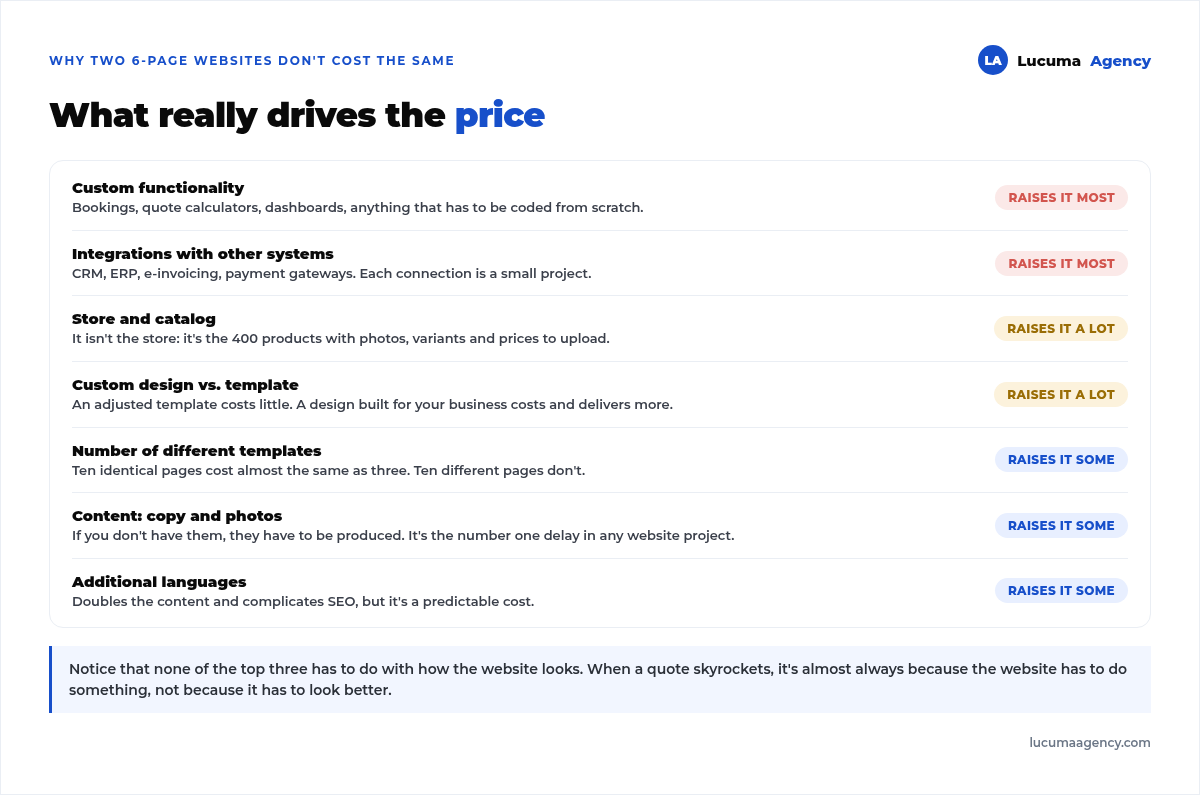
Notice that the first three have nothing to do with how the website looks. A website gets more expensive when it has to build things, not when it has to look better. That's why “I want something simple that connects to my invoicing system” isn't a simple project. We explain when that connection calls for a custom plugin in how to build a custom WordPress plugin.
And one factor that almost never shows up in the quote but does show up on the calendar: the content. If you don't have copy or photos, someone has to produce them, and it's the number one reason a six-week project ends up taking four months.
What you pay once and what you pay every month
Here's the most common trap when comparing quotes. A quote can look cheaper simply because it leaves out half the story. Hosting is the line most often left out; what a plan that can handle the load costs is covered in WordPress hosting in Peru.
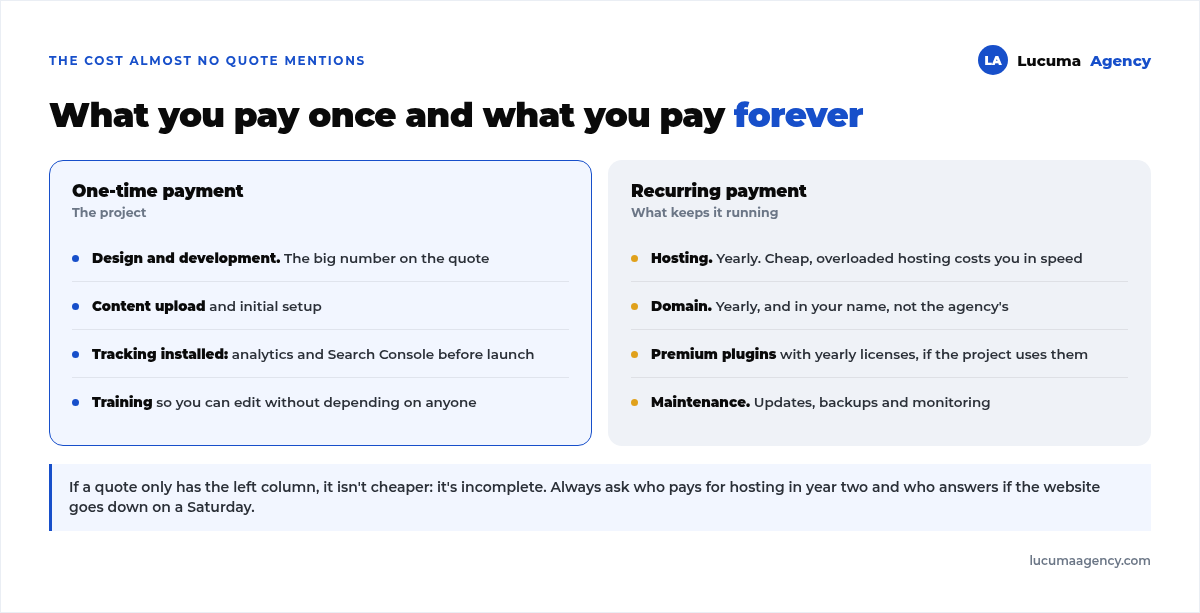
The maintenance is the other one most often left out and the one that costs the most in the long run: a website that isn't updated breaks or gets infected, and recovering it costs far more than maintaining it would have.
Two questions you should always ask before signing: whose name is the domain registered under? and who pays for hosting in year two? If the domain isn't in your name, your website isn't entirely yours.
Why WordPress and not something cheaper
Almost everything we quote is built on WordPress, and not out of habit: it lets you grow without rebuilding the website, edit without depending on anyone and switch providers without getting locked in. We develop it in why build your website on WordPress, and if you're comparing options, in WordPress.com vs WordPress.org vs custom code.
There are site builders for S/ 50 a month. They work for validating an idea. The problem shows up when you want to rank, integrate something or move: that's when you find out that what you saved in year one, you pay for in year two.
What a serious quote should include
Beyond the number, compare this:
Which pages are included and how many different templates are designed.
How many rounds of revisions are included in the price.
Whether tracking is included: analytics and Search Console installed before launch, not after.
Whether training is included so you can edit copy and photos on your own.
Who handles maintenance, how often and for how much.
The real timeline and what happens if the content is delayed.
Frequently asked questions
What's the minimum reasonable price for a website in Peru?
Our real floor is S/ 500 for a landing page and S/ 1,000 for a multi-page website. Below that, you usually get an unadapted template, no tracking and nobody who answers afterward. It isn't cheaper: it's less website.
Why does one agency charge S/ 3,000 and another S/ 15,000 for “the same thing”?
It's almost never the same thing. Check how many templates are designed, whether there's custom functionality, whether someone produces the content and whether maintenance is included. The big differences are almost always in those four lines.
How long does it take to be ready?
A simple website, one or two weeks. A corporate one, three to five weeks. A store, five to eight. A custom system is measured in months. The timeline depends more on how fast your content arrives than on the development.
Is it a good idea to pay in installments?
Yes, that's the norm: a deposit to get started and the balance on delivery. Be wary of anyone who asks for 100% upfront, and of anyone who asks for nothing.
Does the website include showing up on Google?
Not automatically. A well-built website launches with the foundations in place: speed, structure and tracking. But ranking is separate, ongoing work, and we explain it in what SEO is. And if you want timelines, we also have how long it takes for a website to rank.
Conclusion
A website in Peru costs between S/ 500 and S/ 30,000, and the range is so wide because very different things fit under the same word: from a three-section landing page to a system with users and integrations. Placing your project in that range is easy once you stop counting pages and start counting features. For examples from each range, head to our work to see the websites we've built, from landing pages to stores.
And an honest comparison between quotes isn't about the final number, but about what each one includes and what each one leaves out to look cheaper.
In Lucuma Agency we do web development in WordPress with tracking and maintenance on the table from the quote. Want to know which range your project falls into? Book your free consultation and we'll give you an honest estimate in 30 minutes.
Other posts you might like
At almost every real estate developer we work with, the lead takes the same absurd trip: it comes in through the form...
Switching servers is scary for a sensible reason: you rarely do it, and when it goes wrong, it goes wrong in public....
The question always comes the same way: “which payment gateway do you recommend?” And the useful answer doesn't start with a name, because the...
There's a moment, in quite a few projects, when the search for the right plugin becomes the problem. You tried three,...
Almost every online complaints book we audit complies on the outside and fails on the inside. They have the notice,...
The message came in like this: “the complaints book is throwing an error.” The Proba Inmobiliaria website, a page required by law,...
“Top 50 plugins” lists don't help you decide. They help you install fifty plugins. This is ours,...
Almost every business we ask has backups. Almost none has ever restored one. Those two sentences together are...
Almost every hosting conversation starts with price and ends up in the wrong place. The useful question is...
When a business wants to sell outside its country, the conversation almost always starts off wrong: with translation. And the...
Structured data is the piece of code that explains to Google, in a language that leaves no room for interpretation,...
The question comes up in almost every meeting: “if I use AI to write, will Google penalize me?” The short answer...