Your own link in bio vs Linktree: when it pays to have your own page
If you sell on social media, the link in your bio is the door everything goes through: the person who saw your reel, the one who found you on YouTube, the one who followed you on TikTok. Most people put a Linktree there because it's free and takes five minutes to set up. And to get started, that's fine. The problem shows up when that link is already getting thousands of visits a month and you still don't know who those people are, what they click, or how to lead them to what you sell. This article compares both options honestly and walks through how we built the link in bio for Depas con Andrés, a real estate agent and content creator in Lima, on his own domain and in WordPress.
What Linktree does well
It's worth saying first so the comparison is fair: Linktree is free in its basic version, needs no domain or hosting, can be set up in minutes from your phone, and almost everyone recognizes the format. If you're just starting out, if you post occasionally, or if you don't sell anything through social media yet, you don't need more.
What you give up in return
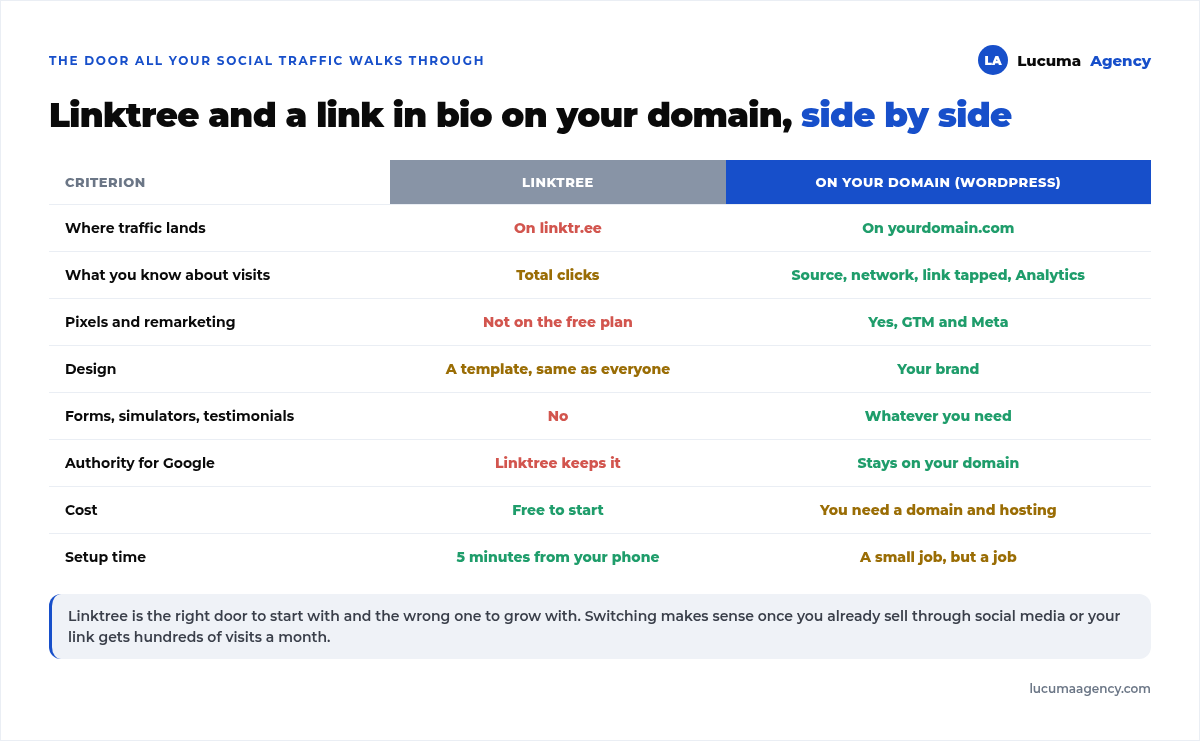
- The domain. Your link reads linktr.ee/yourname. In Google's eyes, the authority those visits build belongs to Linktree, not to you.
- The data. You see total clicks. You don't see which video they come from or how many tapped the WhatsApp link versus the YouTube one, and you can't connect any of it to Google Analytics or a Meta pixel to show them an ad again.
- The design. A list of buttons with your photo on top. Same as everyone else. If your brand has a look, it disappears here.
- Conversion. You can't add a form, a calculator or a social proof block. Only outbound links.
- Control. If Linktree changes its pricing, features or policies, you adapt. And if your account gets blocked one day, the door to all your traffic closes.
The case: a real estate creator with 8,500 subscribers and traffic nobody was measuring
Andrés makes video tours of real estate projects in Lima Moderna. His YouTube channel has about 8,500 subscribers, but his videos average 75,000 views, nine times his base, which means YouTube recommends him to new people all the time. He sells two things from there: 30-minute consultations and, for developers, sponsorships. He also has his own mortgage calculator.
All that traffic went through a generic link that didn't say who he was, didn't highlight the consultation and didn't measure anything. The decision was to build the link in bio on his own domain, depasconandres.com, as one more page of his WordPress site.
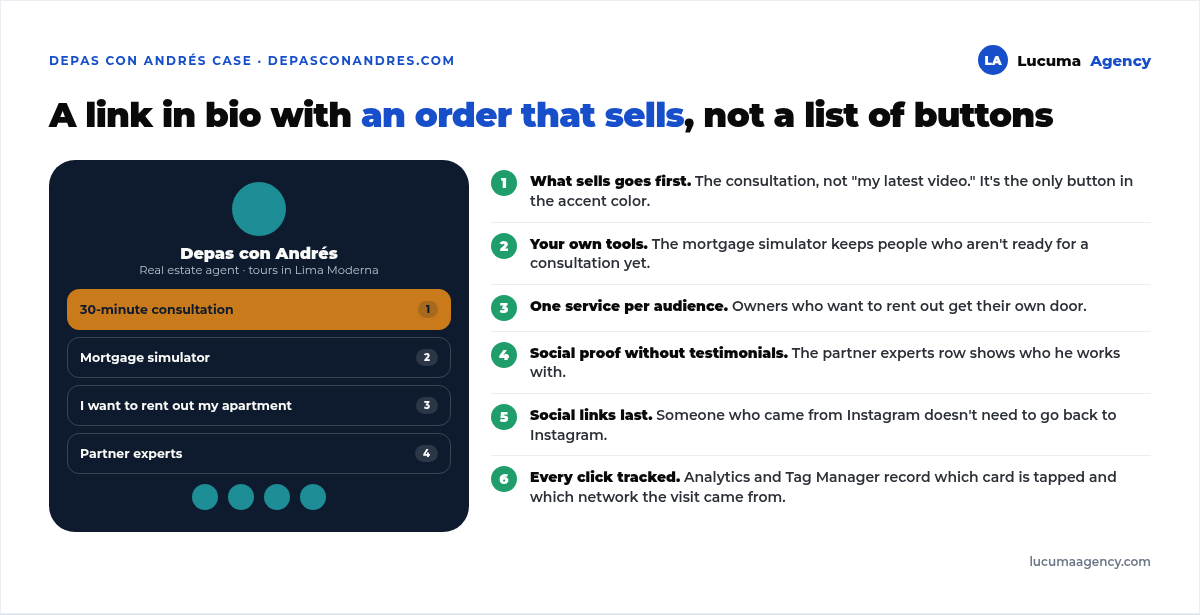
What that page has that Linktree can't
- An order that sells. The consultation comes first, not “my latest video”. Then the mortgage calculator, the service for owners who want to rent out their property, and the row of partner experts. Social media goes last, because someone who arrived from Instagram doesn't need to go back to Instagram.
- His look, not a template's. A blueprint-style background, his own typefaces, his colors. Visitors know they're in his space.
- Every click tracked. Because it's on his domain, Google Analytics and Tag Manager record which card gets tapped and which network the visit came from. That shows which content brings in consultations and which only brings in the curious.
- Authority for his domain. Every visit from YouTube, TikTok and Instagram lands on depasconandres.com, not on a third party. Over time, that shows up in Google.
- Room to grow. Tomorrow it can add a form to capture emails, a membership or a testimonials block, without switching tools.
What it took to do it right, so no one sells it to you as trivial
A links page seems like the simplest thing in the world, and in WordPress with a visual builder it has its traps. Here are ours, documented for next time:
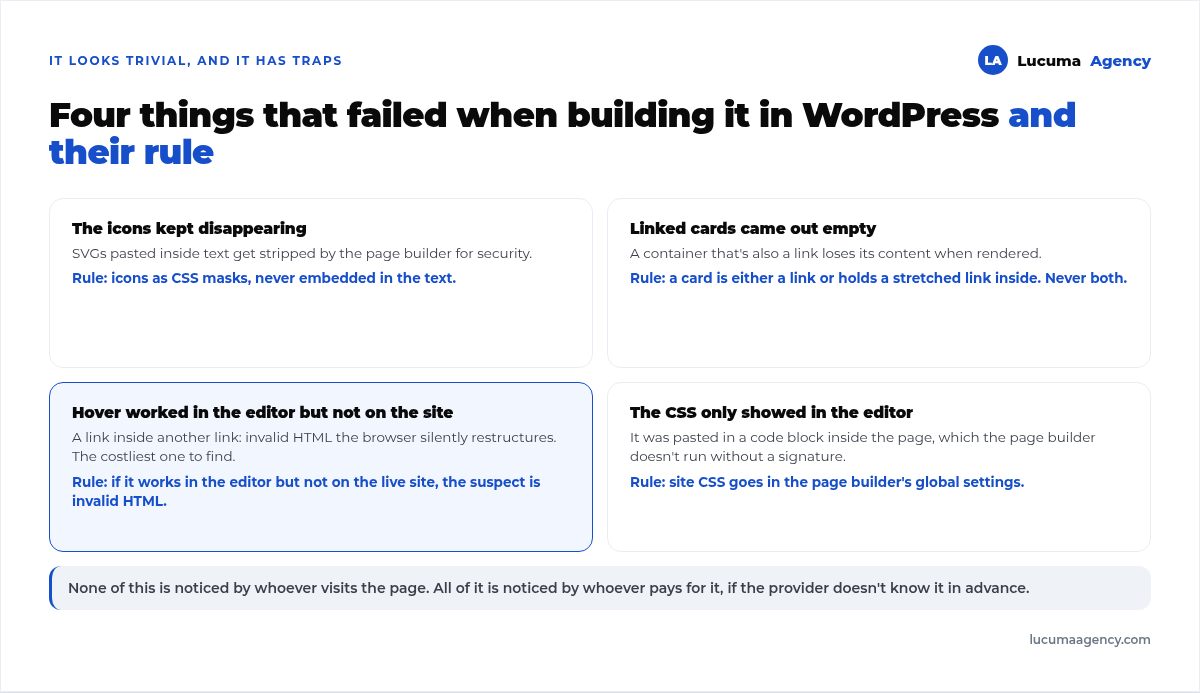
- SVG icons pasted inside text disappear: the builder strips them for security. We solved it with CSS masks.
- A whole card turned into a link rendered empty: the builder drops the content of a container that is also a link. We had to choose one pattern and stick with it.
- Hover effects worked in the editor but not on the live site. The cause was a link inside another link, invalid HTML that the browser silently restructures. It was the most expensive problem to find, and it left a rule: if something works in the editor but not on the live site, the suspect is invalid HTML.
- CSS pasted in the wrong place only showed up in the editor. It belongs in the builder's global settings, never in a code block inside the page.
None of this is noticed by the people who visit the page. All of it is noticed by the person paying for it, if the provider doesn't know it in advance. If you're choosing who will build it for you, what to ask for in a website quote applies to a page this size too.
When to stay on Linktree and when to move to your own domain
- Stay on Linktree if you don't sell anything through social media yet, if you post sporadically, or if you don't have a domain or website and don't plan to get one soon.
- Move to your own domain if you already have a website, if you sell a service or product through social media, if you run or plan to run ads and need pixels and tracking, or if your link gets more than a few hundred visits a month. At that volume, every visit that lands on a third party is data you lose.
If your website already exists, the link in bio is just one more page and gets tracked like the rest: how to track your website's conversions explains which events to set up.
Frequently asked questions
Does a link in bio on my own domain help SEO?
Indirectly. Visits from social media land on your domain instead of a third party's, and the page can link to your services. It won't rank on its own, but it adds authority and gives you the data Linktree keeps for itself.
What URL should I put in my bio?
A short one that's easy to say in a video: yourdomain.com/links or yourdomain.com/bio. And make sure it redirects if you ever change it.
Can I track which video brings the most clicks?
Yes, with parameters on the links you add to each video or with the source Analytics records. That's what a creator who sells needs to know, and it's what Linktree doesn't give you.
How much does a page like this cost?
If you already have a WordPress website, it's just one more page within the scope of a website starting at S/ 1,000, or a small separate job. If you don't have a website, the real cost is having a domain and hosting, which you'll need anyway.
Can it be done with Gutenberg, or does it have to be a page builder?
It works with either. For a custom design with cards and effects, a builder like Bricks gives you more control; for a clean list of buttons, Gutenberg is enough.
Conclusion
Linktree is the right door to start with and the wrong one to grow with. As soon as you sell through social media and your link gets real traffic, that traffic, that data and that authority should land on your domain. For Depas con Andrés, it was a page on his WordPress site, with his look, an order that sells, and every click tracked.
If what you want is a base of your own and not just a link in your bio, that's where our work starts, in Lucuma Agency, digital marketing agency in Lima. The platform we use and why, in why we build websites on WordPress.
At Lucuma Agency we do WordPress web development, from a link in bio to a full website. If you sell on social media and your link tells you nothing, book a free consultation and we'll review it in 30 minutes.
Other posts you might like
At almost every real estate developer we work with, the lead takes the same absurd trip: it comes in through the form...
Switching servers is scary for a sensible reason: you rarely do it, and when it goes wrong, it goes wrong in public....
The question always comes the same way: “which payment gateway do you recommend?” And the useful answer doesn't start with a name, because the...
There's a moment, in quite a few projects, when the search for the right plugin becomes the problem. You tried three,...
Almost every online complaints book we audit complies on the outside and fails on the inside. They have the notice,...
The message came in like this: “the complaints book is throwing an error.” The Proba Inmobiliaria website, a page required by law,...
“Top 50 plugins” lists don't help you decide. They help you install fifty plugins. This is ours,...
Almost every business we ask has backups. Almost none has ever restored one. Those two sentences together are...
Almost every hosting conversation starts with price and ends up in the wrong place. The useful question is...
When a business wants to sell outside its country, the conversation almost always starts off wrong: with translation. And the...
Structured data is the piece of code that explains to Google, in a language that leaves no room for interpretation,...
The question comes up in almost every meeting: “if I use AI to write, will Google penalize me?” The short answer...