Structured data for local businesses: what to include and what not to
Structured data is the piece of code that tells Google, in a language that leaves no room for interpretation, what your business is: its name, where it is, when it opens and what it sells. It isn't visible on the page, which is why almost nobody checks it. When we measured 32 websites of real estate companies in Miraflores, we found that 71% of developers had it and only 39% of brokerages. That thirty-point gap explains a good deal of why some show up on the map and others don't.
What it is, without the jargon
Your page says “Av. Larco 123, open 9 to 6.” A human understands it. Google interprets it, with a margin of error. Structured data removes that margin: instead of guessing, Google reads an orderly record that states the address, hours, phone and business type, each in its own field.
The format used today is called JSON-LD, and it goes in the page's code, not in the visible text. In WordPress an SEO plugin adds it, so in most cases you don't have to write anything: you have to fill in the right fields and check that they show up.
What a local business should include
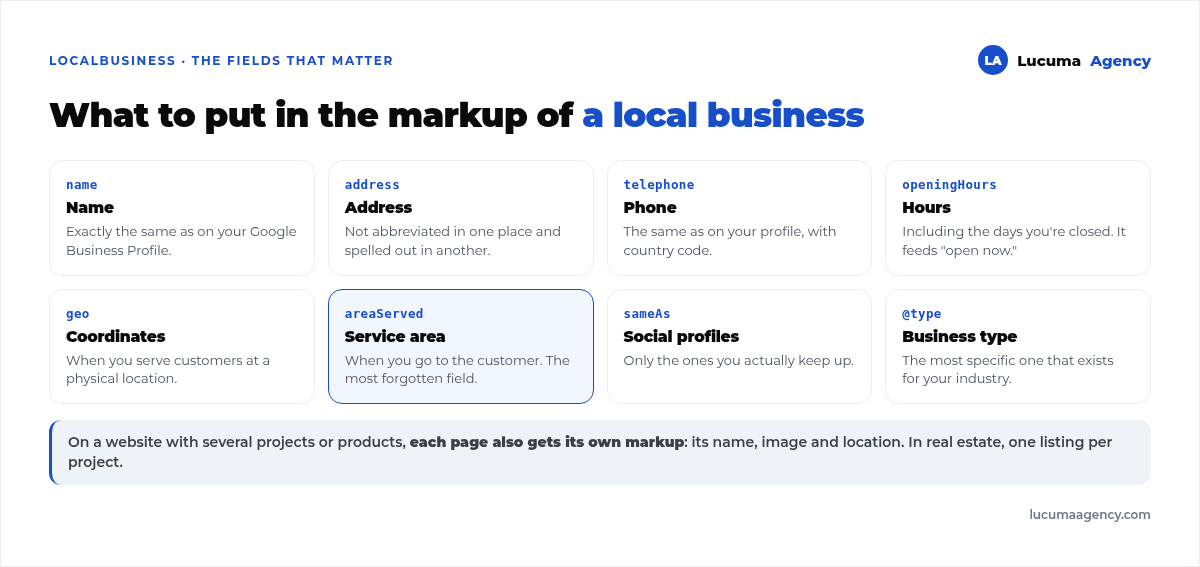
The base markup type is LocalBusiness, or the subtype that best describes your industry. What matters isn't picking the exact name, it's filling in these fields properly:
- Name, address and phone, written exactly as they appear on your Google Business Profile. If the website says “Av.” and the listing says “Avenida,” it's worth making them match.
- Opening hours, including the days you're closed. This is what feeds the search engine's “open now.”
- Coordinates, when you serve customers at a physical location.
- Service area, when you go to the customer. That's the case for many trades and for real estate brokerages, and almost nobody declares it.
- Real social profiles, the ones you actually keep up.
- Business type, the most specific one that exists for what you do.
For a website with several projects or products, each page can also carry its own markup, with its name, image and location. In real estate, that means one record per project, which is exactly what we recommend for any websites for real estate developers.
What does nothing, or actually hurts
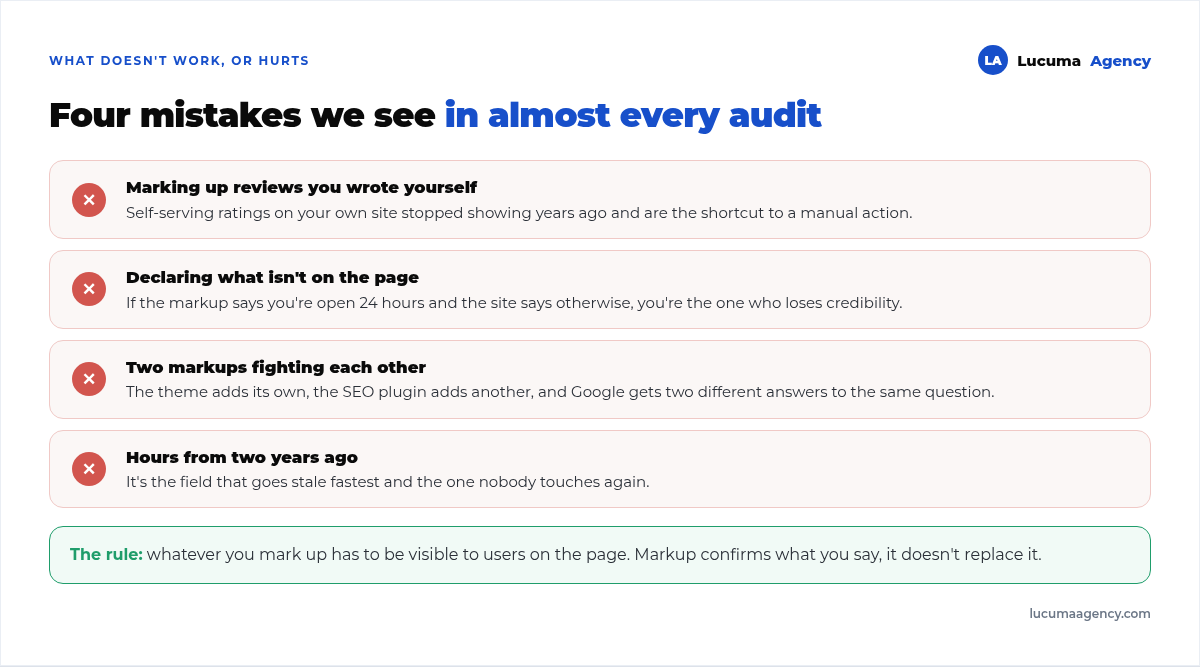
Marking up reviews you wrote yourself. Self-declared ratings on your own website stopped being displayed years ago, and they're the shortcut to a manual action. The reviews that count are the ones on your Google Business Profile, and how to get them is covered in how to get Google reviews.
Declaring what isn't on the page. If the markup says you're open 24 hours and the website says otherwise, you're the one who loses credibility. The rule is simple: whatever you mark up has to be visible to the user.
Having two markups fighting each other. It happens a lot: the WordPress theme brings its own, the SEO plugin adds another, and Google gets two different answers to the same question. You check it once and keep just one.
Opening hours from two years ago. It's the field that ages the fastest and the one nobody touches again.
What we found measuring 32 websites
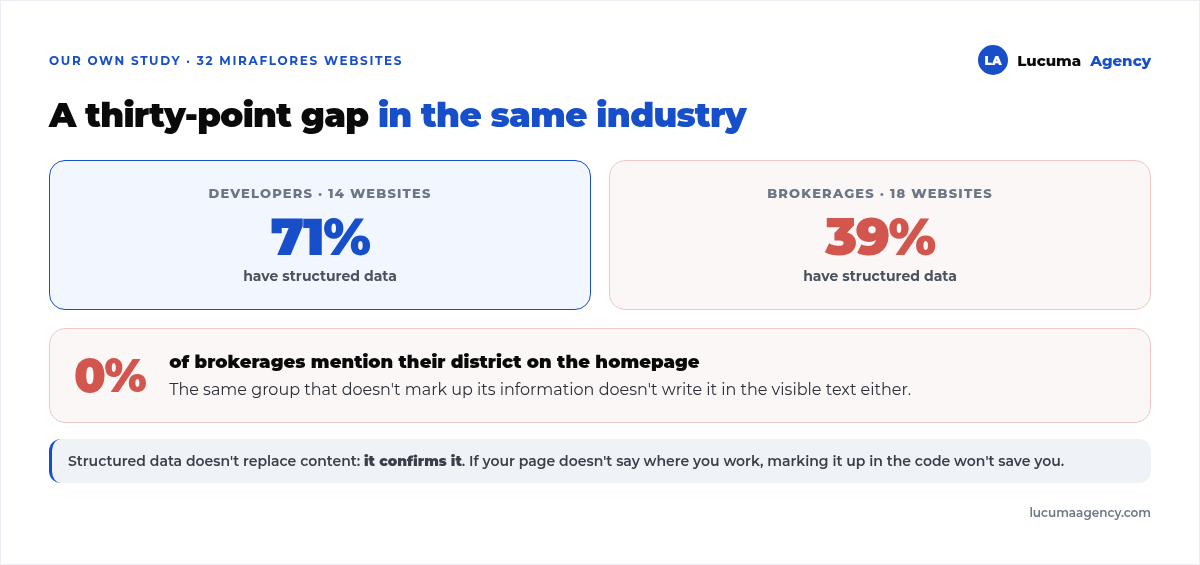
The gap between the two groups is large, but there's a data point that comes with it and explains it better: none of the 18 brokerages mentioned their district on the homepage. Zero. In other words, the same group that doesn't mark up its information doesn't write it in the text either.
That's the practical lesson of this article. Structured data isn't a substitute for content: it's the confirmation of it. If your page doesn't say where you work, marking it up in the code won't save you; if it does, marking it up reinforces it. Together they're what gets you into the local results pack, which is where most service searches in Lima are decided.
How to check yours in five minutes
Open Google's Rich Results Test, paste your homepage URL and see what it detects. Then repeat with an inner page, which is where things usually fail. If nothing shows up, you have no markup; if it shows up with warnings, they're almost always recommended fields left empty, and you fix them by filling them in the plugin.
Do this after any redesign or theme change too, because it's one of those things that gets lost without anyone noticing.
Frequently asked questions
Does structured data improve my ranking on Google?
It's not a direct ranking factor, but it does shape how you're displayed: opening hours, ratings from valid sources, expanded FAQs. That changes your click-through rate, and clicks do end up mattering.
Do I need a developer to add it?
In WordPress, almost never. SEO plugins generate it from the data you enter. What is worth doing is having someone check that there aren't two markups at once and that the fields match your Google Business Profile.
What type of markup do I use if I don't have a physical location?
The service-area type, declaring the areas you serve. That's the case for home-service trades, real estate brokers and many professional services, and it's exactly the one most often forgotten.
Is it worth marking up FAQs?
Yes, and it's one of the most profitable things you can do: the questions have to be visible on the page, each with its own heading. We include them in all our articles for that reason.
How often should I review it?
Once a year, and always after a redesign, a theme change or a move to a new location. If you change your address, update it at the same time in your listing, in the footer and in the markup.
Conclusion
Structured data is ten minutes of work that almost nobody puts in, and in our study it separated one group of companies from the other by thirty points. It doesn't work magic: it confirms what your page already says. That's why the right order is to first write where you work and what you do, and mark it up afterward.
In Lucuma Agency this falls under our Google Business Profile & local SEO, together with your listing and reviews, because on their own each delivers half as much. If you want to know what your website's markup looks like today, book a free consultation and we'll review it in 30 minutes. And if your business is in real estate, the full context is in real estate marketing in Lima.
Other posts you might like
At almost every real estate developer we work with, the lead takes the same absurd trip: it comes in through the form...
Switching servers is scary for a sensible reason: you rarely do it, and when it goes wrong, it goes wrong in public....
The question always comes the same way: “which payment gateway do you recommend?” And the useful answer doesn't start with a name, because the...
There's a moment, in quite a few projects, when the search for the right plugin becomes the problem. You tried three,...
Almost every online complaints book we audit complies on the outside and fails on the inside. They have the notice,...
The message came in like this: “the complaints book is throwing an error.” The Proba Inmobiliaria website, a page required by law,...
“Top 50 plugins” lists don't help you decide. They help you install fifty plugins. This is ours,...
Almost every business we ask has backups. Almost none has ever restored one. Those two sentences together are...
Almost every hosting conversation starts with price and ends up in the wrong place. The useful question is...
When a business wants to sell outside its country, the conversation almost always starts off wrong: with translation. And the...
Structured data is the piece of code that explains to Google, in a language that leaves no room for interpretation,...
The question comes up in almost every meeting: “if I use AI to write, will Google penalize me?” The short answer...