How to get Google reviews (and manage them like a pro)
Two veterinary clinics on the same street in Lince. The first has 8 reviews from two years ago. The second has 140, the latest from the day before yesterday, and the owner replies to every one. When someone searches “veterinaria cerca de mí” (vet near me) with a sick dog, they don't compare prices or services: they look at that number and that date, and decide in three seconds.
The Google reviews are the most powerful trust signal a local business has, and at the same time one of the factors that decide whether Google shows you on the map. In this guide we explain how to get more of them ethically and how to manage them, including the ones you won't like.
This article is part of our complete guide to Google My Business.
Why reviews matter so much
Reviews do two jobs at once, which is why they pay off twice as much as anything else you do on your listing.
Trust. Most people read reviews before deciding, especially when the service matters: a clinic, an auto shop, a school. A business with good, recent reviews wins customers for that alone.
local SEO. The number of reviews, how often they come in and your replies to them are a ranking factor in Google Maps and in the Local SEO. A business that's active with reviews tells Google it's real, still open and cares about its customers.
There's a nuance that often surprises people: frequency matters more than the total. It's better to get two reviews every week than forty all at once and then nothing for a year. A sudden spike is also exactly the pattern Google looks into when it hunts for bought reviews.
How to ask for reviews without making it awkward
Almost all of your happy customers would leave a review. They don't because nobody asks, or because they're asked the wrong way: an email three weeks later with a link that forces them to look up the business on Maps.
The solution isn't to push harder, it's to reduce friction and pick the right moment:
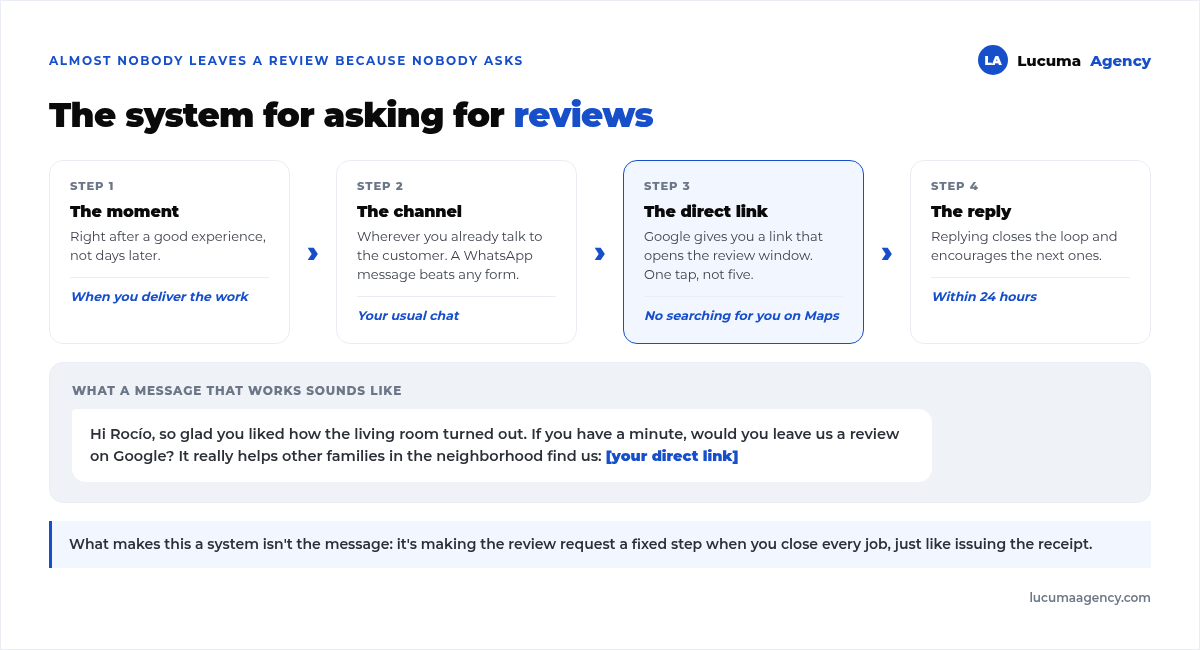
The four points that make the difference:
Ask at the right moment: right after a good experience, while the feeling is still fresh for the customer.
Use the channel where you already talk to them: a short, friendly WhatsApp message works much better than a cold form.
Share your direct link. Google gives it to you from your optimized listing and it opens the review window in one tap. The fewer the steps, the more reviews you get.
Make it part of your process. Make asking for a review a fixed step when you close every sale, just like issuing the receipt. That way it no longer depends on someone remembering.
What you should NOT do
Google prohibits certain practices and can remove reviews or penalize your listing. The line is clearer than it seems:
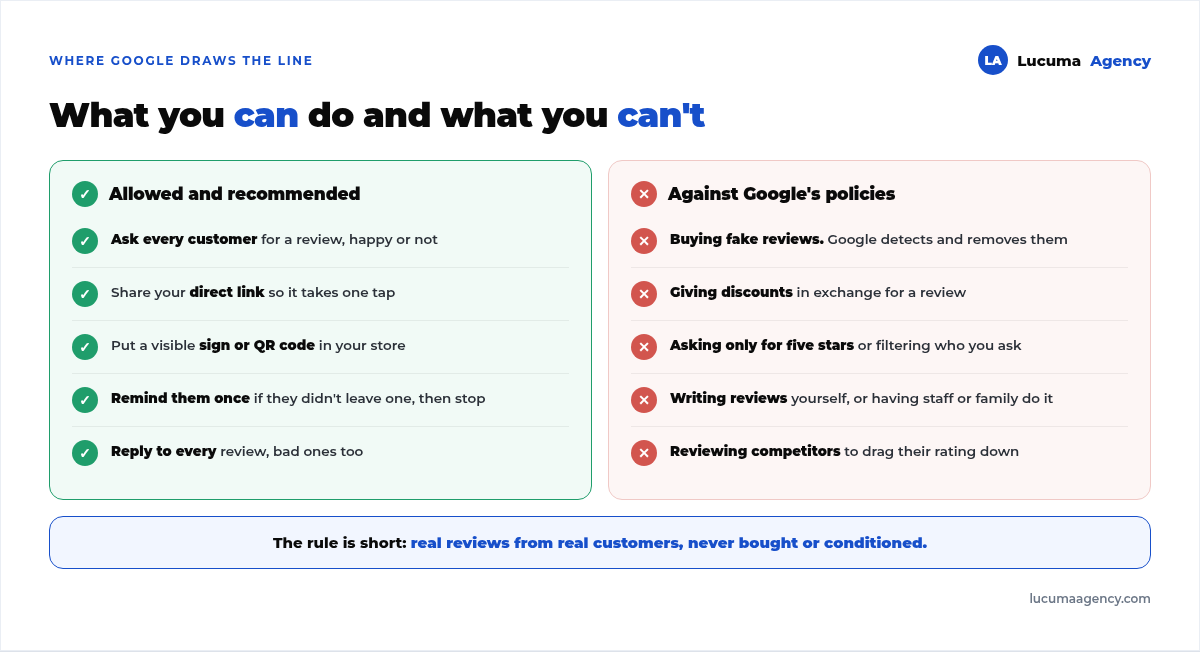
The most common mistake isn't buying reviews: it's filtering who you ask. Asking first whether they were happy and only requesting a review from those who say yes also goes against the policies, and it leaves you without the most useful information you have.
How to respond to reviews (all of them)
Responding is as important as receiving. Google values the interaction, and customers notice how you treat people.
With the positive ones, thank them personally. Don't copy and paste the same text into all twenty: mention something specific from the comment. The difference really shows.
With the negative keywords is where the real test lies, because that reply is read by people who aren't customers yet:
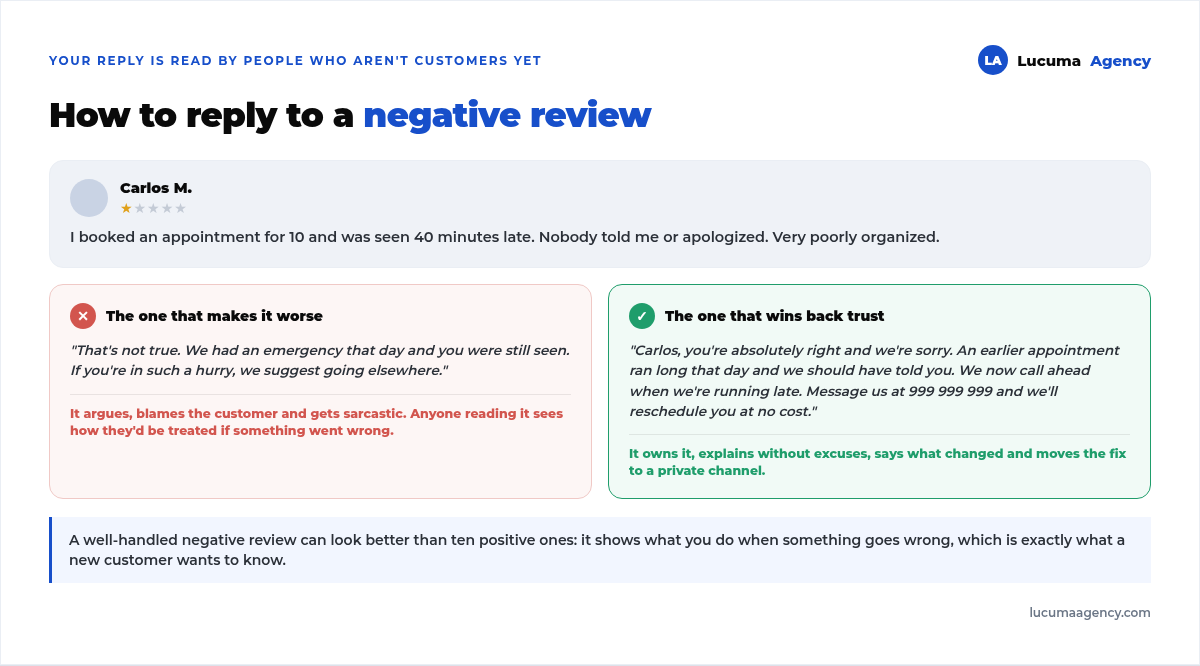
The structure that always works is the same: acknowledge what happened, apologize if appropriate, explain what you've changed so it doesn't happen again and take the solution to a private channel. No arguing, no sarcasm and no taking a week to reply.
What to do with an unfair or fake review
If you get a review that violates Google's policies (spam, offensive language, someone who was never a customer, a competitor), you can report it from your listing so Google reviews it. They don't always remove it and the process takes time, so don't count on it.
In the meantime, respond professionally. If that person truly was never a customer, say so calmly and without accusing: “We can't find any record of service under these details. If there was a mistake, write to us and we'll look into it.” Whoever reads it will draw their own conclusions.
How to turn reviews into more sales
Reviews aren't only useful inside your listing. Take them further:
Show them on your website as social proof, especially on your service pages.
Share them on your social media, with the customer's name and their permission.
Use your customers' words in your messaging. If three people write “they explained everything without rushing me”, that phrase is worth more than any slogan you could come up with.
Frequently asked questions about Google reviews
How many reviews do I need?
There's no magic number, and consistency matters more than the total. As a practical benchmark, aim to have more reviews, and more recent ones, than the business that shows up above you on the map.
Do negative reviews hurt me?
An occasional one, answered well, actually adds credibility: a profile with nothing but five stars and not a single complaint can look fake. What hurts is not responding, or piling up bad reviews without managing them.
Can I delete a bad review?
You can't delete it. You can report it if it breaks the policies, but the most effective move is almost always to respond to it well.
Can I ask a customer to change their review?
You can solve their problem and tell them what you did. If they decide to update it, great. Pressuring them to change it or delete it is what you shouldn't do.
Are reviews worth it if I don't have a physical location?
Yes. If you work within a service area, reviews carry even more weight, because they're the only visible proof that you exist and that you serve people well.
Conclusion
Reviews are an asset you build with consistency: always ask, reply to everything and treat every opinion as free information about your business. Over time they become your best salesperson and one of the signals that most boost your ranking on the map.
And the best part is that they don't depend on budget. They depend on remembering to ask.
In Lucuma Agency we manage your Google profile and your review strategy as part of our Local SEO. Want more reviews and a better reputation? Book your free consultation.
Other posts you might like
At almost every real estate developer we work with, the lead takes the same absurd trip: it comes in through the form...
Switching servers is scary for a sensible reason: you rarely do it, and when it goes wrong, it goes wrong in public....
The question always comes the same way: “which payment gateway do you recommend?” And the useful answer doesn't start with a name, because the...
There's a moment, in quite a few projects, when the search for the right plugin becomes the problem. You tried three,...
Almost every online complaints book we audit complies on the outside and fails on the inside. They have the notice,...
The message came in like this: “the complaints book is throwing an error.” The Proba Inmobiliaria website, a page required by law,...
“Top 50 plugins” lists don't help you decide. They help you install fifty plugins. This is ours,...
Almost every business we ask has backups. Almost none has ever restored one. Those two sentences together are...
Almost every hosting conversation starts with price and ends up in the wrong place. The useful question is...
When a business wants to sell outside its country, the conversation almost always starts off wrong: with translation. And the...
Structured data is the piece of code that explains to Google, in a language that leaves no room for interpretation,...
The question comes up in almost every meeting: “if I use AI to write, will Google penalize me?” The short answer...