Local SEO: how it works and how to rank your business city by city
Most businesses don't compete against the whole country: they compete against those in their own area. That's why, when someone searches “gimnasio cerca de mí” (gym near me) or “abogado en Arequipa” (lawyer in Arequipa), Google doesn't show everyone the same results: it personalizes them based on where each person is and what they need. That game is called Local SEO, and understanding it is the difference between attracting clients in your city or being invisible to them.
In this guide we explain, in plain terms, how local SEO works, how a business ranks city by city and the concepts every business owner should know. Serious about results, warm in how we work with you.
What is local SEO and how is it different from traditional SEO?
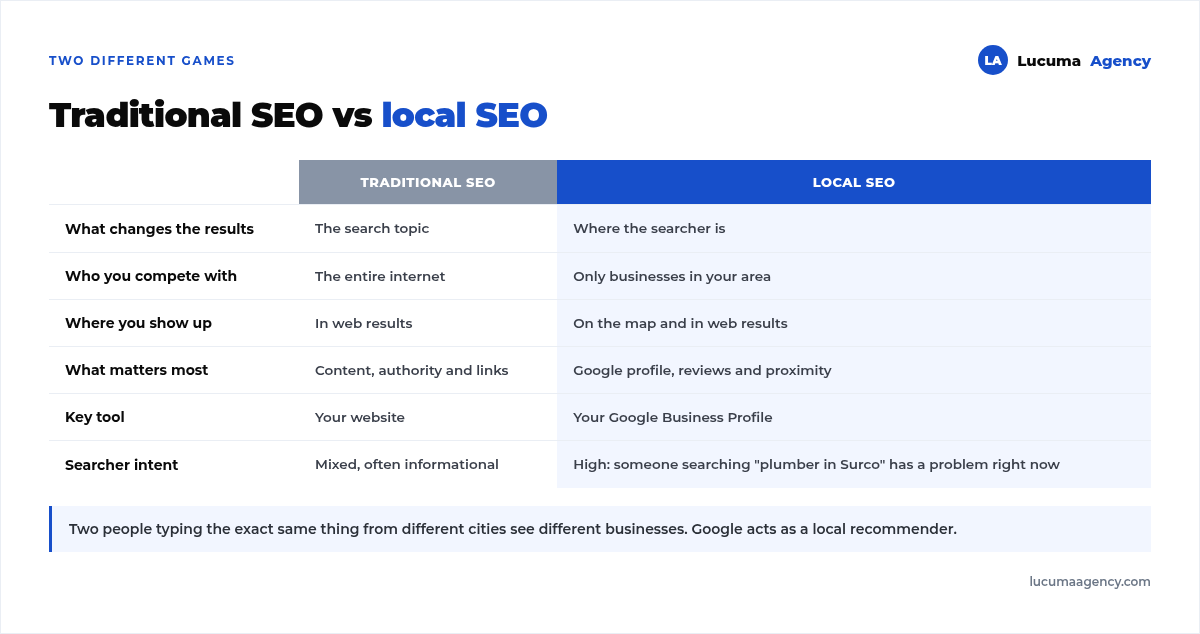
The SEO in its traditional form aims to rank your website for a topic, no matter where the searcher is. By contrast, Local SEO aims to rank you for searches with geographic intent: the ones that include a city, an area or a “cerca de mí” (near me).
The big difference is that in local SEO the searcher's location changes the results. Two people who type the same thing from different cities see different businesses. Google acts as a local recommender: it wants to show each person the most relevant and closest business.
How local SEO works: the three factors Google evaluates
To decide who to show in local searches, Google relies on three factors:
Relevance: how well you match what the person is looking for. Your services, your category and the content of your website and your Google profile carry weight here.
Distance: how close you are to the searcher or to the area they mention. The closer you are and the clearer your presence in that area, the better.
Prominence: how well known and trustworthy you are. This is where your reviews, your mentions around the web, your links and your activity come in.
The key is that these three factors can be built. You don't control each person's distance, but you can make yourself more relevant and more prominent in your city. One way to do that is to tell Google, in your website's code, where you are and what you do: we explain it in structured data for local businesses.
The two places where you can show up
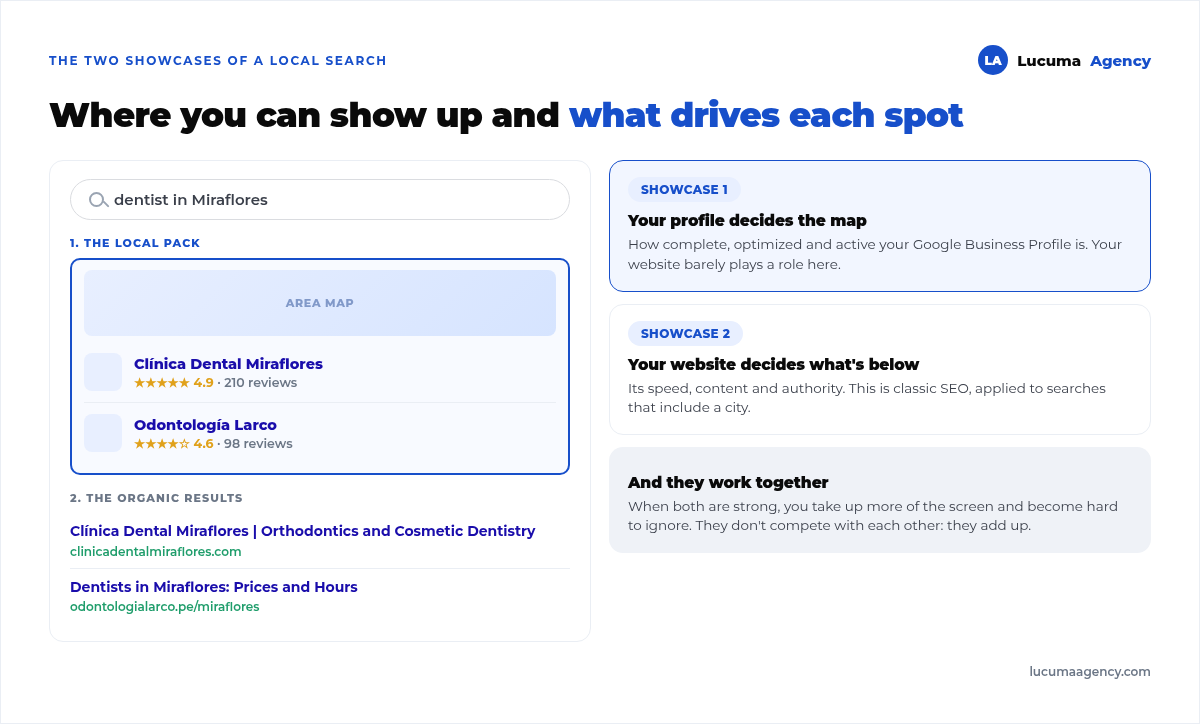
In a local search there are, in practice, two different “storefronts”, and it pays to appear in both:
The Local Pack (the map with three businesses). It's the Google Maps block that appears at the top with three listings, their reviews and their location. It depends mainly on your Google My Business profile: how complete, optimized and active it is.
Local organic results (your website). Right below the map come the web pages. Here it depends on your site's SEO: their speed, content and authority. That's why it pays to have a fast, well-structured website.
They're two engines working together: your listing ranks you on the map and your website ranks you below it. When both are strong, you take up more of the screen and become hard to ignore.
How city-based ranking works
This is the part that raises the most questions: how do I show up in several cities? It depends on your situation.
Case 1: you have physical locations in several cities
If you have real branches in different cities, the strategy is clear: one Google profile per location (with its local address and phone number) and one page on your website per location. Each page should have its own useful content about that location: address, coverage area, testimonials from that city and real details. That way Google understands you have a legitimate presence in each place.
Case 2: you want clients in several cities but don't have a location in all of them
This is the case for businesses that serve at home, remotely or across a wide radius. Here you work with a service area on your Google profile (you define the areas you cover without showing an address) and with pages by city or by service + city on your website.
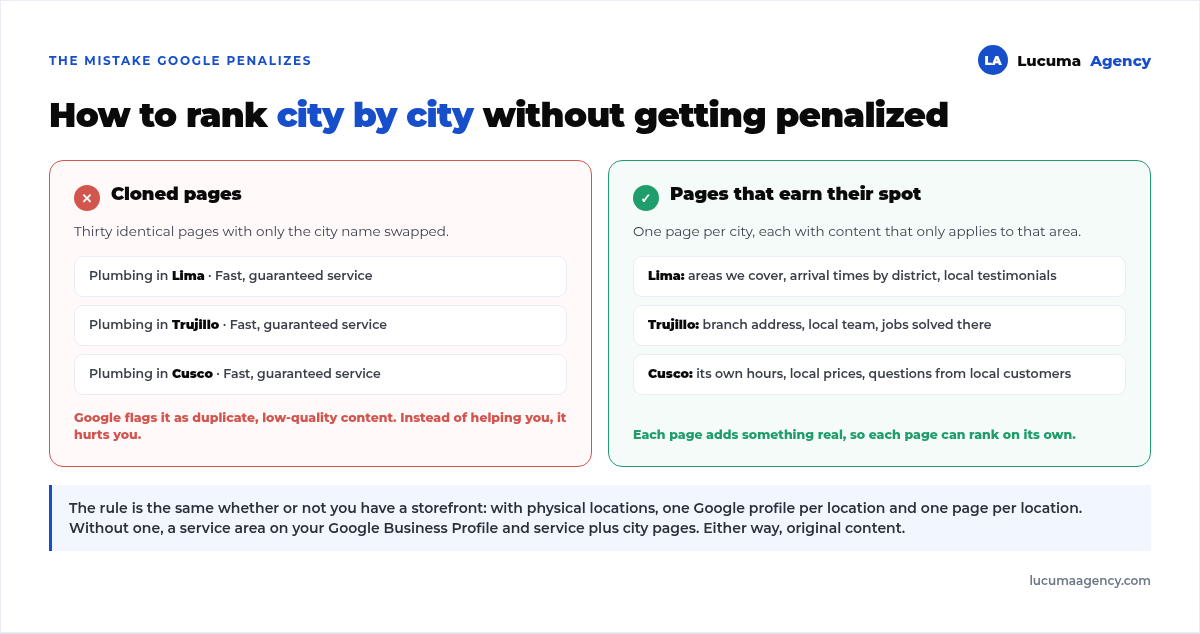
The golden rule: every city page must add real value. Specific content about that city, not the same page copied with only the name changed. It even works across several languages: in our case study on a multilingual WordPress website, a single area's page drew 42 clicks across its three versions. In real estate this translates into one page per project and per district, not twenty cloned apartment pages for every area; that's the approach of our real estate marketing. A good content creation service makes all the difference here.
The mistake Google punishes: cloned pages
Many businesses create 30 identical pages, swapping only “Lima” for “Trujillo” or “Cusco”. In real estate the right equivalent is a real page per project, with its district in the title; we cover it in detail in a construction company's website for selling in pre-sale. Google detects that duplicate, low-quality content and, instead of helping you, penalizes you. Ranking city by city works when each page earns its place with unique, useful content, not with mass copy and paste.
Local keywords: how your customer thinks
To rank city by city, you first need to understand how people search. Local searches usually take three forms:
With “cerca de mí” (near me): “veterinaria cerca de mí” (vet near me). Google uses the phone's location to answer.
With a city or area: “dentista en Miraflores”, “contador en Arequipa” (dentist in Miraflores, accountant in Arequipa). The local intent is explicit.
Implicit local intent: often the person types only “cerrajería” (locksmith) and Google, from context, already assumes they want one nearby. Location matters even when they don't type it.
Knowing these variations tells you which pages and what content to create for each city and service.
The pillars that build your local authority
Beyond your website and your listing, local SEO rests on several signals you should work on together:
An optimized Google profile. Your complete Google My Business listing, with the right categories, photos and posts.
NAP consistency. Your name, address and phone number (Name, Address, Phone) identical on your website, your listing and every directory. Inconsistencies confuse Google.
Local citations or directories. Having your business mentioned with its details in trustworthy directories and guides strengthens your prominence.
Reviews. Quantity, frequency and replies. They're one of the strongest signals in local SEO and in trust.
Local links and mentions. When media outlets, blogs or businesses in your area mention or link to you, it tells Google you're relevant in that area.
Local content on your website. Pages and articles about your city, your services and your local customers' questions.
Why you can't “cheat” on location
A common question: “can I rank first in a city where I have nothing?”. The honest answer is that proximity and real presence carry a lot of weight. You can grow in new cities, but you get there by building legitimate signals (content, reviews, mentions and, where it applies, a physical presence), not by gaming the system. Google keeps getting better at spotting fake listings and made-up addresses, and it penalizes them.
If you need immediate results while your local SEO matures, you can complement it with Google Ads, which lets you appear at the top in the cities you choose from day one.
Common local SEO mistakes
Having different details on your website, your listing and directories.
Creating cloned city pages with no content of their own.
Neglecting your Google profile or not replying to reviews.
Ignoring the mobile version, when most local searches happen on a phone.
Expecting results overnight: local SEO is steady and gradual. If your business is in the capital, we handle it as part of our SEO in Lima.
Frequently asked questions about local SEO
Can I rank in a city where I don't have an office?
Yes, but it takes real work: a dedicated page for that city, a service area on your listing and local signals (reviews, mentions, content). It isn't automatic.
How long does local SEO take to deliver results?
It's gradual. The first gains usually show up within 1 to 3 months, and they consolidate with consistency in reviews, content and activity.
Does local SEO help if I sell online nationwide?
If you sell 100% online with no geographic focus, your priority is traditional SEO. Local SEO is key when you serve specific areas or have physical locations.
Do I need a separate page for each city?
If you want to rank in several cities, yes, but each one with unique, useful content. A single generic page rarely ranks well across many areas.
Local SEO or Google Ads?
It's not one or the other. Local SEO builds a lasting asset and Ads gives you immediate results. They work best together.
Conclusion: win your city before fighting for the country
For most businesses, local SEO is the most direct path to more clients: it puts you in front of people who are already looking for what you offer, right in your area. It works when you understand how Google thinks (relevance, distance and prominence), work on your profile and your website at the same time, and build a real presence in every city you care about. And if the city you care about is in another country, the game changes: we saw it in international SEO from Peru.
In Lucuma Agency we design local SEO and city-based ranking strategies so you show up where people are looking for you and turn those searches into clients. Serious about results, warm in how we work with you.
Want to rank your business in your city? Book your free 30-minute consultation and we'll give you an honest assessment of your local presence.
Other posts you might like
At almost every real estate developer we work with, the lead takes the same absurd trip: it comes in through the form...
Switching servers is scary for a sensible reason: you rarely do it, and when it goes wrong, it goes wrong in public....
The question always comes the same way: “which payment gateway do you recommend?” And the useful answer doesn't start with a name, because the...
There's a moment, in quite a few projects, when the search for the right plugin becomes the problem. You tried three,...
Almost every online complaints book we audit complies on the outside and fails on the inside. They have the notice,...
The message came in like this: “the complaints book is throwing an error.” The Proba Inmobiliaria website, a page required by law,...
“Top 50 plugins” lists don't help you decide. They help you install fifty plugins. This is ours,...
Almost every business we ask has backups. Almost none has ever restored one. Those two sentences together are...
Almost every hosting conversation starts with price and ends up in the wrong place. The useful question is...
When a business wants to sell outside its country, the conversation almost always starts off wrong: with translation. And the...
Structured data is the piece of code that explains to Google, in a language that leaves no room for interpretation,...
The question comes up in almost every meeting: “if I use AI to write, will Google penalize me?” The short answer...