A construction company's website: what it needs to sell a pre-construction project
A builder doesn't sell the same thing as a store or a law firm. It sells apartments that don't exist yet, to people who are about to commit years of savings, and it competes against portals with thousands of listings. Its website has a specific job: to make sure that someone looking for an apartment in that district finds the project, understands what's still available and requests a quote without friction. This article walks through what it needs, using as an example the website we built for LuRoss Constructora Inmobiliaria, in Lima, and its Residencial Bordeaux project in Magdalena del Mar.
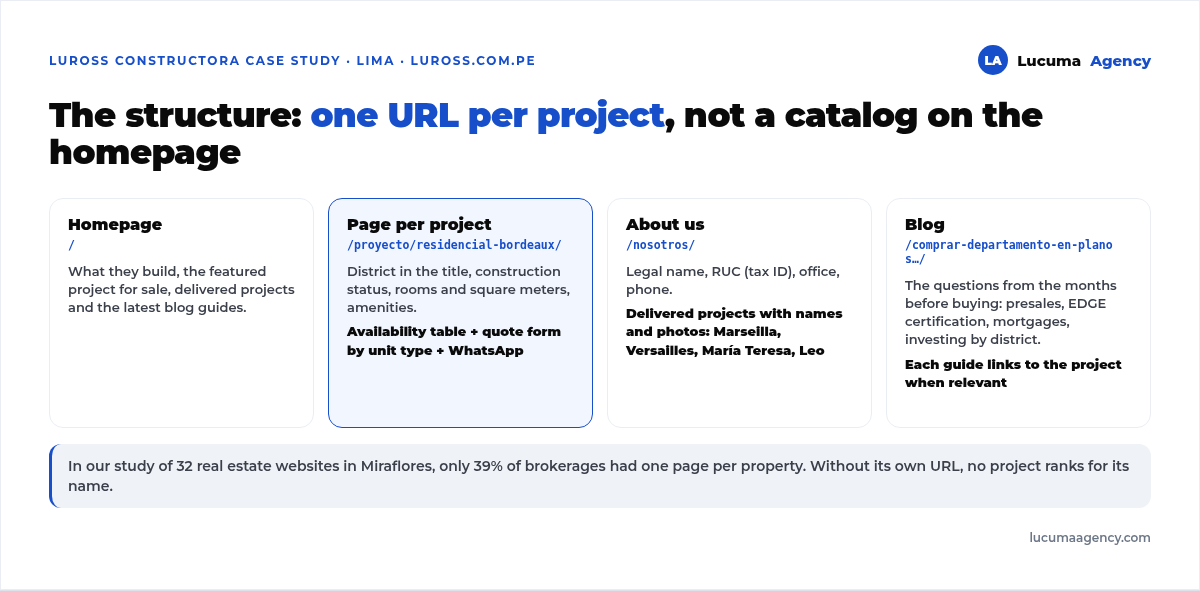
One page per project, not a catalog on the homepage
The most common mistake on builders' websites is piling all the projects onto a single page with a photo and a button. That way no project can rank for its name or its district, and people searching “departamentos en Magdalena” (apartments in Magdalena) land on the generic homepage or, more likely, on a portal.
On the LuRoss website, each project has its own URL: Bordeaux, Versailles, Marseilla. Each with its own title, district, rooms and square meters, common areas and its own quote button. When someone searches for the building's name, they land on the building's page. It's the same conclusion we reached after measuring 32 real estate websites in Miraflores: the ones that split by project compete on name, area and unit type; the rest only compete with their homepage.
The availability table, kept up to date
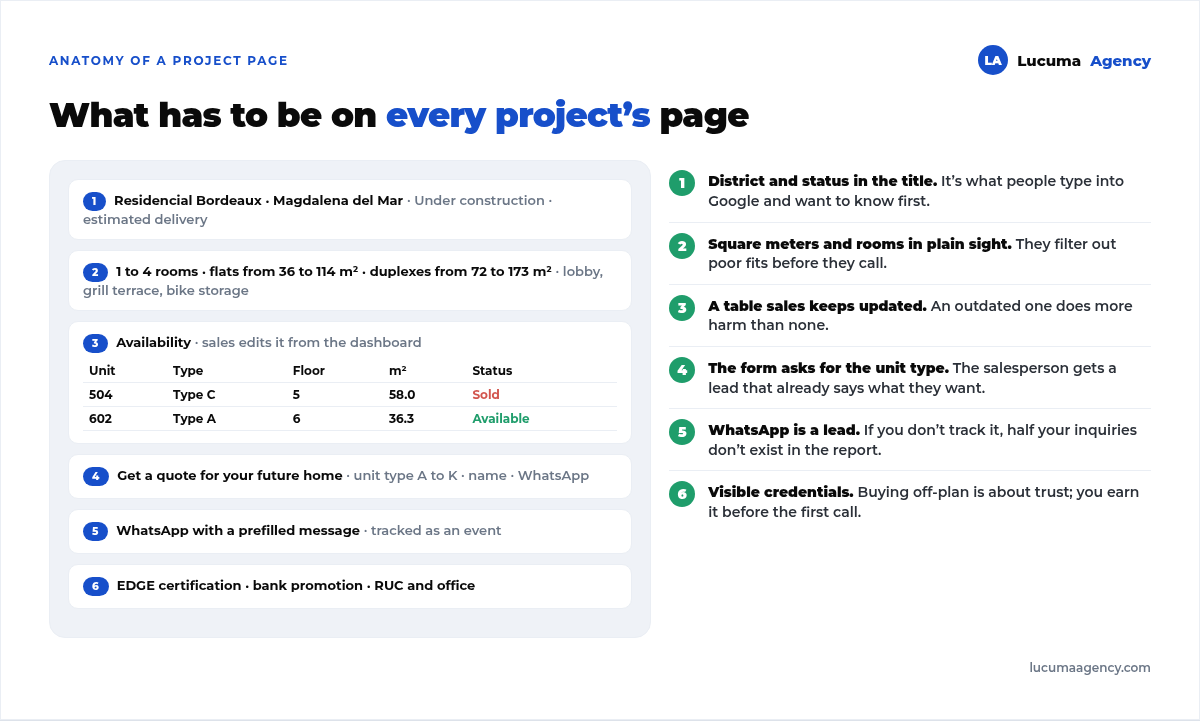
Presale buyers want to know what's left. The Bordeaux page shows the apartment table with unit type, floor, square meters and status: available or sold. So that the table doesn't depend on someone editing the website every time a unit sells, we built it with a custom plugin that the builder updates from its dashboard, without touching the design.
An outdated table does more harm than not having one: the client calls about an apartment that's already sold, the salesperson apologizes, and the first impression is gone. If your website can't be updated in two minutes by someone in sales, it doesn't have a table, it has an old brochure.
The quote form by unit type
The generic contact form (name, email and message) is a waste on a real estate website. On Bordeaux, the form asks which unit type they're interested in, from A to K, along with the contact details. That way the salesperson gets a lead that already says what it wants, and the builder knows which unit types draw the most interest before selling the first one. And if that lead flows straight into the CRM, the sales advisor has it within minutes: we explain it in how to integrate your website with a real estate CRM.
Next to the form, the WhatsApp button with a prefilled message. In Peru, half of real estate inquiries come through there, and they need to be tracked as what they are: a lead. We explain it in how to track your website's conversions.
What builds trust for someone buying off-plan
Buying in presale is an act of trust, and the website has to earn it before the first call:
- Construction status, visible and up to date: under construction, with an estimated delivery date.
- Delivered projects, with names and real photos. LuRoss shows Marseilla, Versailles, María Teresa and Leo. It's proof that they finish what they start.
- Certifications and backing: Bordeaux meets EDGE sustainable construction standards and has bank sponsorship. That belongs on the project page, not hidden in a PDF.
- Company details: legal name, RUC, office address and a phone number that someone answers. It sounds obvious, and yet in the Miraflores study we found 17 real estate companies with their website down and their Google Business Profile active.
The blog that answers the questions people ask before buying
Someone about to buy an off-plan apartment researches for months before writing to anyone: what EDGE certification is, whether buying in presale is safe, how a mortgage works, whether that district is a good investment. If those answers are on your website, they reach you before the competition. And the competition leaves a gap: of the 100 real estate companies in Miraflores we measured, 17 had their website down; we cover it in real estate SEO in Miraflores.
For LuRoss we wrote four guides with that logic: buying off-plan with its pros and risks, what EDGE certification is, mortgages in Peru step by step, and investing in Lima real estate by district. Each one links to the project when relevant, and none talks about the project before answering the question. For the ranking side, local SEO by city and district explains why the district has to be in the titles.
The technical side you don't see that decides whether you rank
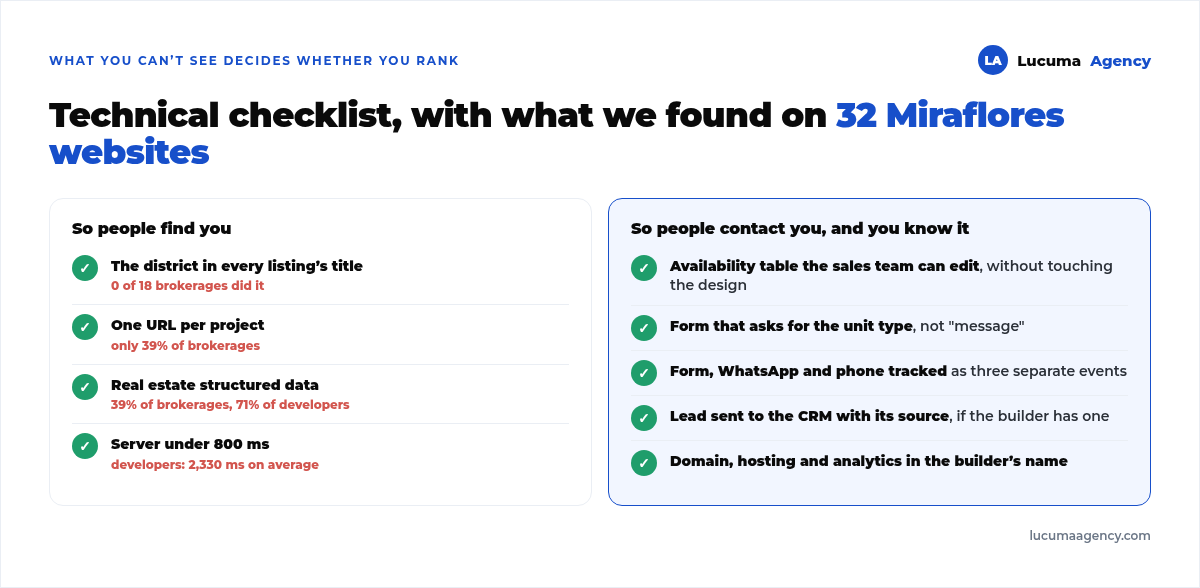
- The district in the title of every project page. Zero of the 18 Miraflores brokerages we measured did this.
- Structured data so Google understands it's a property and can show price, photos and rating.
- Speed: the server responding in under 800 milliseconds. Miraflores developers averaged 2,330, because of shared hosting with no caching.
- Tracking of all three contact paths: form, WhatsApp and phone, as separate events.
- CRM integration if the builder has one, so the lead comes in with its source recorded. We have a dedicated service for website integration with Sperant and other CRMs.
Frequently asked questions
How much does a builder's website cost?
It depends on how many projects there are and whether it includes an editable availability table and a quote form. A website with project pages, a blog and tracking starts at S/ 1,000 in our pricing and goes up with integrations. The ranges are in how much a real estate company website costs in Peru.
Do I need a landing page per project, or is a page within the website enough?
A page within the website, with its own URL, works for ranking and for the campaign at the same time. A separate landing page only makes sense if you're going to advertise heavily and want to measure it separately, with no menu or distractions.
Who updates the availability table?
Someone in sales should be able to do it from the WordPress dashboard, without touching the design. If every change means calling the agency, the table will be out of date within a month.
Should I put prices on the website?
At least the “from” price. Hiding all pricing saves you inquiries from the merely curious, but it also scares off serious buyers who don't want to call just to find out whether they can afford it.
Does the website replace real estate portals?
No, it complements them. The portal brings volume; your website is where the client verifies that you exist, sees your delivered projects and writes to you without intermediaries. And a lead that comes through your website doesn't cost you a commission.
Conclusion
A builder's website sells trust before it sells apartments: a page per project that ranks for its name and district, an availability table that sales can update, a quote form that asks for the unit type, delivered projects in plain view and a blog that answers what people search for in the months before buying. That's how the LuRoss website is built, and that's how we measure the ones that work.
A presale website performs when it comes with lead generation: how we approach it at each stage of the project is in real estate marketing in Lima. And the reasoning behind the platform, in why we build websites on WordPress.
At Lucuma Agency we do web design for real estate developers and builders with a page per project, a quote form and tracking. If you have a project in presale and a website that isn't selling it, book a free consultation.
Other posts you might like
At almost every real estate developer we work with, the lead takes the same absurd trip: it comes in through the form...
Switching servers is scary for a sensible reason: you rarely do it, and when it goes wrong, it goes wrong in public....
The question always comes the same way: “which payment gateway do you recommend?” And the useful answer doesn't start with a name, because the...
There's a moment, in quite a few projects, when the search for the right plugin becomes the problem. You tried three,...
Almost every online complaints book we audit complies on the outside and fails on the inside. They have the notice,...
The message came in like this: “the complaints book is throwing an error.” The Proba Inmobiliaria website, a page required by law,...
“Top 50 plugins” lists don't help you decide. They help you install fifty plugins. This is ours,...
Almost every business we ask has backups. Almost none has ever restored one. Those two sentences together are...
Almost every hosting conversation starts with price and ends up in the wrong place. The useful question is...
When a business wants to sell outside its country, the conversation almost always starts off wrong: with translation. And the...
Structured data is the piece of code that explains to Google, in a language that leaves no room for interpretation,...
The question comes up in almost every meeting: “if I use AI to write, will Google penalize me?” The short answer...