Real estate SEO: what we learned measuring 100 Google listings in Miraflores
In September 2026 we ran our own study: we took a hundred Google Business Profile listings of real estate companies in Miraflores and measured their digital presence with public data, one by one. It wasn't an academic exercise. We wanted to know, with numbers instead of gut feeling, who a Lima real estate company really competes against when it decides to invest in SEO. The results explain why this industry is one of the clearest opportunities we've seen, and also why so many real estate campaigns underperform.
The first filter already tells the story
Of the hundred listings, fewer than half had a working website of their own.
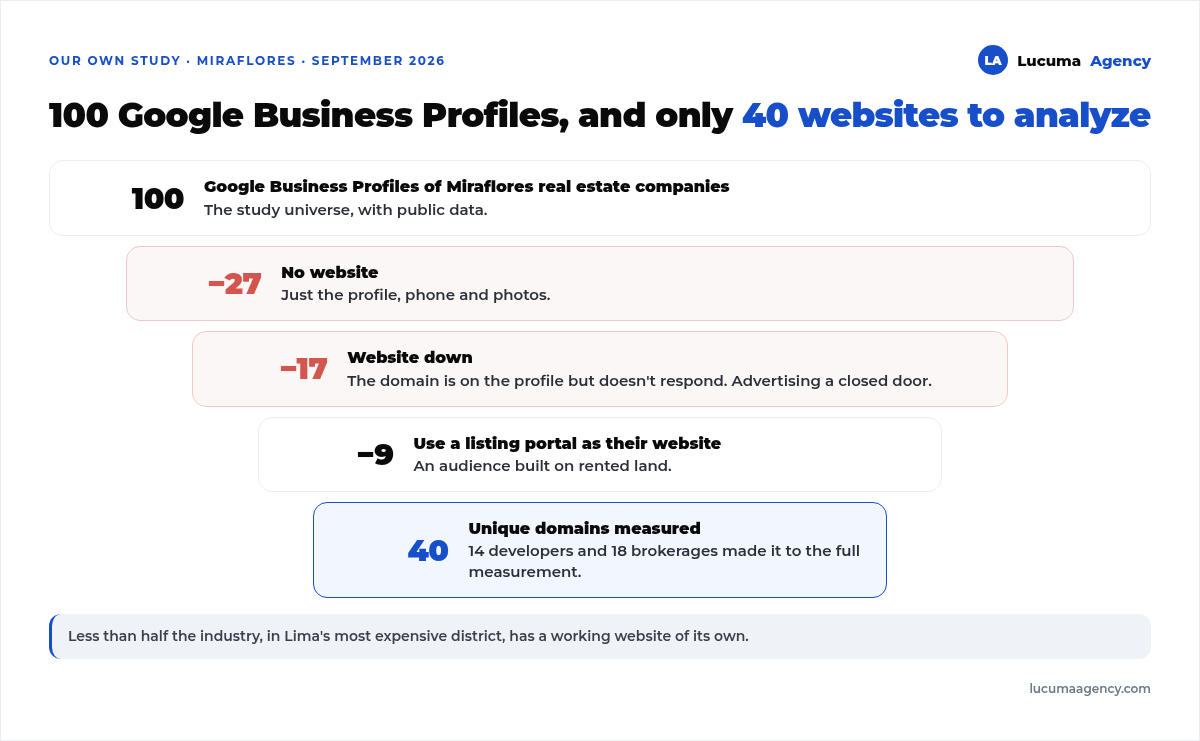
27 had no website. Just a Google listing, a phone number and photos. 17 had their website down: the domain was on the listing but didn't load, or loaded with an error. These are companies spending on advertising to send people to a locked door, and they probably don't know it because nobody checks. Another 9 used a real estate portal as if it were their website, in other words, building an audience on rented land.
That left 40 truly unique domains. We ran the full measurement on those.
Two different businesses within the same industry
When we sorted them, something we didn't expect showed up: developers and brokerages behave like two different industries. A developer builds and sells its own projects; a brokerage handles third-party properties.
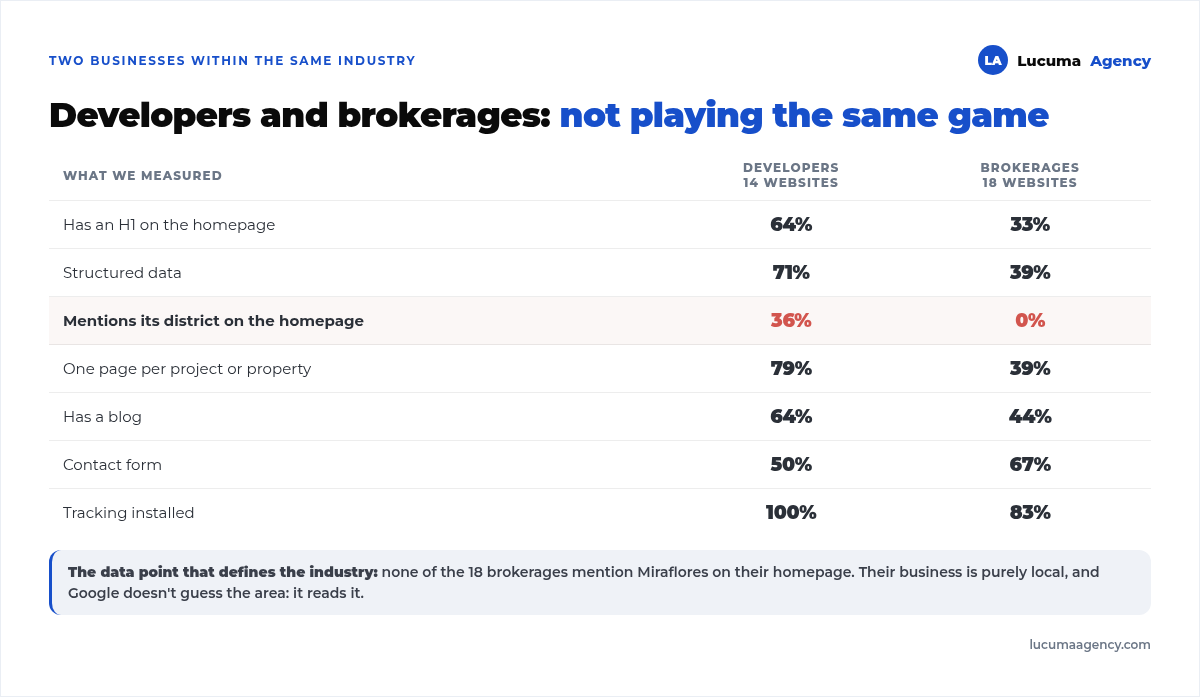
Developers come out ahead on almost everything Google reads: 64% have an H1 versus 33%, 71% have structured data versus 39%, 79% have a page per project versus 39%. It makes sense: their website is the catalog that drives the sale.
But there's one indicator where developers win by default and still score poorly, and it's the one that surprised us most.
The 0% that defines the industry
36% of developers mention their district on the homepage. Among brokerages, 0% do. Not one of the eighteen.
These are companies whose entire business is local, that depend on someone searching “departamentos en Miraflores” (apartments in Miraflores) or “corredor inmobiliario en Miraflores” (real estate broker in Miraflores), and whose homepage doesn't mention the district even once. Google doesn't guess where a business operates: it reads it. That one fix, writing where you operate in the title, the H1 and the text, is the cheapest, highest-impact change there is in real estate marketing in Lima.
Speed: the problem is where nobody looks
We measured the causes, not the score: how long the server takes to send its first response and how much the homepage weighs with all its resources.
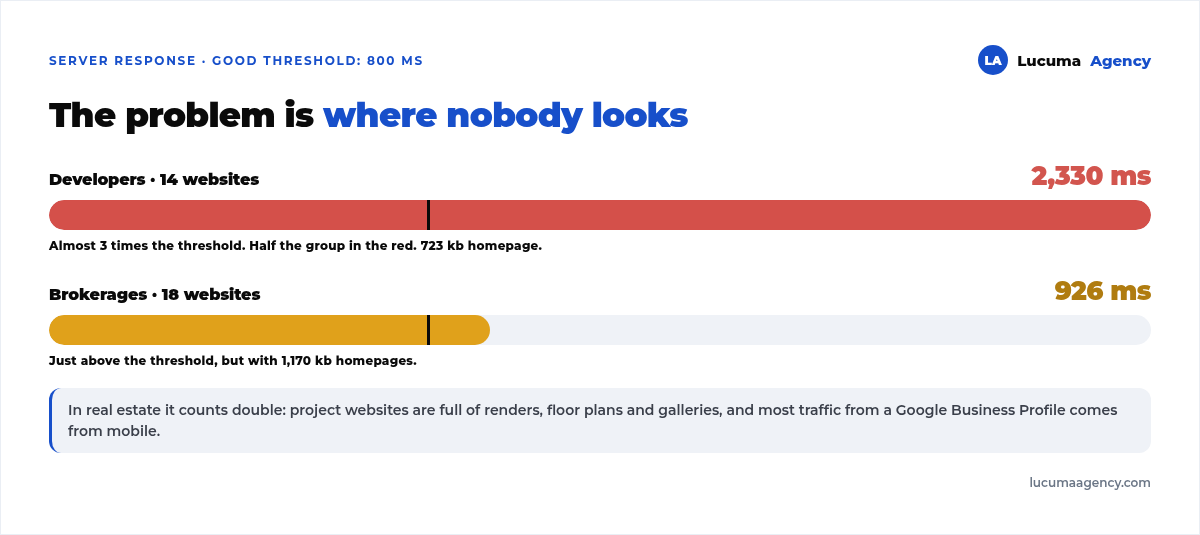
Developers averaged 2,330 milliseconds of server response time, almost three times the 800 threshold we use as good. Half the group came out in the red. Brokerages responded much better, 926 milliseconds, but with heavier pages.
This matters more in real estate than in other industries for a simple reason: project websites are full of renders, floor plans and galleries. It's the kind of website that gets slow without anyone making a bad decision, just through accumulation. And most of the traffic from a Google listing comes from mobile, which is where it hurts most.
What I would do if I ran a real estate company in Lima
With these numbers in hand, the order of work is pretty clear, and almost none of the first steps cost money:
- Open your website on your phone, right now. If it doesn't load, that's your number one problem, and the 17 cases in the study say it's not a far-fetched scenario.
- Write your district on your homepage. In the title, the H1 and the first paragraph. It's free, and in this industry almost nobody does it.
- One page per project, with its own address. Not a gallery that changes from the inside. Each project needs a URL that can rank and that you can use in campaigns. It's the foundation of a websites for real estate developers that sells.
- Measure your server response time. If it's over 800 milliseconds, you have plenty of room to improve without redesigning anything.
- Connect your form to your CRM. Ranking is pointless if the lead lands in an inbox nobody checks on weekends.
Frequently asked questions about real estate SEO
Does SEO work for a real estate developer, or is it better to stick to paid ads?
Both work, and they do different things. Paid ads bring leads while you pay for them; SEO builds an asset that keeps bringing them in when you cut your spend. In an industry where 27 out of 100 companies don't even have a website, the cost of getting into SEO is unusually low. We break down what it costs to get a lead with ads in Google Ads for real estate developers.
What keywords does a real estate company in Lima work on?
Three families: the project and its district, the property type with its area, and the questions buyers have before purchasing, which is where almost nobody writes. The first two compete against real estate portals; the third is practically wide open.
Do you need a blog?
In the sample, 64% of developers and 44% of brokerages had something resembling a blog, almost always abandoned. A blog that isn't updated doesn't help or hurt much. One that answers a buyer's real questions does change the picture, because it's the only content where you aren't competing against the portals.
How long does it take to see results in this industry?
The same as in any other: impressions show up within weeks, clicks once you reach the top 10. The difference is that competitors here are so weak that the ramp-up is shorter. The full timelines are in how long it takes to rank a website on Google.
Is it worth having a website if I list on the portals?
Yes, for the same reason you don't build on someone else's land. The portal lends you an audience and charges you for it; the website is yours, builds authority and can be connected to your CRM. Ideally you use both instead of choosing.
Conclusion
Real estate SEO in Lima isn't hard: it's empty. When 27 out of every 100 companies in the city's most expensive district have no website, 17 have it down and not a single brokerage mentions its own district on the homepage, the job isn't beating a strong competitor. It's getting the basics right before everyone else, which is a much easier advantage to gain and a much harder one to lose.
The full study, with the ranking of the top companies in each group, is published on our website. And if you want to know where your company falls in those numbers, at Lucuma Agency we'll review it with you: book a free consultation 30-minute call.
Other posts you might like
At almost every real estate developer we work with, the lead takes the same absurd trip: it comes in through the form...
Switching servers is scary for a sensible reason: you rarely do it, and when it goes wrong, it goes wrong in public....
The question always comes the same way: “which payment gateway do you recommend?” And the useful answer doesn't start with a name, because the...
There's a moment, in quite a few projects, when the search for the right plugin becomes the problem. You tried three,...
Almost every online complaints book we audit complies on the outside and fails on the inside. They have the notice,...
The message came in like this: “the complaints book is throwing an error.” The Proba Inmobiliaria website, a page required by law,...
“Top 50 plugins” lists don't help you decide. They help you install fifty plugins. This is ours,...
Almost every business we ask has backups. Almost none has ever restored one. Those two sentences together are...
Almost every hosting conversation starts with price and ends up in the wrong place. The useful question is...
When a business wants to sell outside its country, the conversation almost always starts off wrong: with translation. And the...
Structured data is the piece of code that explains to Google, in a language that leaves no room for interpretation,...
The question comes up in almost every meeting: “if I use AI to write, will Google penalize me?” The short answer...