How long it takes to rank a website on Google
It's the question that makes or breaks any SEO conversation, and the honest answer is uncomfortable: between three and six months to see clear progress, and about a year for traffic to become predictable. Anyone who promises you thirty days isn't speeding up the process, they're describing a different one that doesn't exist.
The frustrating part isn't the timeline itself. It's that during the first months it looks like nothing is happening, when in fact something is, just in a metric almost nobody looks at. In this guide we explain what happens each month, how to tell you're on track before the clicks arrive, and what makes one project take twice as long as another.
If you're just getting started, begin with what SEO is and how it works. And if you've already decided to invest, see how we handle SEO in Lima.
The timeline, month by month
An SEO project doesn't move forward evenly: it moves in stages, and each one has its own signal.
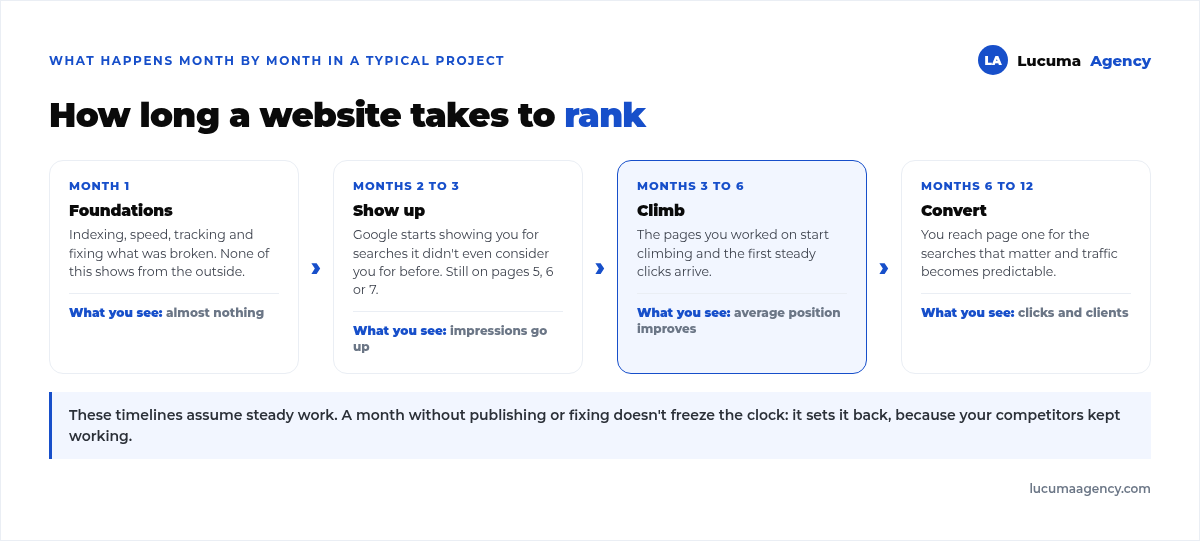
Month 1: the foundations
Almost all the work is invisible: making sure Google can crawl and index the website, fixing the speed, setting up tracking and repairing whatever was broken. It's the month that frustrates clients the most and the one that shapes everything else.
Months 2 to 3: you start to show up
Google starts showing you for searches where it didn't even consider you before. You're on page 5, 6 or 7, so nobody clicks through yet. But you went from not existing to existing, and that's measurable.
Months 3 to 6: you start to climb
The pages you've worked on move up in rankings and the first steady clicks arrive. This is where the project stops being an act of faith.
Months 6 to 12: you start to convert
You reach the first page for the searches that really matter and traffic becomes predictable. From here on, SEO behaves like an asset: it keeps paying off even if you slow down. What work fits into each of those months depends on the plan; we break it down in how much SEO costs in Lima.
Why it looks like nothing is happening
Here's the key almost nobody explains, and the reason so many businesses cancel SEO right before it starts working. The three metrics don't move at the same time: they move in order.
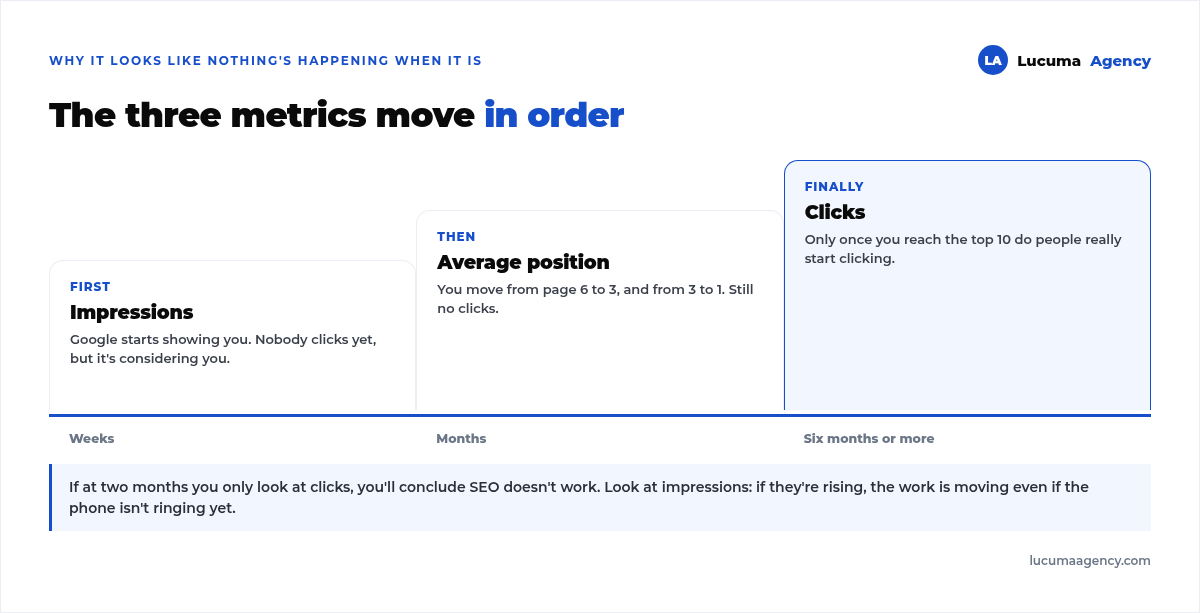
First come the impressions: Google shows you, even if nobody clicks through. Next, you improve your average position: you go from page 6 to page 3, and from 3 to 1. And only at the end come the clicks, because people click within the top 10 and almost never below it.
The practical consequence is simple: if you look only at clicks after two months, you'll conclude that SEO doesn't work. Look at impressions in Search Console. If they're rising, the work is moving forward even if the phone is still silent. Looking at the metric that fits each stage, instead of always looking at the last one, is part of working with a method: we apply it to the whole funnel in our growth marketing guide.
What speeds up and what slows down the clock
Two businesses with the same budget can take twice as long as each other. This is what makes the difference:
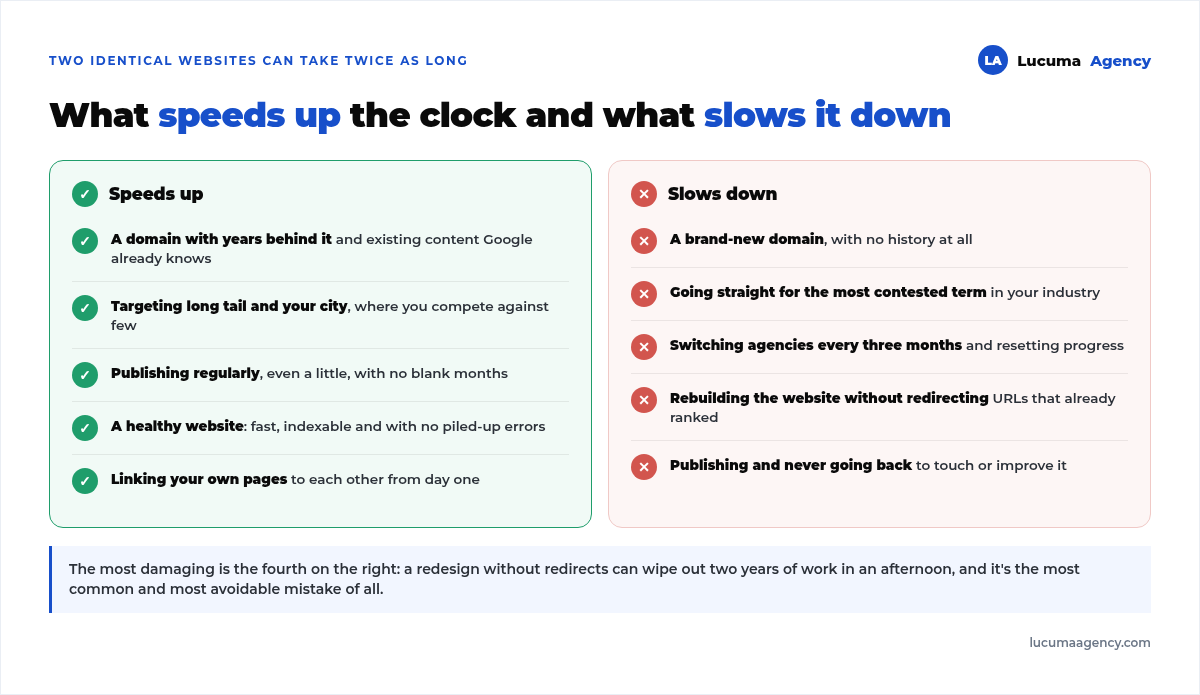
Of all of them, the most damaging is rebuilding the website without redirecting the old URLs. It can wipe out two years of work in a single afternoon, and it's completely avoidable: we explain it step by step in how to migrate your website without losing rankings.
And the most underestimated one is switching agencies every three months. Every switch resets progress: the new agency spends its first month figuring out what the previous one did, and nobody ever reaches the point where results show up. The opposite extreme exists too: a site that published 1,486 articles in eight months and never got past position 42; we tell that story in how we relaunched a media site with zero traffic.
What you can genuinely speed up
It's not all waiting. There are three decisions that shorten the timeline honestly:
Go after the long tail and your city first. “Gasfitero en Surco” (plumber in Surco) can be won in weeks; “gasfitero” competes against the whole country. That's why Local SEO is the shortest path there is to your first clicks.
Work on your Google profile in parallel. The Business Profile can give you visibility on the map within weeks, long before your website climbs. It's what keeps the business going while SEO matures.
Improve what's already in positions 8 to 20. These pages are one push away from the first page. Optimizing them pays off faster than writing new content from scratch, and you'll find how in On-page SEO.
Frequently asked questions
How long does a new website take compared to an existing one?
A website with years behind it and existing content can see movement in two or three months. A freshly bought domain usually needs six to twelve, because it starts with no history at all. Something similar happens when you enter another market and another language: in international SEO from Peru we share which language responded and which didn't.
Can I pay to go faster?
A bigger budget buys more work in parallel, and that shortens timelines. What it can't buy is skipping stages: even if you publish forty articles in the first month, Google needs time to evaluate them.
After how many months should I cancel if I see nothing?
Don't judge before month six. But do demand signals from month two: if impressions don't move at all, something is wrong and it needs to be checked, not waited out.
What happens if I stop doing SEO?
It doesn't collapse overnight. What you've gained holds for a while and then erodes, because your competitors keep publishing and Google favors what stays up to date.
What if I need clients right now?
Then you need Google Ads while SEO matures. They don't compete: ads bring you clients from day one, and SEO brings them without paying for every click. The sensible move is to start with both and scale back ad spend as organic traffic holds up.
Conclusion
Ranking a website takes three to six months to see clear progress and about a year for traffic to become predictable. The timeline isn't negotiable, but you can read it well: look at impressions before clicks and you'll know you're on the right track long before your first client arrives. How to read them, with our own numbers, is in how to measure SEO in Search Console without losing your mind.
And if you need results sooner, the answer isn't rushing SEO: it's keeping the business going with ads and your Google profile while organic does its job.
In Lucuma Agency we handle the SEO with honest timelines and reports that show all three metrics, not just the flattering one. Want to know where your website stands today? Book your free consultation.
Other posts you might like
At almost every real estate developer we work with, the lead takes the same absurd trip: it comes in through the form...
Switching servers is scary for a sensible reason: you rarely do it, and when it goes wrong, it goes wrong in public....
The question always comes the same way: “which payment gateway do you recommend?” And the useful answer doesn't start with a name, because the...
There's a moment, in quite a few projects, when the search for the right plugin becomes the problem. You tried three,...
Almost every online complaints book we audit complies on the outside and fails on the inside. They have the notice,...
The message came in like this: “the complaints book is throwing an error.” The Proba Inmobiliaria website, a page required by law,...
“Top 50 plugins” lists don't help you decide. They help you install fifty plugins. This is ours,...
Almost every business we ask has backups. Almost none has ever restored one. Those two sentences together are...
Almost every hosting conversation starts with price and ends up in the wrong place. The useful question is...
When a business wants to sell outside its country, the conversation almost always starts off wrong: with translation. And the...
Structured data is the piece of code that explains to Google, in a language that leaves no room for interpretation,...
The question comes up in almost every meeting: “if I use AI to write, will Google penalize me?” The short answer...