International SEO: how we rank a business in another country from Peru
When a business wants to sell outside its country, the conversation almost always starts off on the wrong foot: with translation. And translation is the last decision, not the first. From Peru, we run SEO for a client that operates in Spain, and the question we had to answer before writing a single line was a different one: what language do the people who buy from them search in? The answer wasn't the obvious one, and the numbers made it clear.
The first decision isn't your client's language: it's their customer's
The business is in Spain, so the intuitive move was to work in Spanish. We looked at the data and it turned out the other way around: their real audience is foreign visitors, and the language they search in is English. Today the English homepage brings in 702 of the roughly 930 clicks for the site, with an average position of 9.3. The Spanish version, in the language of the country where the business is physically located, gets 8 clicks with the homepage at position 37.9.
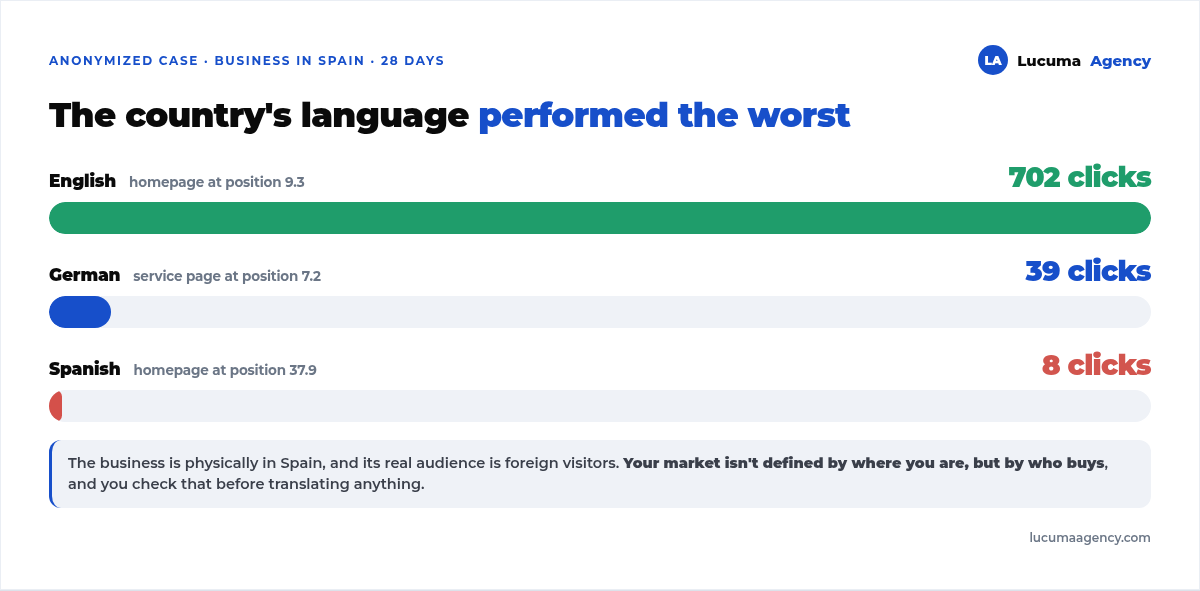
German, the language that got the least attention, punches above its weight: 39 clicks with a service page at position 7.2. In other words, the third language was bringing in five times more than the local one.
That's the lesson for any business that wants to sell abroad: your market isn't defined by where you are, but by who buys. And you find that out by looking at search volume by language and country before you invest, not after.
How to validate a foreign market before spending
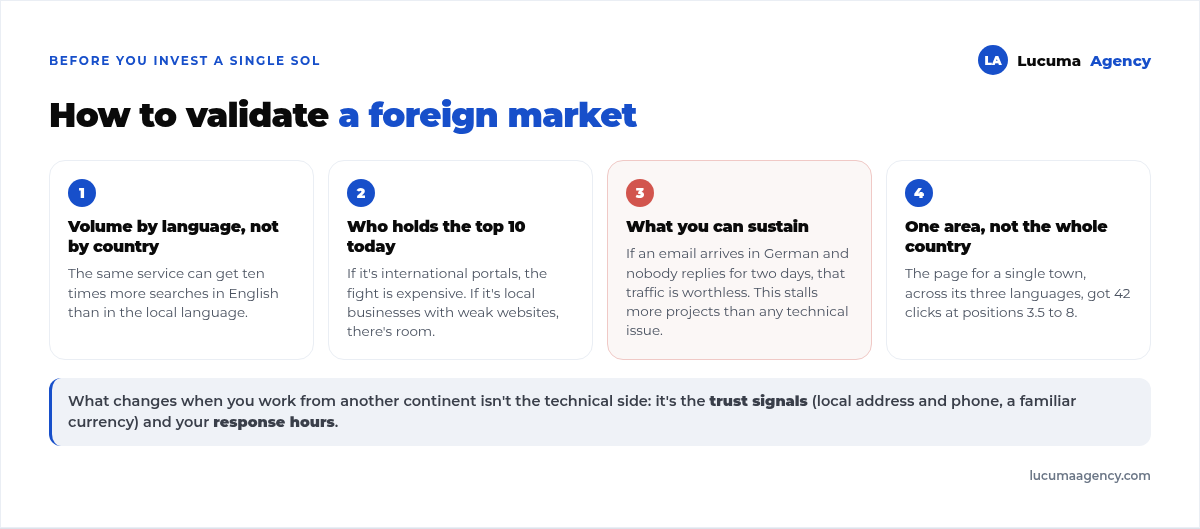
1. Measure volume by language, not by country. The same service can get ten times more searches in English than in the local language if the buyer is a foreigner.
2. Look at who holds the top 10 for those searches today. If it's international portals and aggregators, the fight is expensive. If it's local businesses with weak websites, there's room.
3. Check what you can sustain. Ranking in a language means responding in that language. If an email arrives in German and nobody can answer it within two days, that traffic is worthless. This stalls more international projects than any technical issue.
4. Start with one area, not the whole country. In this case, what worked best was the page-per-area model: the page for one specific town, adding up its three languages, got 42 clicks at positions from 3.5 to 8. It's the same logic we explain in Local SEO and city-based rankings, applied to another country.
What changes when you work from another continent
The technical side is the same in any language. What changes is everything else, and that's where time gets lost if you don't plan for it:
- You don't know the market from the inside. You don't know which words people actually use, or which competitor carries prestige. You make up for it by reading the real searches in Search Console, not by guessing.
- The trust signals are different. A local address, a phone number from that country, a currency and payment methods the visitor recognizes. Without them, you can rank and still not convert.
- Time zones work against you. With a six- or seven-hour difference, an inquiry sent on a European morning gets answered in the early hours in Peru. You have to decide in advance who replies and when.
- Machine translation isn't free. Translating is cheap; reviewing the translation isn't. Our case has exactly that open wound: the least-reviewed language is the one that performs worst.
The mistake we made, and what we'd do the other way around
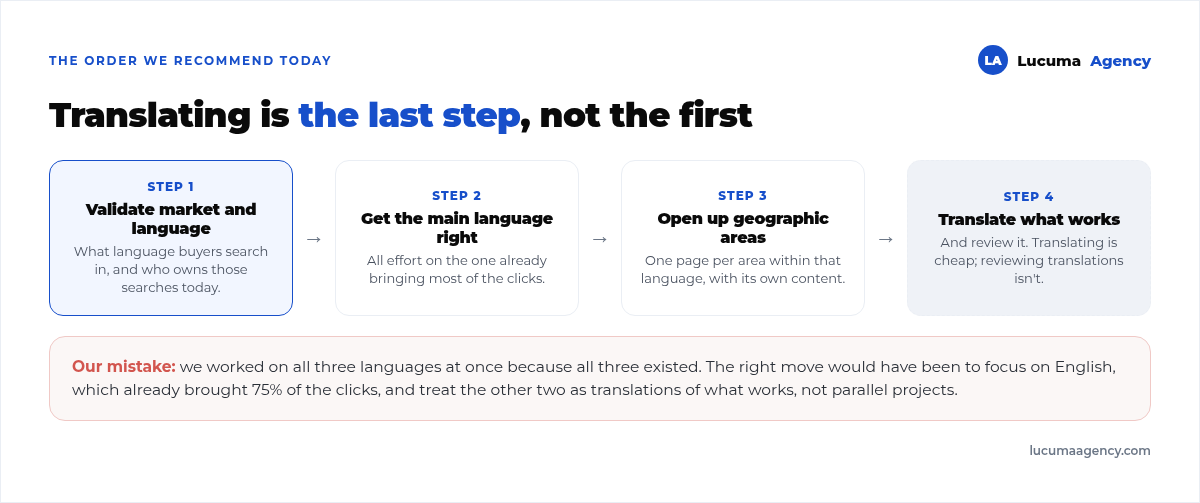
We started out serving all three languages at once because all three existed. Looking at the results, the right call would have been to focus all our effort on English, which was already bringing in 75% of the clicks, and treat Spanish and German as translations of what works, not as parallel projects.
The order we recommend today is: validate the market and language, build out the main language properly, open geographic areas within that language, and only then translate. The technical side of that last step, which has plenty of nuance in WordPress, is covered in Multilingual SEO in WordPress.
FAQ about international SEO
Is it better to have one domain per country or a single domain with languages?
For most businesses, a single domain with a folder per language. A domain per country multiplies the work and splits authority across several sites that all start from zero. It only makes sense when the operations are independent too.
Can you rank in another country without an office there?
Yes for general search, with caveats for local searches: the map results pack does require a verifiable presence in the area. If your business depends on the map, you need a real address there.
What language do I write in if my audience is mixed?
In the language with the most search volume and the one you can best respond in, and then you translate. Doing two languages halfway performs worse than doing one well, and our own case proves it.
How long does it take to rank in a new market?
The same as in your own, with one difference: you start with no brand signals at all in that country, so the first rankings come sooner for very specific searches, like one area or one particular service. General timelines are covered in how long it takes to rank a website on Google.
Is SEO worth it for a Peruvian company that wants to sell abroad?
It depends on the ticket size and your capacity to serve. For high-ticket services, yes. For low volume and thin margins, the effort rarely pays off compared with working the local market well.
Conclusion
International SEO is decided before you translate: what language your buyers search in, who holds those searches today, and what you can sustain operationally. In our case, the language of the country where the business is located turned out to be the one that performs worst, and the third language in importance brought in five times more. Neither of those things would have come to light by translating first.
In Lucuma Agency, digital marketing agency in Lima, we run SEO projects in Peru and abroad, and the first session is always this conversation. If you're thinking about selling abroad, book a free consultation and we'll look at search volume by language together, in 30 minutes.
Other posts you might like
At almost every real estate developer we work with, the lead takes the same absurd trip: it comes in through the form...
Switching servers is scary for a sensible reason: you rarely do it, and when it goes wrong, it goes wrong in public....
The question always comes the same way: “which payment gateway do you recommend?” And the useful answer doesn't start with a name, because the...
There's a moment, in quite a few projects, when the search for the right plugin becomes the problem. You tried three,...
Almost every online complaints book we audit complies on the outside and fails on the inside. They have the notice,...
The message came in like this: “the complaints book is throwing an error.” The Proba Inmobiliaria website, a page required by law,...
“Top 50 plugins” lists don't help you decide. They help you install fifty plugins. This is ours,...
Almost every business we ask has backups. Almost none has ever restored one. Those two sentences together are...
Almost every hosting conversation starts with price and ends up in the wrong place. The useful question is...
When a business wants to sell outside its country, the conversation almost always starts off wrong: with translation. And the...
Structured data is the piece of code that explains to Google, in a language that leaves no room for interpretation,...
The question comes up in almost every meeting: “if I use AI to write, will Google penalize me?” The short answer...