Google Ads for real estate developers: how much a lead costs in Lima
The question we always get is “cuánto cuesta un lead” (how much does a lead cost). And the honest answer is uncomfortable: it depends so much on the district, the project's stage and how the campaign is set up that any standalone figure won't help you much. A lead for a pre-sale project in an emerging district and a lead for an apartment in San Isidro don't cost the same, and they aren't alike.
What you can do, and it's far more useful, is learn to calculate your own and know what's driving it up. That's what you'll find here.
Why Google Ads works well for real estate
Someone who types “departamentos en Magdalena” (apartments in Magdalena) into Google has already decided two things: that they want to buy, and where. You don't have to spark their interest, you just have to be there when they search. And when they land, they should find a project page that answers their questions: in what a construction company's website should have to sell in pre-sale you'll find the anatomy of that page. The same goes for organic traffic, which takes longer to arrive but isn't paid per click: how long it takes to rank a website on Google explains it with real timelines.
That's the difference from social media, where you interrupt someone who was looking at something else. Both work, but they play different roles: Google Ads captures demand that already exists, and Meta Ads creates demand where there isn't any yet.
How to calculate your cost per lead
The formula is simple:
Cost per lead = monthly spend ÷ leads generated
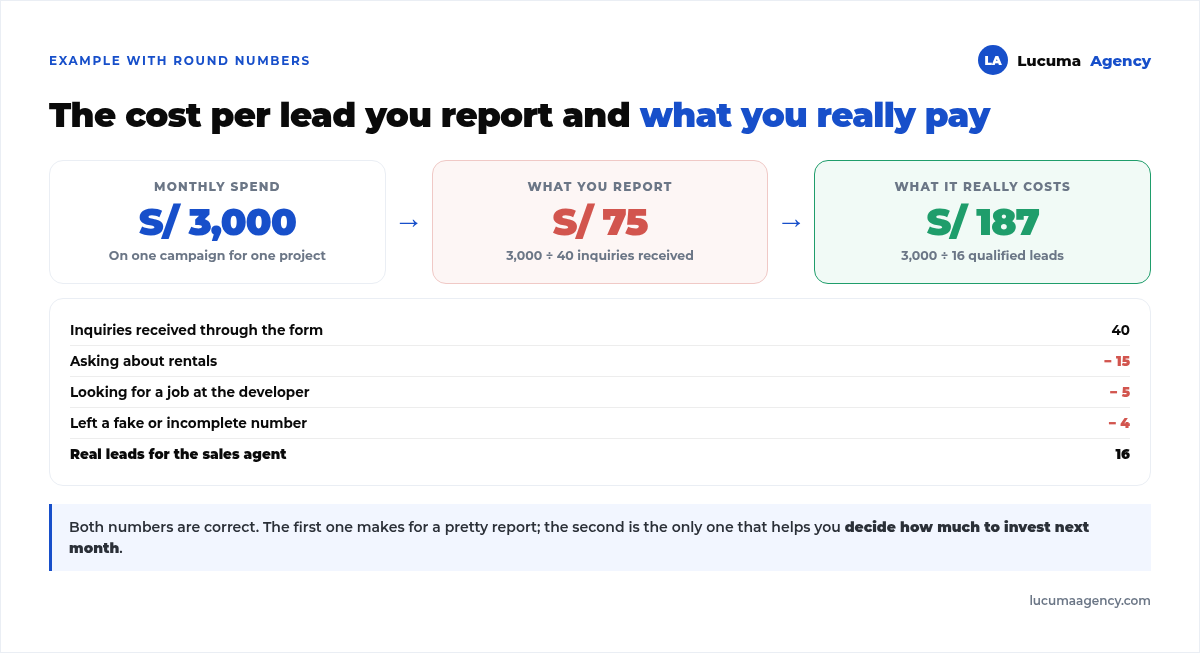
Say you invest S/ 3,000 in a month and your project's form gets 40 inquiries. Your cost per lead is S/ 75. Anyone can get that far.
The question almost nobody asks is this: of those 40, how many were real? If 15 were asking about rentals, 5 were looking for a job and 4 left a fake number, your useful leads were 16 and your real cost per lead is S/ 187, not S/ 75.
That second number is the only one that helps you decide.
What drives up your cost per lead without you noticing
- Poorly managed negative keywords. If you don't exclude “alquiler”, “alquilar”, “trabajo”, “empleo” and “planos gratis” (rent, renting, work, jobs, free floor plans), you're paying for clicks from people who were never going to buy.
- All your projects in one campaign. When you mix projects with different locations and prices, you can't tell which one performs or shift budget with any judgment.
- Ads without a price. Showing “desde S/ X” (from S/ X) filters out people who can't afford it. It sounds like losing clicks, but it actually saves money.
- Sending everyone to the homepage. If the ad is about one project and the person lands on the homepage, they have to go looking for it. Many won't.
- Slow responses. It doesn't raise the cost per click, but it does raise the cost per converted lead: the prospect contacts three projects and moves forward with whoever answers first.
The cheap lead that ends up costing you
It's tempting to optimize for a lower cost per lead. The problem is that lowering it is easy: just broaden your keywords and collect any inquiry that comes in.
You end up with a beautiful report and burned-out sales agents calling people who were looking to rent. That's why the metric worth watching isn't cost per lead, but cost per lead that requested a visit. It takes longer to get, and it's the only one that looks like a sale.
Track all the way to the CRM, not just to the form
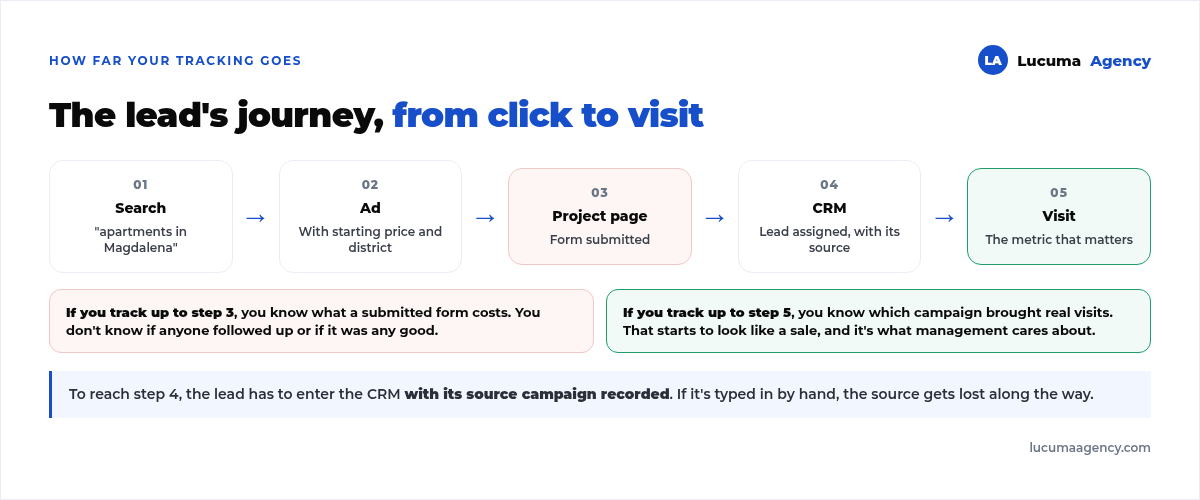
If your tracking stops when someone submits the form, you're only halfway there. What management needs to know is which campaign brought in the leads that turned into visits and reservations. For that, the lead has to enter the CRM with its source campaign; we cover it in integrating your website with a real estate CRM.
For that, the lead has to reach the CRM with its source recorded. We explain it in detail in web integration with your real estate CRM, and it's what lets you close the loop between what you spend and what you sell. The first stretch, from click to form, is set up with GTM and GA4: how to track your website's conversions walks through it with the five events you need to create.
How much budget you need to get started
Rather than a fixed figure, apply a rule of thumb: your monthly budget should be enough to get a number of leads large enough to learn something. With four or five inquiries a month, you can't tell whether the problem is the ad, the page or the price.
If your budget only stretches that far, it pays off more to focus it on a single project and a single area than to spread it across all of them. Better to learn well from one than to stay in the dark on five. And choose carefully where the click lands: in landing page or full website we explain why, in real estate, the project page beats a standalone landing page. And before paying for clicks, make sure the page they land on is up to the task: in how much a real estate company website costs in Peru we detail what it should include.
Frequently asked questions about Google Ads for real estate developers
How long until leads start coming in?
From the first week, because you're buying visibility. What takes one to three months is fine-tuning the keywords, the ads and the page so your cost per lead goes down and lead quality goes up.
Does it work for pre-sale or only for projects under construction?
For both, with a different message. In pre-sale you communicate the entry price and the expected appreciation; when construction is well advanced you communicate certainty and the delivery date.
Can I pause the campaign once everything is sold?
Yes, and it's best to work project by project precisely so you can turn campaigns on and off without affecting the rest. We cover it in Google Ads for real estate projects.
Am I competing against the real estate portals?
Partly, yes, and they usually have bigger budgets. That's why it rarely pays to fight over generic terms. Better ground is your project's name and searches by district and unit type. The same goes for organic, and it starts with your Google Business Profile: we saw it by measuring 100 Google Business Profiles of real estate developers in Miraflores.
Do I need my own website, or is a portal listing enough?
You need a page you can measure and change. If the ad sends people to a portal, the lead belongs to the portal and you control neither the message nor the data. We look at it in web design for real estate developers.
Conclusion
There's no benchmark cost per lead that will work for your project, because it depends on your area, your stage and your competition. What does exist is a right way to measure it: divide your spend by the leads that are qualified, not by everyone who came in, and follow the trail all the way to the CRM.
If you do that for three months, you'll have your own number, which is worth more than any market average.
In Lucuma Agency we'll handle campaigns for real estate projects with tracking connected to the CRM. Want to know what cost per lead is realistic in your area? Book your free consultation and we'll review it together.
Other posts you might like
At almost every real estate developer we work with, the lead takes the same absurd trip: it comes in through the form...
Switching servers is scary for a sensible reason: you rarely do it, and when it goes wrong, it goes wrong in public....
The question always comes the same way: “which payment gateway do you recommend?” And the useful answer doesn't start with a name, because the...
There's a moment, in quite a few projects, when the search for the right plugin becomes the problem. You tried three,...
Almost every online complaints book we audit complies on the outside and fails on the inside. They have the notice,...
The message came in like this: “the complaints book is throwing an error.” The Proba Inmobiliaria website, a page required by law,...
“Top 50 plugins” lists don't help you decide. They help you install fifty plugins. This is ours,...
Almost every business we ask has backups. Almost none has ever restored one. Those two sentences together are...
Almost every hosting conversation starts with price and ends up in the wrong place. The useful question is...
When a business wants to sell outside its country, the conversation almost always starts off wrong: with translation. And the...
Structured data is the piece of code that explains to Google, in a language that leaves no room for interpretation,...
The question comes up in almost every meeting: “if I use AI to write, will Google penalize me?” The short answer...