Single-service landing page: why it's sometimes better than a full website
“I want a website” is almost always how the conversation starts, and about one in three times what the person actually needs is something else: a single page, for a single service, with a single goal. It costs half as much, goes live in a week, and converts better for that specific case. But there are also businesses that ask for a landing page when what they're missing is a full website, and they end up with a pretty page that doesn't rank for anything. This article explains the difference with two of our own cases, when each one makes sense, and the mistake we see most often: a landing page that competes against the client's own website.
What each one is, without the marketing
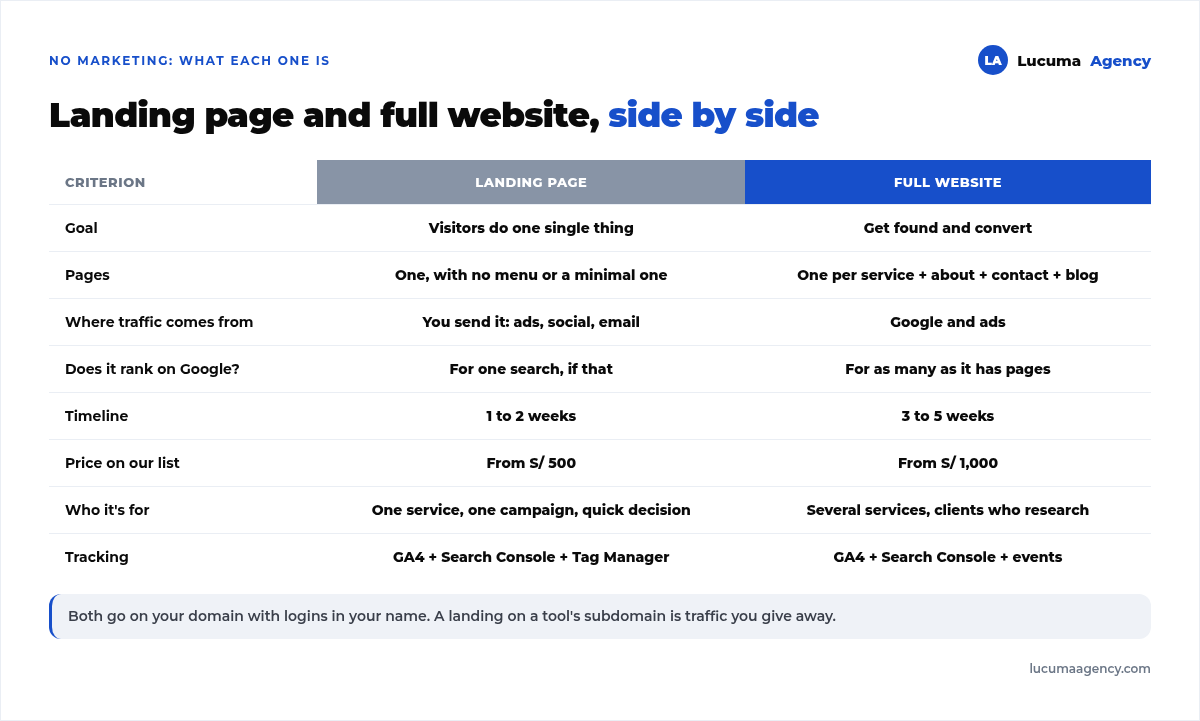
A landing page is a single page with a single goal: getting the visitor to do one thing, message you on WhatsApp, request a quote, book an appointment. It has no menu, or a minimal one, because every exit is a leak. It lives on traffic you send: a campaign, a link on social media, an email.
A full website is the home of the business: several pages, one per service, about us, contact, and usually a blog. Its goal is twofold: convert whoever arrives and, above all, get people to arrive on their own from Google, searching for what you do. It lives on SEO as much as on advertising.
Case 1: a solar installer that already had a website and needed a landing page
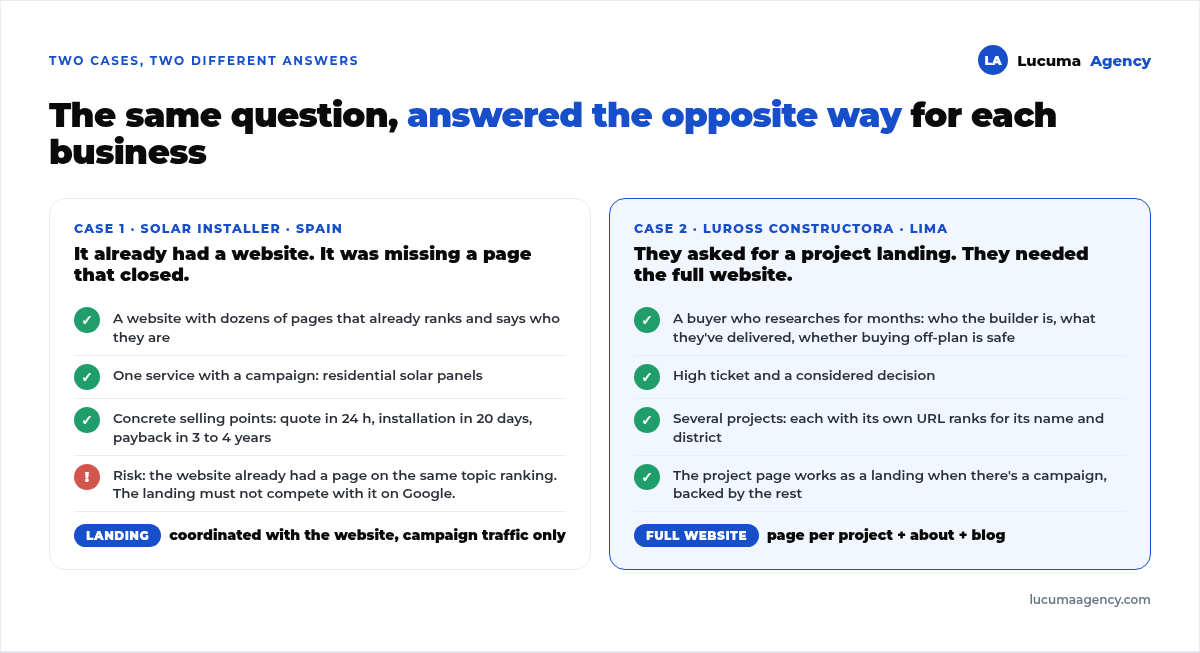
A solar panel installation company in Spain, with more than ten years in the market and a website with dozens of pages, wanted to generate more quote requests for residential solar panels. It already had the full website. What it lacked was a page designed purely to convert visitors coming from an ad or from a search with clear intent: a value proposition on the first screen, the numbers they use to sell (quote in 24 hours, installation in 20 days, payback in 3 to 4 years), social proof with their reviews, a short form, and nothing else.
That's where a landing page makes complete sense: the website already does the work of ranking and telling people who they are; the landing page does the work of closing. But the analysis also found the classic risk: the website already had a page about solar panels for homes that was ranking. A new landing page on the same topic, without coordination, would have competed against its own page on Google. The solution was to keep the landing page from being indexed for the same search and send it only campaign traffic, while the website's page kept ranking. It's the number one landing page mistake: building them as if the website didn't exist.
Case 2: a construction company that needed the full website, not a landing page per project
LuRoss Constructora, in Lima, is selling a pre-construction project in Magdalena del Mar. The temptation was to build a landing page for the project and call it done. The problem: someone buying an apartment off-plan doesn't decide based on one page. They look up who the builder is, what it has delivered before, whether buying pre-construction is safe, how the mortgage works. If the landing page doesn't answer that, the buyer goes looking elsewhere and doesn't come back.
That's why LuRoss has a full website: a page per project with its availability table and quote calculator, an about page with the projects delivered, and a blog that answers the questions buyers have in the months before purchasing. The project page works as a landing page when there's a campaign, but it's backed by everything else. We cover it in detail in what a construction company's website should have.
When a landing page makes sense
- You have a specific campaign, on Google Ads or Meta, and you need a page that converts that traffic without distractions.
- You sell a single service or product, or you want to test a new one before adding it to the website.
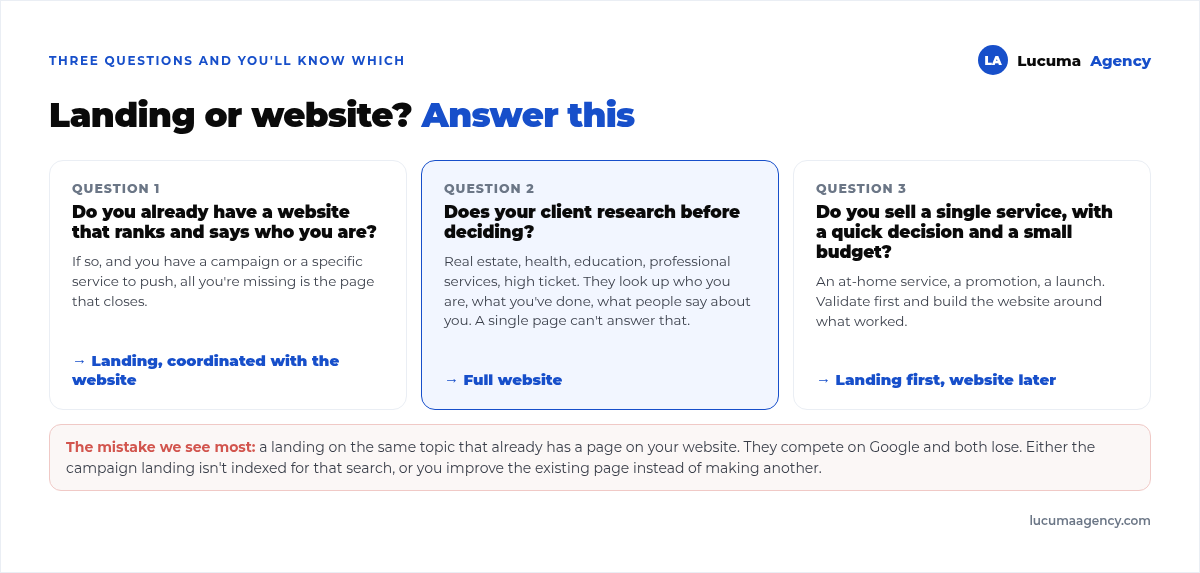
- You already have a website that ranks and tells people who you are; the landing page just has to close.
- Your customer decides quickly and with little information: an at-home service, a promotion, an event.
- You need to be online in one or two weeks on a small budget. On our price list, a landing page starts at S/ 500 and launches with GA4, Search Console, and Tag Manager tracking.
When you need the full website
- You want people to find you on Google without paying for every click. A single page competes for a single search; a website with one page per service competes for ten.
- Your customer researches before deciding: real estate, health, education, professional services, high-ticket projects.
- You sell several services and each one has its own audience.
- You need credibility: about us, case studies, team, blog. A landing page on its own, in front of a skeptical buyer, looks like what it is: a campaign page.
- You're going to advertise on several fronts and don't want a standalone landing page for each one. On our price list, a website starts at S/ 1,000 and scales with pages and features.
The three mistakes we see most
- The landing page that competes with the website. Same search, two pages on the same domain. Google picks one, almost never the one you wanted, and both lose. If the landing page is for a campaign, it shouldn't be indexed for the search your website already wins.
- The “landing page” with a full menu. If it has nine exit links, it isn't a landing page, it's a homepage without the rest of the website. It loses the best of a landing page without gaining what a website offers.
- The full website with empty pages. The flip side: paying for ten pages and filling three. A well-crafted landing page beats a website of half-written templates. How to tell where you stand is covered in what you need to know before getting a website.
What both absolutely must have
Tracking. A landing page without WhatsApp and form events can't tell you whether the campaign works, and a website without Search Console can't tell you which pages are pulling their weight. Both launch with GA4, Search Console and, when there's a campaign, Tag Manager. And both should have the accounts in your name and live on your domain; a landing page on a subdomain of whatever tool is trendy is traffic you're giving away. Prices and what each option includes are in how much a website costs in Peru.
Frequently asked questions
Can a landing page rank on Google?
It can rank for a very specific search if it has enough content, but that's not its job. It competes for a single intent; a website competes for as many as it has pages.
Can I start with a landing page and build the website later?
Yes, and it's a good path when the budget is tight: the landing page validates the service, and the website gets built around what worked. What matters is that the landing page lives on your domain, so you don't lose what you've gained.
How much does a landing page cost in Peru?
On our price list, from S/ 500 with tracking installed. It goes up with custom design, several social proof sections, or integrations.
Does the landing page go inside my website or separately?
Always on your domain, as a page with no menu. Separately only if there's a tracking or branding reason that justifies it, and even then on a subdomain you own.
What happens if I build a landing page for a service that already has a page on my website?
They compete with each other. Either the landing page isn't indexed and only gets campaign traffic, or you improve the existing page instead of building another one.
Conclusion
A landing page wins when there's a campaign, a single service, and a website behind it that already does the rest. A full website wins when the customer researches before deciding and you want to be found without paying for every click. The mistake isn't choosing one or the other, it's building a landing page as if the website didn't exist, or a website as if it were a landing page with nine empty pages.
The choice between the two usually comes with two more questions behind it: what you really need and what it's built with. We go over the first one with you in Lucuma Agency, digital marketing agency in Lima; the second is in why we build websites on WordPress.
At Lucuma Agency we do landing pages from S/ 500 and websites from S/ 1,000, both with tracking from day one. If you're not sure which one is right for you, book a free consultation and we'll tell you in 30 minutes, even if the answer is the cheapest one.
Other posts you might like
At almost every real estate developer we work with, the lead takes the same absurd trip: it comes in through the form...
Switching servers is scary for a sensible reason: you rarely do it, and when it goes wrong, it goes wrong in public....
The question always comes the same way: “which payment gateway do you recommend?” And the useful answer doesn't start with a name, because the...
There's a moment, in quite a few projects, when the search for the right plugin becomes the problem. You tried three,...
Almost every online complaints book we audit complies on the outside and fails on the inside. They have the notice,...
The message came in like this: “the complaints book is throwing an error.” The Proba Inmobiliaria website, a page required by law,...
“Top 50 plugins” lists don't help you decide. They help you install fifty plugins. This is ours,...
Almost every business we ask has backups. Almost none has ever restored one. Those two sentences together are...
Almost every hosting conversation starts with price and ends up in the wrong place. The useful question is...
When a business wants to sell outside its country, the conversation almost always starts off wrong: with translation. And the...
Structured data is the piece of code that explains to Google, in a language that leaves no room for interpretation,...
The question comes up in almost every meeting: “if I use AI to write, will Google penalize me?” The short answer...