What you need to know before getting a website: complete guide 2026
Asking for quotes for your first website is like asking for a construction estimate without knowing how many rooms you want. You get three numbers that look nothing alike, each one describes different things, and you have no way to compare them. So you choose by price, which is the worst possible criterion.
The problem is almost never that you don't know about technology. It's that there are six decisions that need to be made before the first meeting, and no vendor can make them for you. In this guide we go through them one by one, plus the questions you should ask before signing and the real reason web projects run late. And if for now you only sell through social media, there's a minimum page that's already worth having on your own domain: your own link in bio vs Linktree.
The six decisions that are yours
None of these is technical. They all depend on your business, and they all determine whether the quote you get matches what you need:
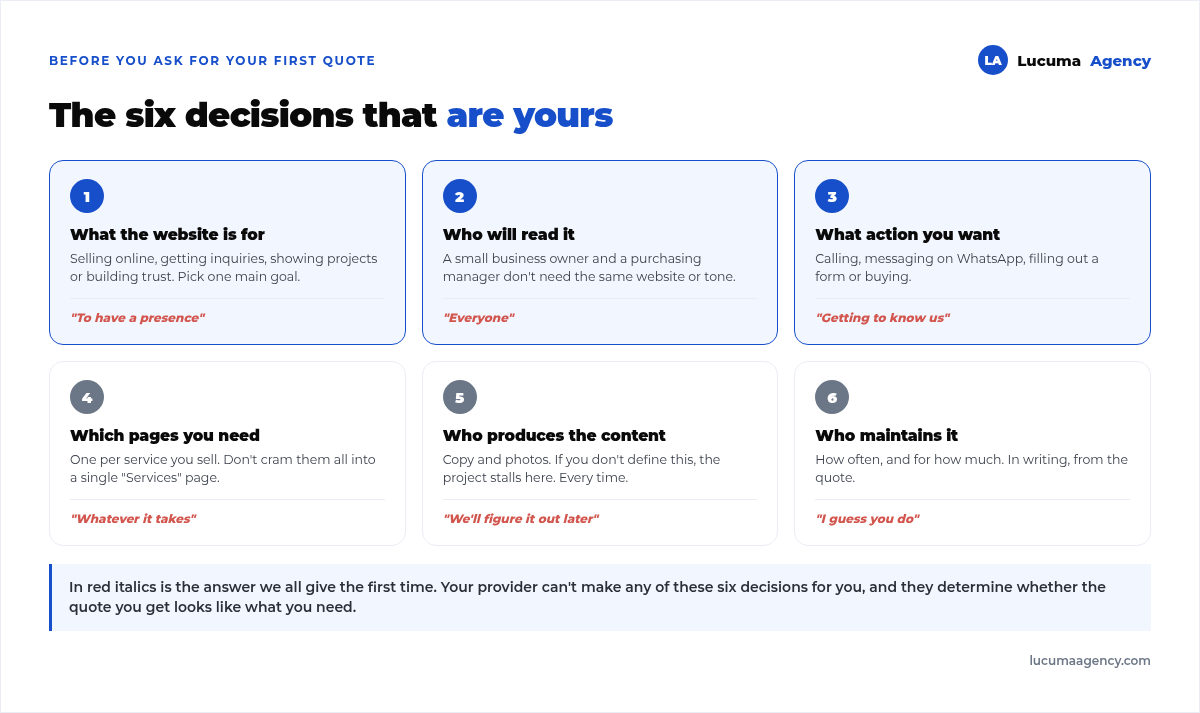
1. What the website is for
Selling online, getting inquiries, showcasing projects, or building trust with people who already know you. Choose one main goal. A website that tries to do all four at once does none of them well, and above all, it can't be measured.
2. Who's going to read it
A small business owner who buys quickly and a purchasing manager who needs formal quotes don't need the same website or the same tone. “Everyone” is not an audience.
3. What action you want them to take
Call, message you on WhatsApp, fill out a form, or buy. That action shapes the entire design of every page. If you don't choose it, the designer chooses it by default. And that same action is what you'll then need to track: how to track your website's conversions with GTM and GA4 explains how to know how many people complete it.
4. Which pages you need
One for each service you sell. And if what you sell is apartments, one for each project: we show it in a construction company's website for selling in pre-sale. If you sell real estate projects, the logic is the same: one page per project, as we explain in web design for real estate developers. The most common and most expensive mistake is cramming eight services onto a single “Services” page: Google doesn't know which one to rank it for and ends up ranking it for none, as we explain in On-page SEO.
5. Who produces the content
The copy and the photos. If you don't define it with a name and a date, the project stalls here. Every time.
6. Who maintains it
And how often, and for how much. A website without maintenance gets outdated, breaks, and in the worst case gets infected. Make sure it's in the proposal from the start, not a surprise the following year.
Why web projects run late
Here's the expectation that causes the most frustration. They tell you six weeks, you sign, and four months later the website still hasn't launched. It's almost never development's fault:
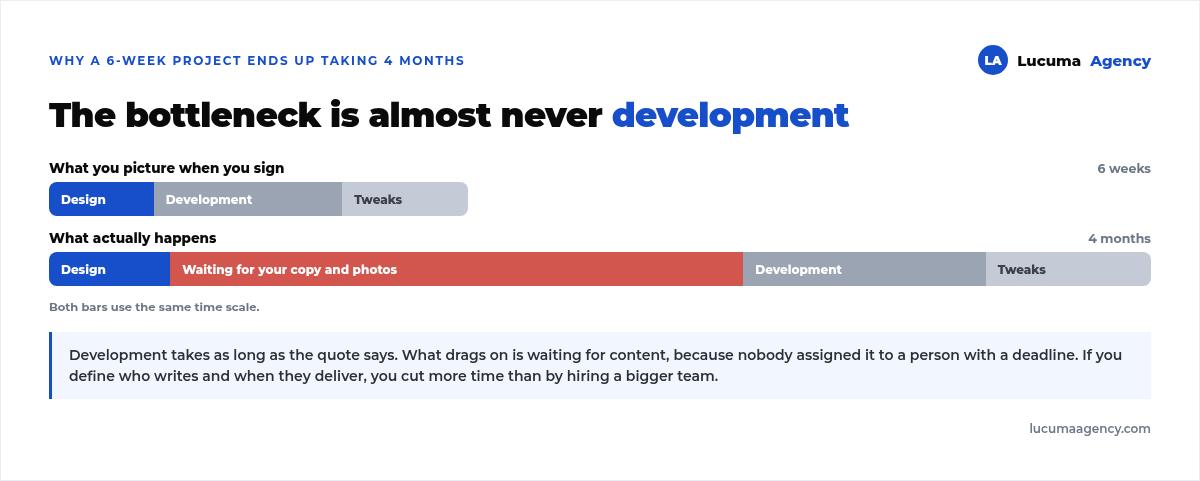
Development takes roughly what the quote says. What drags on is the wait for content, because nobody assigned it to a specific person with a specific date.
If you want to shorten your project's timeline, the lever isn't hiring a bigger team: it's having the copy and photos ready before you start, or paying someone to produce them.
How much it costs and what it depends on
Website prices in Peru span a very wide range, from a simple landing page to a system with integrations, and the difference is almost never in the design: it's in how many things the website has to build beyond just being displayed.
Before comparing numbers, check that all three quotes include the same things: how many pages, how many different templates, how many rounds of revisions, whether tracking is installed, and whether maintenance is included or not. A cheaper proposal is often just a shorter proposal.
And don't forget the recurring costs: hosting and domain are paid every year, no matter who pays them.
Seven questions before you sign
None of these is technical, all of them can be answered on a call, and they're the ones that prevent year-two problems:
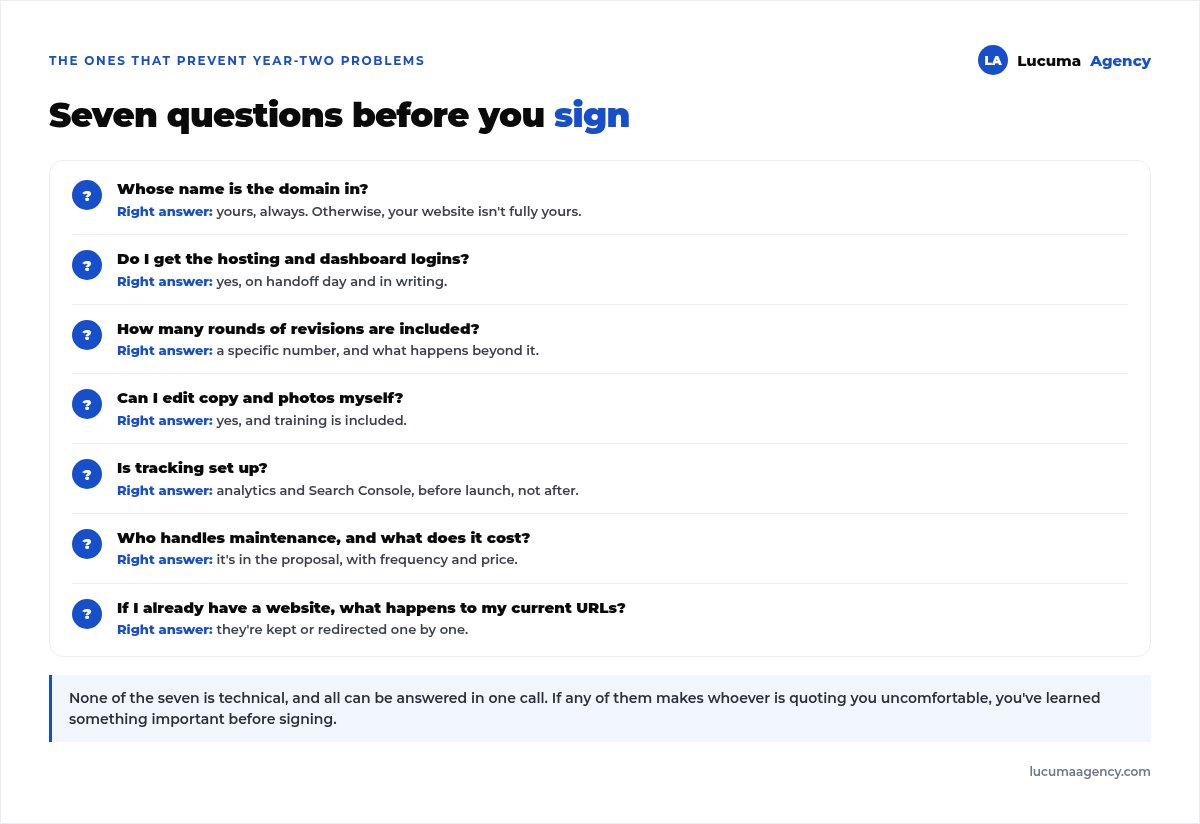
The first one is the most important of all. The domain has to be in your name, not in the name of whoever builds your website. Otherwise, the day you want to switch vendors, an awkward negotiation begins over something you already paid for.
And the last one only applies if you already have a website: switching sites without keeping or redirecting the old URLs wipes out the rankings you already had, and it's one of the most frequent and most avoidable kinds of damage. We explain it in how to migrate your website without losing rankings.
What to expect, and not expect, from your new website
It won't show up on Google by itself. A well-built website launches with the foundations in place, but ranking is separate, ongoing work. You'll find it in what SEO is.
It won't sell on its own in the first month. It needs traffic, and traffic comes from SEO, advertising, or your own communication.
It should make you self-sufficient. Changing a price, uploading a photo, or publishing an article shouldn't require calling anyone.
It should be able to grow. You should be able to add a store or a blog two years from now without rebuilding it, which is one of the reasons we work with WordPress.
Frequently asked questions
Do I need the content ready before we start?
Not all of it, but you do need to know who's going to write it and by when. That's the difference between six weeks and four months.
Can I start small and expand later?
Yes, and it's usually the smartest move. A small, well-built website that grows beats a big one that's half done. What matters is that the foundation lets it grow without a rebuild.
What if I don't like the result?
That's why rounds of revisions are agreed in writing and the design is reviewed before development. Fixing a mockup costs little; fixing a website that's already built costs a lot.
Should I use a purchased template?
It's cheaper up front and comes with hundreds of features you don't use that still load on every visit, which affects speed. It works for validating an idea; for a business that's serious, it shows.
When should I start thinking about SEO?
Before building, not after. The same goes for the paperwork you sign: in what to ask for in a website quote you'll find the nine lines it should include. The page structure you decide on in point 4 is already an SEO decision, even if it doesn't look like one. And if your business serves clients in several countries, decide the original language from the start: in Multilingual WordPress that shapes everything else. And if you already have a website and this will be your second, first read how redesigning your website without losing rankings.
Conclusion
Getting a website doesn't start with asking for quotes: it starts with making six decisions only you can make. With those clear, the proposals you receive will be comparable, and you'll be able to choose on judgment, not on price.
And of everything you're going to sign, keep two things in mind: that the domain is in your name and that you know who produces the content. Those two explain most of the problems we see in web projects that went wrong.
In Lucuma Agency we start with these questions before quoting anything, and we build web development with tracking and maintenance on the table. Thinking about your website? Book your free consultation and we'll organize the project with you.
Other posts you might like
At almost every real estate developer we work with, the lead takes the same absurd trip: it comes in through the form...
Switching servers is scary for a sensible reason: you rarely do it, and when it goes wrong, it goes wrong in public....
The question always comes the same way: “which payment gateway do you recommend?” And the useful answer doesn't start with a name, because the...
There's a moment, in quite a few projects, when the search for the right plugin becomes the problem. You tried three,...
Almost every online complaints book we audit complies on the outside and fails on the inside. They have the notice,...
The message came in like this: “the complaints book is throwing an error.” The Proba Inmobiliaria website, a page required by law,...
“Top 50 plugins” lists don't help you decide. They help you install fifty plugins. This is ours,...
Almost every business we ask has backups. Almost none has ever restored one. Those two sentences together are...
Almost every hosting conversation starts with price and ends up in the wrong place. The useful question is...
When a business wants to sell outside its country, the conversation almost always starts off wrong: with translation. And the...
Structured data is the piece of code that explains to Google, in a language that leaves no room for interpretation,...
The question comes up in almost every meeting: “if I use AI to write, will Google penalize me?” The short answer...