How much a real estate developer's website costs in Peru
A real estate developer with three projects in Lima reached out to us with three quotes on the table: S/ 1,200, S/ 8,000 and S/ 24,000. The question was the usual one: which is the fair price. The three described different things. The first was a showcase website with a form. The second had a page per project and a panel to load them. The third added a search by unit type and a custom quote calculator.
The price of a real estate website doesn't depend on the design: it depends on how many projects you'll publish, who will update them, and whether leads need to flow into your CRM automatically. In this guide we explain which range your case falls into and what to ask before you sign.
Why it isn't quoted like a corporate website
A corporate website has pages that barely change: about us, services, contact. It's built once and looked at twice a year.
A real estate website is the opposite. Each project has its unit types, its prices, its construction progress and its gallery, and all of that changes month to month. When a project sells out, it comes down; when a new one comes in, it has to be loaded in full. If every change depends on calling the agency, the website is outdated within three months.
That's why what drives up the cost of a real estate website isn't the homepage, it's the admin panel that lets your sales team add and edit projects without touching code. The same goes for construction companies and architecture firms, which have the same problem with their builds and portfolio.
The ranges, specifically
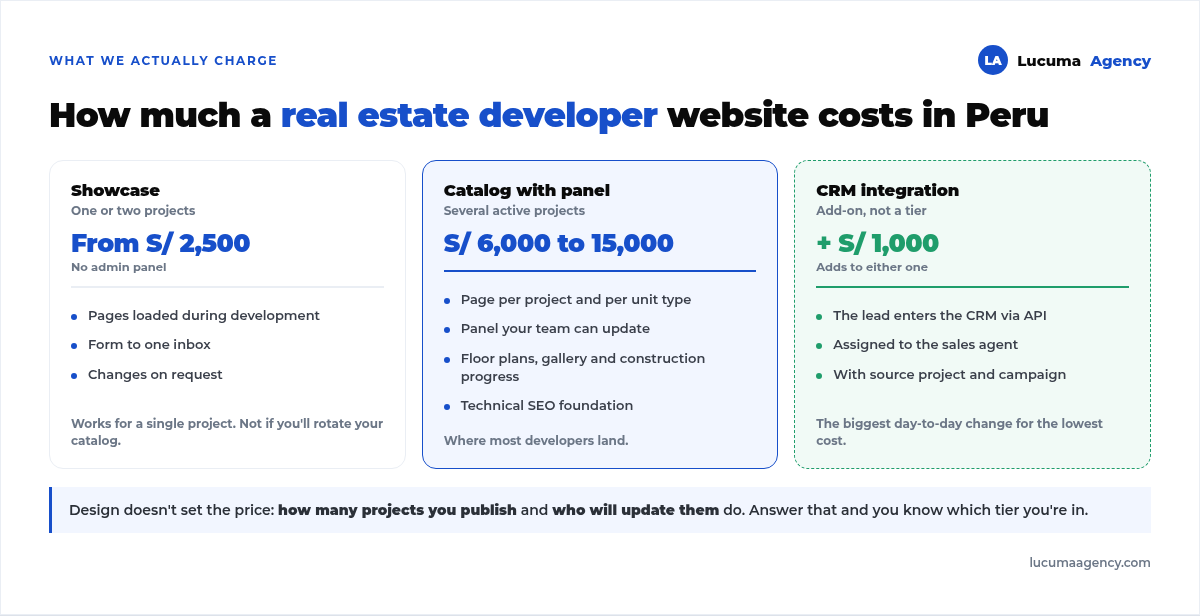
In how much a website costs in Peru we explain the general market ranges. These are the tiers where a real estate project usually falls.
Showcase: from S/ 2,500
A website for a real estate developer with one or two projects, without its own admin panel. Project pages are loaded during development and changes are requested by email. A contact form that goes to an inbox. Making sure it actually arrives isn't automatic: we explain it in form that never arrives: how we fixed WordPress outgoing email.
It works if you're going to sell a single project and don't have a catalog. It doesn't work if you expect to rotate projects every few months, because every update costs money and time.
Catalog with admin panel: S/ 6,000 to S/ 15,000
The tier where most real estate developers with several active projects fall. It includes a project listing, a page per project and per unit type, a gallery, construction progress, downloadable floor plans and a panel where your team loads everything without depending on the developer.
This is also where the technical SEO foundation comes in, which in this industry isn't an extra: someone searching “departamentos en Magdalena” (apartments in Magdalena) is one search away from buying, and if your project pages aren't built properly, someone else gets that search.
CRM integration: S/ 1,000 extra
Here's the pleasant surprise. Connecting your website form to your CRM via API, so each lead comes in assigned to a sales agent with its project and source campaign recorded, we charge at S/ 1,000 as an add-on. It isn't a price tier: it's an add-on to either of the two above. How it's done, with the Proyecto Domus case, is in integrating your website with a real estate CRM.
It's probably the best ratio between what it costs and what it changes in day-to-day sales, because it eliminates manual lead entry and finally makes the marketing and sales reports match.
That price applies when the CRM has a documented API. With Sperant, the most widely used CRM in the industry, the integration is already built and tested, so you aren't charged for development from scratch. We cover it in web integration with your real estate CRM.
What pushes the quote up
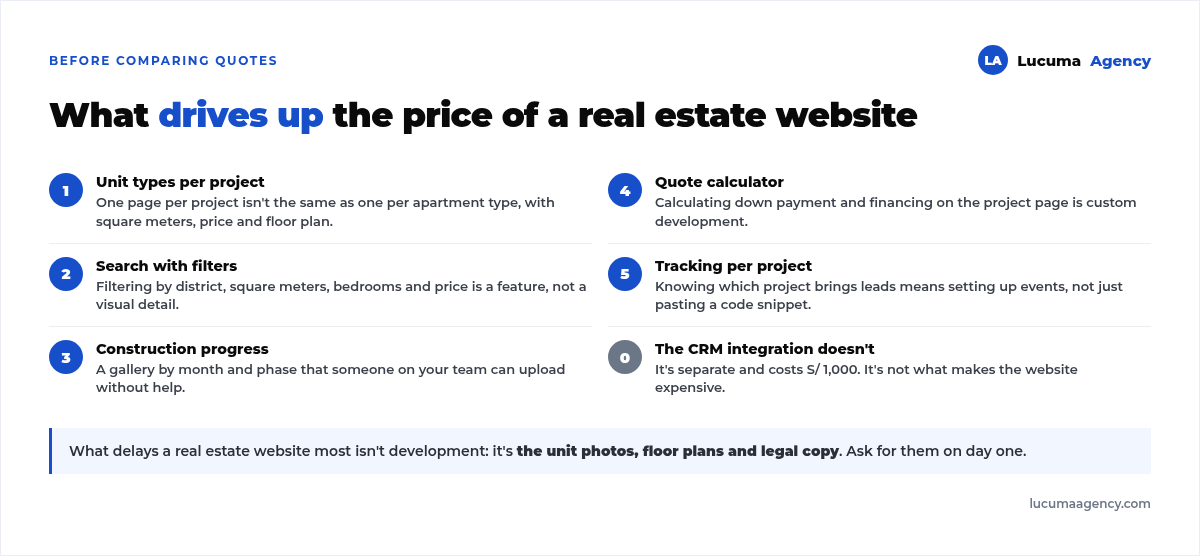
- Number of unit types per project. One page per project isn't the same as one page for each apartment type, with its square footage, its price and its floor plan.
- Search with filters. Filtering by district, square footage, bedrooms and price range is a feature, not a design detail.
- Construction progress. If you want a gallery by month and by phase, someone has to be able to upload it easily.
- Quote calculator. Calculating the down payment and financing on the project page itself is custom development.
- Tracking. Knowing which project brings in leads requires setting up events per project, not just installing a code snippet and calling it done.
What you pay once and what you pay every month
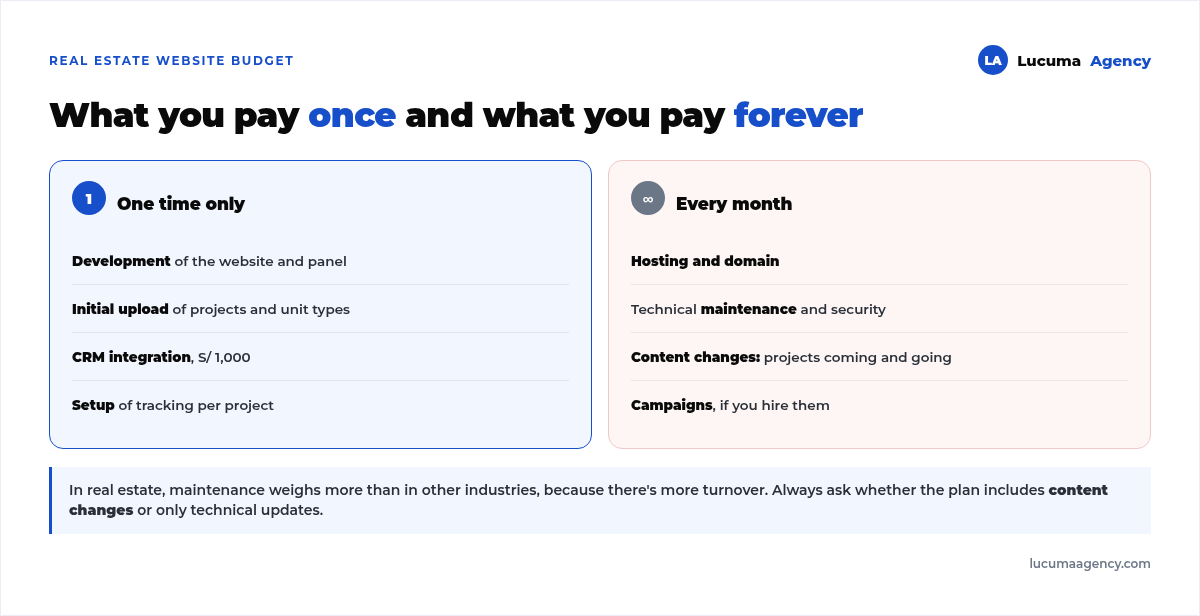
Development is paid once. What keeps running every month is hosting, the domain, maintenance and, if you hire it, content and campaign management.
On a real estate website, maintenance weighs more than in other industries, because there's more activity: projects coming in, projects selling out, prices being updated. Always ask whether the plan includes content changes or only technical updates.
What a serious quote should include
- How many projects and unit types the price covers, and what it costs to add one more.
- Whether it includes an admin panel and who can use it.
- Whether the CRM is integrated and how much that add-on costs.
- What happens to the leads that came in before the integration.
- Access in your name: domain, hosting and analytics.
- A written timeline and what depends on you delivering materials.
That last point is what delays projects most in this industry. Unit photos, floor plans and legal texts tend to take longer than the development itself. On the legal side, the complaints book (libro de reclamaciones) is both mandatory and technical: we explain it in virtual complaints book in WordPress.
Frequently asked questions about the cost of a real estate website
Can I start with a simple website and expand it later?
Yes, and it's often the sensible choice. What matters is saying so from the start so the foundation is ready. Expanding a website that was built to grow costs far less than rebuilding it from scratch.
Should I use a real estate portal instead of my own website?
They aren't mutually exclusive. A portal gives you volume, but the lead is theirs and you compete side by side with every other project. Your own website is the only place where you control the message and keep the prospect's data. And in this industry it's still an advantage: of the 100 Google Business Profiles of real estate developers in Miraflores we measured, 27 had no website; the data is in Real estate SEO: what we learned measuring 100 listings.
How long does development take?
A catalog website with an admin panel usually takes four to eight weeks, depending on how many projects need to be loaded. The CRM integration is usually done in parallel.
Who loads the projects at the start?
It's best for the agency to load the first ones, to set the standard, and for your team to load them from then on. If your people do it from day one, the format gets messy fast.
What if I'm a construction company or an architecture firm?
The ranges are similar because the structure is the same: instead of projects for sale, you publish completed builds or a portfolio. We explain it in web design for real estate developers.
Conclusion
A real estate developer's website in Peru costs from S/ 2,500 for a showcase site and between S/ 6,000 and S/ 15,000 if you need a catalog with its own admin panel. CRM integration is added separately for S/ 1,000. The price difference isn't in the design, but in how many projects you publish and who updates them.
Before comparing prices, decide one thing: who will update the projects. That answer defines the tier you're in.
In Lucuma Agency we build websites for real estate developers with its own admin panel and per-project tracking. Want to know which range your case falls into? Book your free consultation and we'll give you an honest estimate in 30 minutes.
Other posts you might like
At almost every real estate developer we work with, the lead takes the same absurd trip: it comes in through the form...
Switching servers is scary for a sensible reason: you rarely do it, and when it goes wrong, it goes wrong in public....
The question always comes the same way: “which payment gateway do you recommend?” And the useful answer doesn't start with a name, because the...
There's a moment, in quite a few projects, when the search for the right plugin becomes the problem. You tried three,...
Almost every online complaints book we audit complies on the outside and fails on the inside. They have the notice,...
The message came in like this: “the complaints book is throwing an error.” The Proba Inmobiliaria website, a page required by law,...
“Top 50 plugins” lists don't help you decide. They help you install fifty plugins. This is ours,...
Almost every business we ask has backups. Almost none has ever restored one. Those two sentences together are...
Almost every hosting conversation starts with price and ends up in the wrong place. The useful question is...
When a business wants to sell outside its country, the conversation almost always starts off wrong: with translation. And the...
Structured data is the piece of code that explains to Google, in a language that leaves no room for interpretation,...
The question comes up in almost every meeting: “if I use AI to write, will Google penalize me?” The short answer...