Bricks vs Elementor vs Gutenberg: what we build with and why
When an agency tells you “hacemos tu web en WordPress” (we build your website in WordPress), it hasn't told you anything yet. What defines how it will load, how much it will cost to maintain and how easy it will be to change is the tool used to build on top of WordPress. Today the three serious options are Gutenberg, the editor that comes with WordPress out of the box; Elementor, the best-selling visual builder; and Bricks, the builder we've been working with since 2025. This is the comparison based on what we've measured on real websites, without fanaticism, and including the cases where we wouldn't choose Bricks.
What each one is, in one sentence
- Gutenberg is WordPress's native block editor. Free, lightweight, and designed for writing content more than for designing sales pages.
- Elementor is a drag-and-drop visual builder with a huge ecosystem of templates and add-ons. It's the one most freelancers in Peru use.
- Bricks is a newer visual builder that generates clean code, works with reusable classes and is designed for people who build lots of websites and want control.
The data point that weighs most: how much the page weighs
A page's weight determines how long it takes to load on a phone using mobile data, which is how most of your clients in Peru arrive. Two of our own cases:
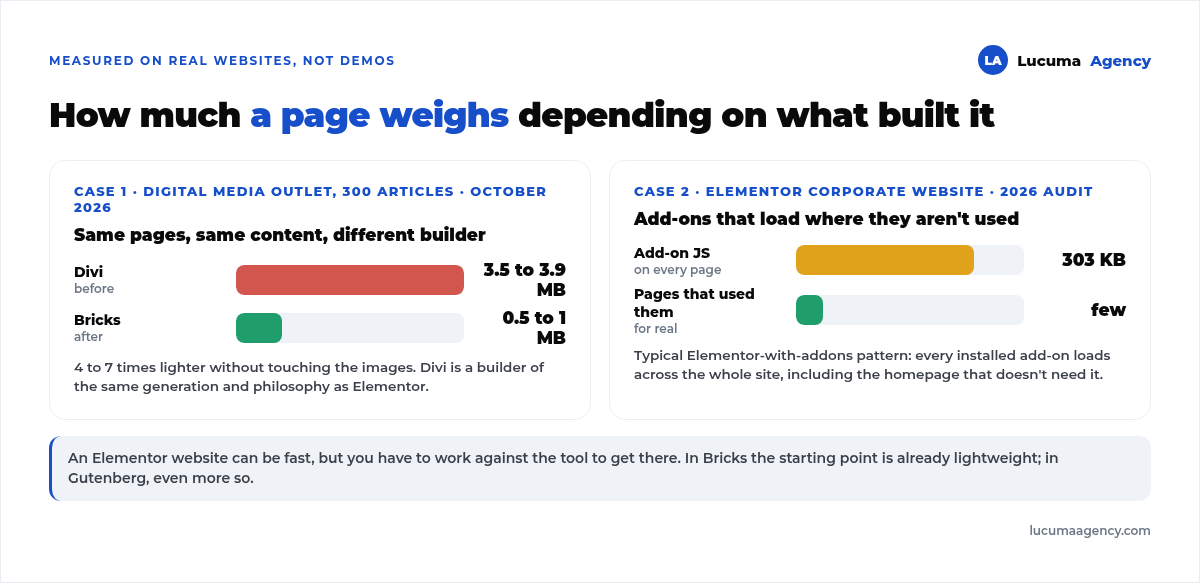
- A digital news outlet we rebuilt in October 2026 moved from Divi, a builder from the same generation as Elementor, to Bricks. The same pages, with the same content, went from weighing between 3.5 and 3.9 MB to between 0.5 and 1 MB. Four to seven times lighter, without touching the images.
- A corporate website on Elementor that we audited for a company in Spain loaded 303 KB of JavaScript from Elementor add-ons on every page, including the homepage, which didn't use any of those modules. It's the typical pattern: every add-on you install loads across the whole site.
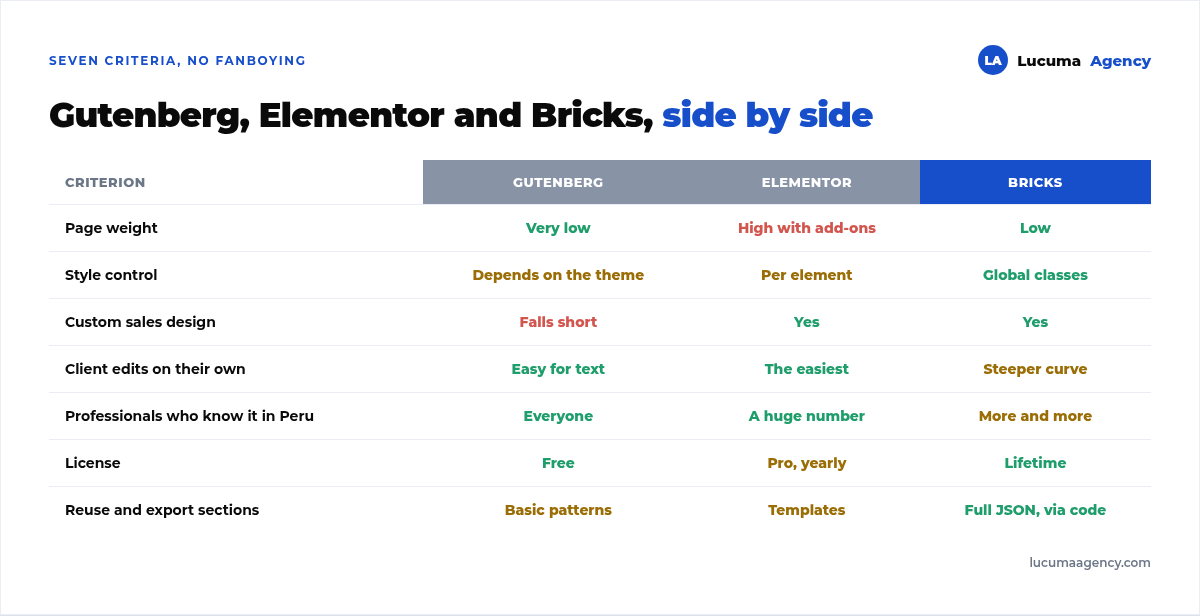
This doesn't mean an Elementor website has to be slow. It means that to keep it from being slow you have to work against the tool: disable modules, clean up add-ons, add optimization plugins. In Bricks the starting point is already lightweight, and in Gutenberg even more so.
Control: classes, code and what happens when you want to change something
This is the difference a business owner doesn't see on launch day but does six months later, when they ask “change the blue on all the buttons”.
- In Elementor, styling usually lives on each element. If the site's 40 buttons were styled one by one, changing the color means 40 changes, or a CSS patch nobody documents.
- In Bricks, styling lives in global classes. You change the button class once and all 40 change. Plus, any section can be exported as a text file and reused on another website: we generate entire pages that way and import them with our own plugin, without pasting by hand.
- In Gutenberg, control depends on the theme. With a good block theme it works; for custom sales designs, it quickly falls short or needs third-party blocks that add the weight back.
Long-term maintenance and risk
- Gutenberg can't stop existing: it's WordPress. Zero risk of the builder being abandoned.
- Elementor has the largest user base, which guarantees support and professionals who know it. On the other hand, every major update has broken things on sites with lots of add-ons, and the Pro license is paid yearly.
- Bricks is younger and has fewer professionals who master it, so switching providers is somewhat harder. Its lifetime license works out cheaper over three years than Elementor Pro. And it's a developer tool: if your team wants to edit the website without help, the learning curve is steeper than in Elementor.
When we would choose each one
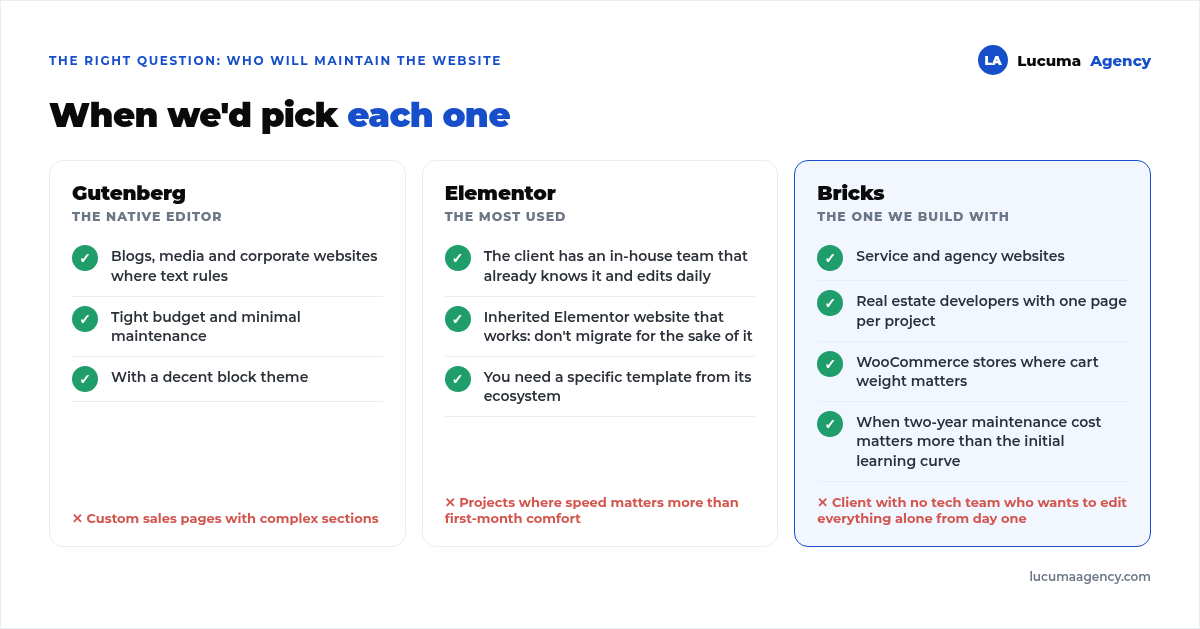
- Gutenberg: a blog, a news outlet or a corporate website where the text is what matters and the budget is tight. With a decent block theme it's the cheapest and fastest option to maintain.
- Elementor: when the client already has an in-house team that knows it and will edit the website daily without asking for help, or when they inherit an Elementor website that works and rebuilding it isn't justified. We never recommend migrating from Elementor to Bricks just for the sake of it.
- Bricks: service websites, real estate developers with a page for each project, WooCommerce stores and any project where speed and two-year maintenance costs matter more than first-month convenience. It's what we use on our own website and on our clients' websites since 2025.
What doesn't change with any of them
No builder fixes slow hosting, uncompressed images, 40 active plugins or a poorly planned page structure. In how to speed up your WordPress website you'll find the order in which to tackle that, and in how to speed up a slow WooCommerce store, a case where the builder wasn't the problem. If you're choosing for the first time, why build your website on WordPress answers the question that comes before this one.
Frequently asked questions
Is Bricks better than Elementor?
For speed, style control and long-term license cost, yes. For a client with no experience to edit their website on their own, and for finding professionals who know it, Elementor still wins. It depends on who is going to maintain the website.
Can I move my website from Elementor to Bricks?
Yes, but it means rebuilding it, not converting it: there's no button that migrates it. It's only worth it if the current website has real speed or maintenance problems, and it has to be done with a redirect plan so you don't lose rankings.
Is Gutenberg good enough for a business website?
For a corporate site or a blog, yes. For sales pages with custom sections, complex forms and a page for each service or project, it falls short or needs add-ons that cancel out its lightweight advantage.
Does the builder affect SEO?
Indirectly, through speed and code cleanliness. All three can rank well. What hurts SEO is a 4 MB page on a phone using mobile data, and that's easier to avoid in Bricks and Gutenberg than in Elementor with lots of add-ons.
What happens if my agency disappears and my website is in Bricks?
The website keeps working: it's WordPress with a theme and a license you can renew or not. What you need is for the access credentials to be in your name and for the next provider to know Bricks, and more and more of them do.
Conclusion
Gutenberg for content, Elementor when the client will edit on their own and already knows it, Bricks when speed and two-year maintenance matter. We build in Bricks because we measure how much pages weigh and because we reuse what we build, but the right question isn't which one is better, it's who will maintain your website and how much you care that it loads on a phone using mobile data.
The tool is a technical decision within a broader job, which you can see in our digital marketing services. Why we use WordPress as the foundation is explained in why we build websites on WordPress.
At Lucuma Agency we do WordPress web development with Bricks, and we also support Elementor websites that already work. If you don't know what yours is built with or whether that's a problem, book a free consultation and we'll review it in 30 minutes.
Other posts you might like
At almost every real estate developer we work with, the lead takes the same absurd trip: it comes in through the form...
Switching servers is scary for a sensible reason: you rarely do it, and when it goes wrong, it goes wrong in public....
The question always comes the same way: “which payment gateway do you recommend?” And the useful answer doesn't start with a name, because the...
There's a moment, in quite a few projects, when the search for the right plugin becomes the problem. You tried three,...
Almost every online complaints book we audit complies on the outside and fails on the inside. They have the notice,...
The message came in like this: “the complaints book is throwing an error.” The Proba Inmobiliaria website, a page required by law,...
“Top 50 plugins” lists don't help you decide. They help you install fifty plugins. This is ours,...
Almost every business we ask has backups. Almost none has ever restored one. Those two sentences together are...
Almost every hosting conversation starts with price and ends up in the wrong place. The useful question is...
When a business wants to sell outside its country, the conversation almost always starts off wrong: with translation. And the...
Structured data is the piece of code that explains to Google, in a language that leaves no room for interpretation,...
The question comes up in almost every meeting: “if I use AI to write, will Google penalize me?” The short answer...