SEO for an online store: how we chose keywords for an unclaimed niche
Most online stores do SEO backwards: they write first, then check whether anyone was searching for that. In July 2026 we took on Vaporis, a Peruvian store selling diffusers and home fragrances that sold well on social media and didn't exist on Google. Before writing a single word, we exported the organic rankings of four competitors in Peru. That gave us 1,422 rankings and 474 unique keywords. This article explains how we got from those 474 down to 29, and why that subtraction is almost all of the work.
First: who your real competitors are
The most expensive mistake in ecommerce SEO is copying the keywords of whoever looks biggest. The four sites we analyzed weren't playing the same game.
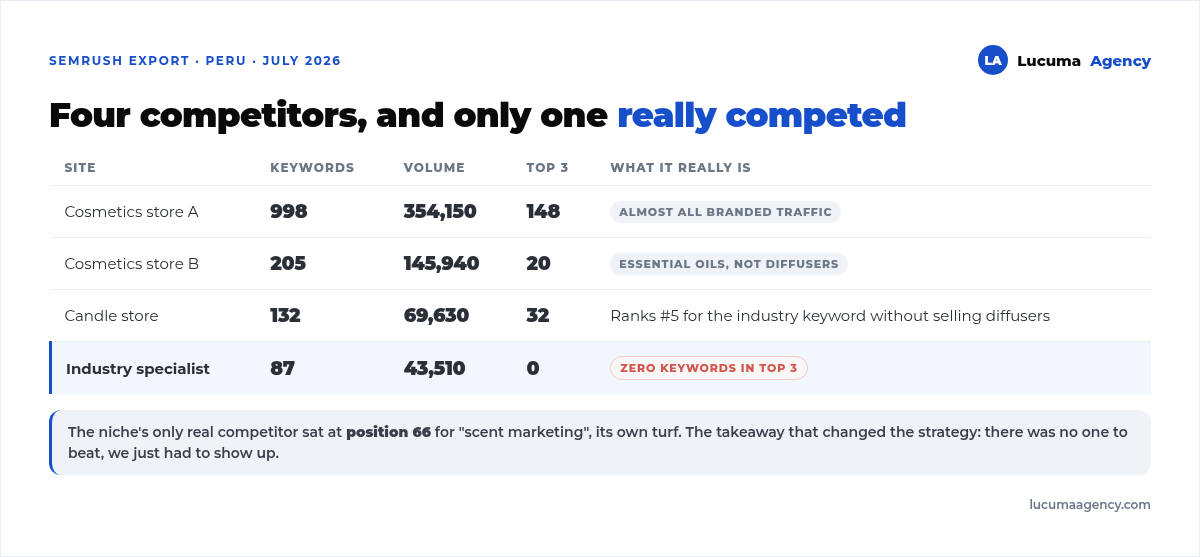
Two of them, natural cosmetics stores, padded their numbers with searches for their own brand: thousands of visits from people who already knew them and typed their name. Once you took that out, their presence in diffusers was marginal. A third, a candle store, ranked fifth for the most valuable keyword in the industry without selling diffusers, just because it had a category with that name. And the only real competitor, the professional scenting specialist, didn't have a single keyword in the top 3; for “marketing olfativo” (scent marketing), its own turf, it sat at position 66.
That conclusion changed the whole strategy: there was nobody to beat. We just had to show up.
Second: isolate the core of the business
Most of the 474 keywords were useless. Some were other brands, others were products the store doesn't sell, others had informational intent far removed from a purchase. We kept the ones at the core of the business with at least 90 searches a month.
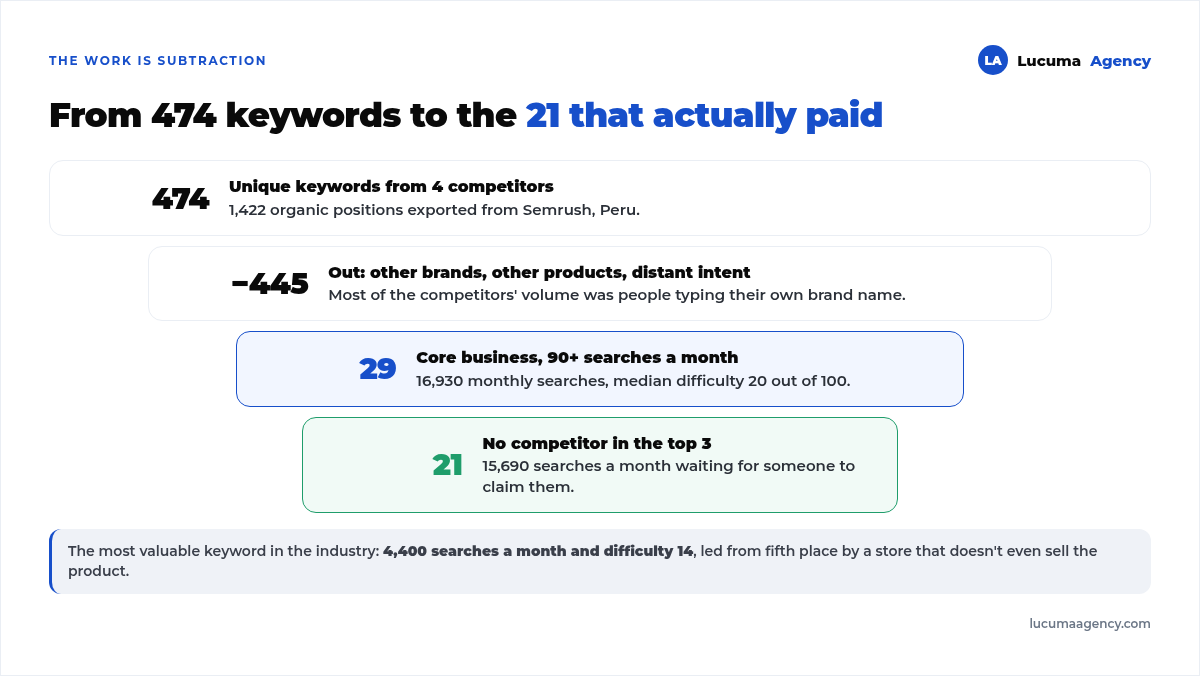
That left 29 keywords with 16,930 searches a month and a median difficulty of 20 out of 100. And the figure that decided everything: in 21 of those 29, with 15,690 monthly searches between them, no competitor was in the top 3. The most valuable keyword in the industry, with 4,400 searches a month, had a difficulty of 14 and was led from fifth place by a store that isn't even in the industry.
What a difficulty of 11 to 25 means
Keyword difficulty estimates how much effort it takes to break into the top 10. Below 30, a store with its technical foundation in order and decent content can compete in months, not years. Above 60, you're talking about budgets and timelines of a different size. When you see an entire niche between 11 and 25, you're not looking at a tough market: you're looking at one nobody has worked on.
Third: the technical finding that was worth more than the keywords
In parallel, we reviewed the store. It had no product descriptions, no articles and no meta descriptions. But the most serious problem was something else: it didn't have a single category URL. It filtered products by parameter, with addresses like "shop with a number at the end," and a URL with a parameter can't compete as a landing page.
Meanwhile, the four competitors ranked almost exclusively with collection pages. That was the asymmetry: they weren't being beaten by whoever had better content, but by whoever had a page Google could match to a search.
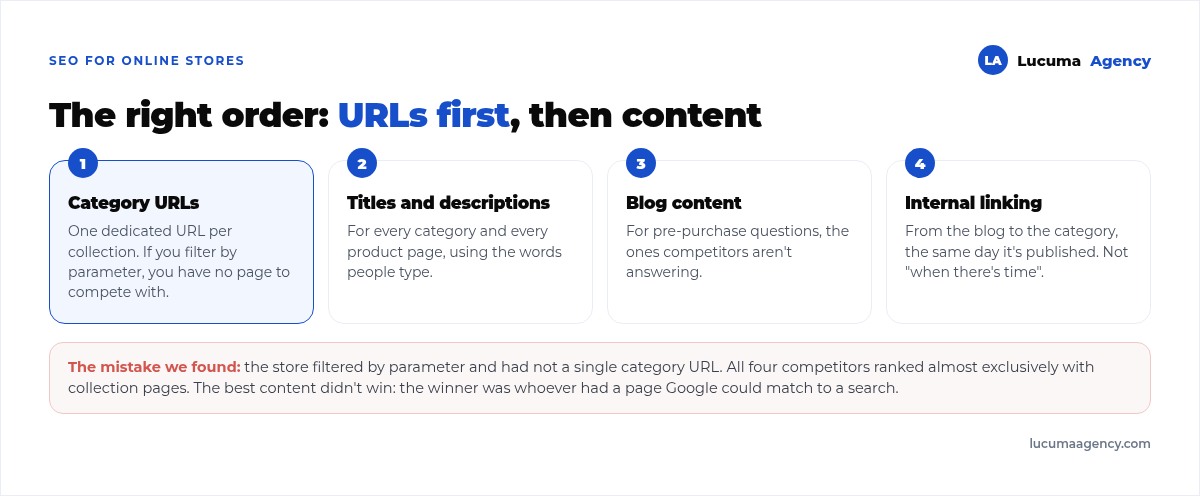
That's why the plan didn't start with the blog. It started by creating the category pages that didn't exist, and only then by filling them. It's the same order we apply in any plan: first you fix what keeps you from competing, then you publish. If that order sounds familiar, it's the one we explain in what SEO is and how it works.
How to do this for your store
You don't need a paid export to get started. With Search Console and some patience, you can get pretty far.
- List your real competitors, not the big players. Ask yourself who sells exactly what you sell, not who has the most traffic. A store with ten times your traffic may not compete with you on anything.
- Discount branded searches. If their traffic is people typing their name, that traffic isn't up for grabs and tells you nothing about the niche.
- Stick to the core. The words that describe what you sell, with enough volume to matter and a difficulty you can take on.
- Find the gap. Keywords where nobody is in the top 3 are the ones that pay off first. Search them on Google in incognito mode and see who shows up: if you get forums, marketplaces and results from another country, there's room.
- Check your URLs before your content. If your categories live in parameters, no word you write will perform.
That upfront review is what we do in a website & SEO audit before proposing any content plan.
Frequently asked questions about ecommerce SEO
How many keywords should an online store target?
Fewer than you think. In this case, 29 well-chosen ones covered 16,930 monthly searches. A typical Lima store can hold its own with 20 to 40 keywords spread across categories and product pages, plus a blog that tackles pre-purchase questions. And once customers arrive, checkout decides: which payment gateway to choose is covered in WooCommerce with Yape and Plin.
What is an unclaimed keyword?
A search with real volume where none of the top 3 results is a strong competitor in the industry: you see marketplaces, forums, results from another country or stores that sell something else. These are the first ones to go after because they pay off in weeks, not years.
Do category pages matter more than the blog?
In ecommerce, almost always yes. The category page is the one that can sell in the same visit, and the one competitors use to rank. The blog helps you reach people who are still deciding, and then pushes them toward the category with an internal link.
Is SEO worth it if I already sell well on Instagram?
Yes, because they're two different audiences. Instagram sells to people who already follow you; Google brings you people searching for what you sell without knowing you exist. The advantage of the second is that it keeps coming when you stop posting.
How long does it take to see results for a new store?
New category pages usually start getting impressions within weeks, and clicks come later, once they break into the top 10. The timeline details are in how long it takes to rank a website on Google.
Conclusion
SEO for an online store isn't won by writing more, it's won by choosing better. Out of 474 keywords, 29 remained, and of those 29, the first 21 were valuable because nobody had claimed them. The work of subtraction, which nobody sees and no tool does on its own, is what separates a content plan that sells from one that just spends.
In Lucuma Agency we build and rank online stores in that order: first the URLs that can compete, then the content. If you want to know whether your industry has gaps like this one, book a free consultation and we'll look at it together in 30 minutes.
Other posts you might like
At almost every real estate developer we work with, the lead takes the same absurd trip: it comes in through the form...
Switching servers is scary for a sensible reason: you rarely do it, and when it goes wrong, it goes wrong in public....
The question always comes the same way: “which payment gateway do you recommend?” And the useful answer doesn't start with a name, because the...
There's a moment, in quite a few projects, when the search for the right plugin becomes the problem. You tried three,...
Almost every online complaints book we audit complies on the outside and fails on the inside. They have the notice,...
The message came in like this: “the complaints book is throwing an error.” The Proba Inmobiliaria website, a page required by law,...
“Top 50 plugins” lists don't help you decide. They help you install fifty plugins. This is ours,...
Almost every business we ask has backups. Almost none has ever restored one. Those two sentences together are...
Almost every hosting conversation starts with price and ends up in the wrong place. The useful question is...
When a business wants to sell outside its country, the conversation almost always starts off wrong: with translation. And the...
Structured data is the piece of code that explains to Google, in a language that leaves no room for interpretation,...
The question comes up in almost every meeting: “if I use AI to write, will Google penalize me?” The short answer...