How we audit a website before doing SEO: the 10 things we check
There's an order almost nobody follows: before publishing a single article, you need to know whether the website can compete. We always use the same ten-point checklist, and we use it the same way for a new client as for a market study. In fact, the last time we applied it at scale was on a hundred Google listings of real estate companies in Miraflores, and the numbers that came out of it are the ones you'll see in this article. If you want to do the review yourself, this is exactly what we look at and with what thresholds.
The ten points, in the order we review them
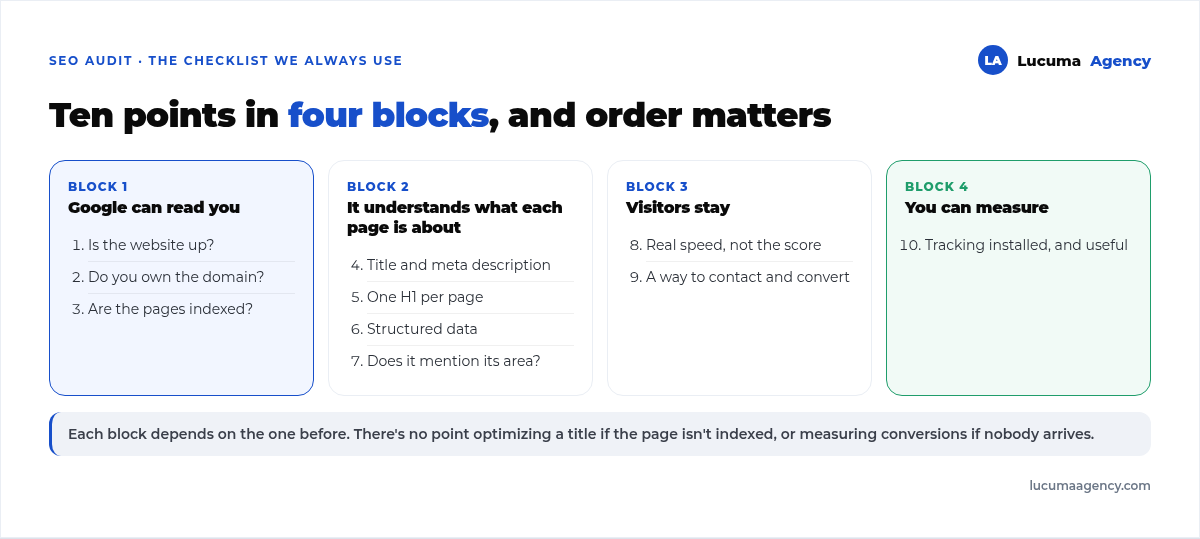
They're grouped into four blocks, and the order matters: each block depends on the previous one. There's no point optimizing a title if the page isn't indexed, or measuring conversions if nobody arrives.
Block 1: Google can read you
1. Does the website load? It sounds like a joke until you measure it. Of the hundred listings we analyzed, 27 had no website and 17 had their website down while their Google listing was active. These are companies paying for ads that lead to a locked door.
2. Is the domain your own? Websites built on subdomains borrowed from free site builders don't build authority for you. In our measurement, 89% of brokerages had their own domain: the rest were building on someone else's land.
3. Are the pages indexed? You check this in Search Console, in the pages report. The typical case is an entire website blocked by a WordPress checkbox someone left ticked at launch.
Block 2: Google understands what each page is about
4. Title and meta description, one per page. In the sample, 79% of developers had a meta description, and so did 83% of brokerages. Sounds good until you notice many were the same one repeated across the whole site.
5. One H1 per page, and it should say something. This is where the gap opens: 64% among developers versus 33% among brokerages. Two out of three brokerage websites don't tell Google what their homepage is about.
6. Structured data. The markup that explains to the search engine what your business is, where it is and what you sell. 71% versus 39% between the two groups.
7. Does it mention its area? The most revealing figure of the whole study: 36% of developers mention their district on the homepage, and brokerages, 0%. None. In a business that is purely local.
Block 3: the visitor stays
8. Real speed, not the score. We don't use the PageSpeed score because it mixes things together. We measure its verifiable causes, with fixed thresholds.
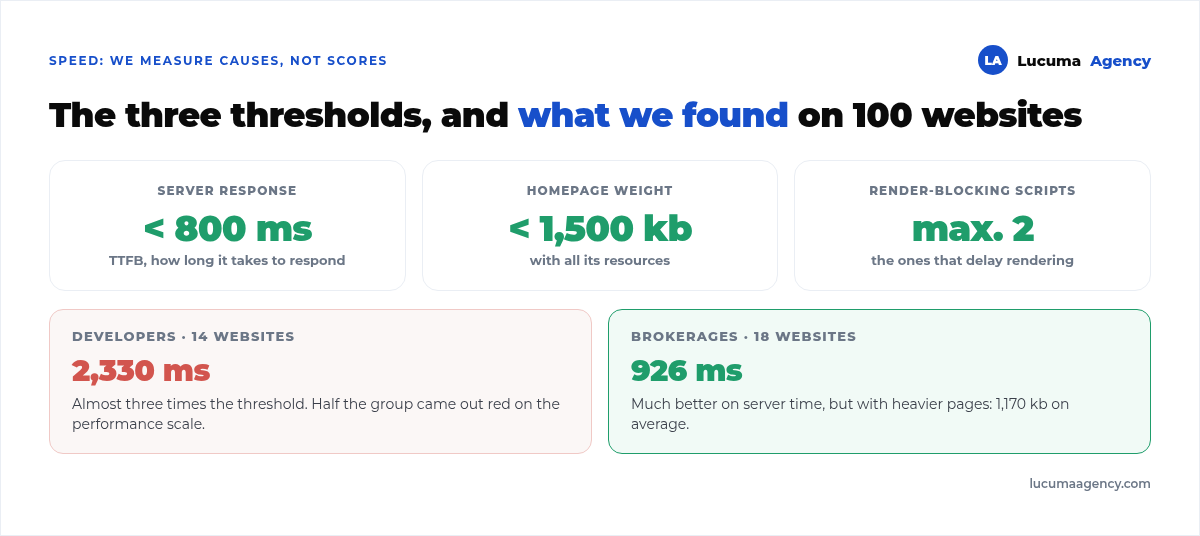
The sample's results were harsh: developers averaged 2,330 milliseconds of server response time, almost three times the threshold. Brokerages, 926 milliseconds, much better, but with heavier pages.
9. Is there a way to get in touch and convert? A form, WhatsApp, a visible phone number. In the sample, 89% and 93% had a contact page, but only half of the developers had a real form.
Block 4: you can measure
10. Is tracking installed, and does it work? 100% of developers had some kind of tracking tool. That doesn't mean it measured anything useful: having GA4 installed without a single conversion event set up is the most common thing we find. How to set it up properly is covered in how to track conversions with Google Tag Manager and GA4.
What we do with the results
The audit doesn't end in a list of problems: it ends in an order of work. That's the difference between a report and a plan.
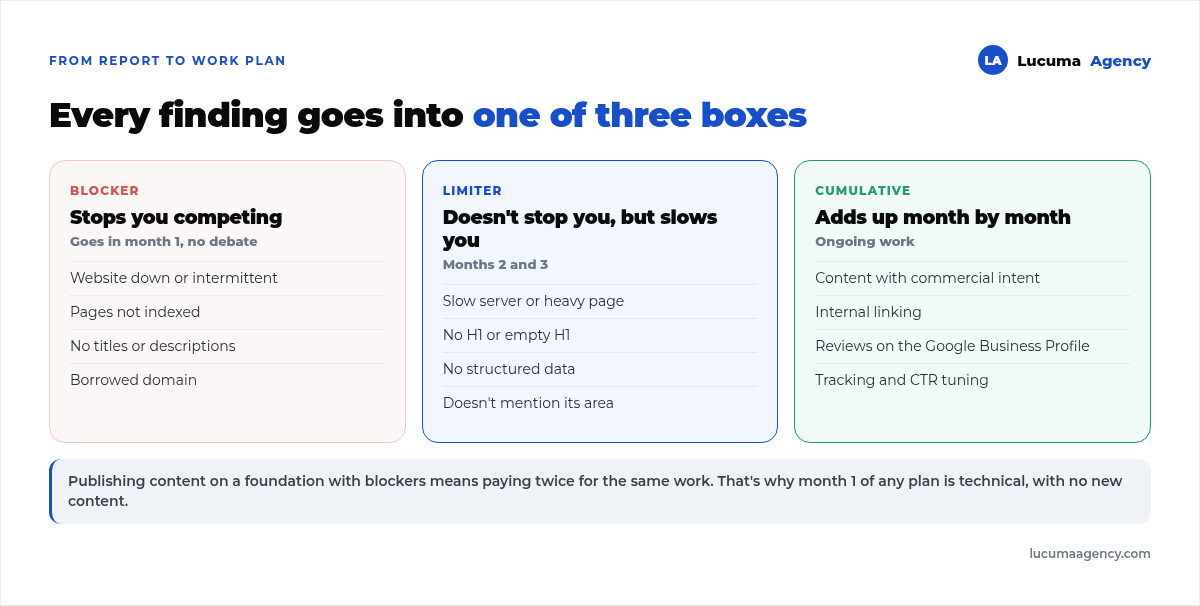
Every finding goes into one of three boxes. Blocking: it keeps you from competing and goes into month one, no discussion (website down, not indexed, no titles). Limiting: it doesn't stop you, but it holds you back (speed, missing H1, no structured data). Cumulative: it adds up month after month and is never urgent, but it's what decides the six-month result (content, internal linking, reviews).
That's why the first month of any SEO in Lima plan is technical, with no new content: publishing on a broken foundation means paying twice.
Frequently asked questions about SEO audits
How long does an SEO audit take?
Reviewing these ten points on a typical website takes two to four hours. What takes longer isn't looking, it's deciding the order and estimating what each fix will cost.
Can I do it myself?
Anyone can check points 1, 2, 7 and 9 by opening their own website. Points 3, 4 and 10 require Search Console and GA4. The rest require tools, although there are free versions good enough to give you an idea.
Does the PageSpeed score work as an audit?
As a thermometer, yes; as a diagnosis, no. A score of 40 doesn't tell you what to fix first. That's why we measure the causes separately: server response time, page weight and render-blocking scripts.
What if the audit says the website needs to be rebuilt?
It happens sometimes, and it's better to know before investing six months of content in a foundation that can't be fixed. The choice between fixing and rebuilding is made with numbers, not taste.
How often should it be repeated?
Once a year on a stable website, and always after a redesign or a migration, which is when things break without anyone noticing.
Conclusion
An SEO audit isn't a list of errors: it's an order of work. The ten points above are always reviewed in the same order because each one depends on the previous one, and the results are sorted into three boxes that decide what goes into month one, what goes into month two and what is ongoing work. When that sorting doesn't happen, SEO plans start with the fun part, which is publishing, and run into the boring part six months later.
In Lucuma Agency this is the first step of every project, and we also sell it on its own as a website & SEO audit. If you want to know which box your website falls into, book a free consultation and we'll review it together in 30 minutes.
Other posts you might like
At almost every real estate developer we work with, the lead takes the same absurd trip: it comes in through the form...
Switching servers is scary for a sensible reason: you rarely do it, and when it goes wrong, it goes wrong in public....
The question always comes the same way: “which payment gateway do you recommend?” And the useful answer doesn't start with a name, because the...
There's a moment, in quite a few projects, when the search for the right plugin becomes the problem. You tried three,...
Almost every online complaints book we audit complies on the outside and fails on the inside. They have the notice,...
The message came in like this: “the complaints book is throwing an error.” The Proba Inmobiliaria website, a page required by law,...
“Top 50 plugins” lists don't help you decide. They help you install fifty plugins. This is ours,...
Almost every business we ask has backups. Almost none has ever restored one. Those two sentences together are...
Almost every hosting conversation starts with price and ends up in the wrong place. The useful question is...
When a business wants to sell outside its country, the conversation almost always starts off wrong: with translation. And the...
Structured data is the piece of code that explains to Google, in a language that leaves no room for interpretation,...
The question comes up in almost every meeting: “if I use AI to write, will Google penalize me?” The short answer...