Title and meta description: how we write them for 30 service pages
The title and the meta description are the only things Google shows someone before they decide whether to visit your website or a competitor's. They're two sentences, they take ten minutes to write, and almost nobody works on them. We have 30 published pages and 41 articles, and we keep a document that holds the title and meta of every one, because writing them one by one always ends in duplicates. This is our exact method, with the lengths we use and a case where changing a single line moved us up ten positions.
The lengths, which aren't up for debate
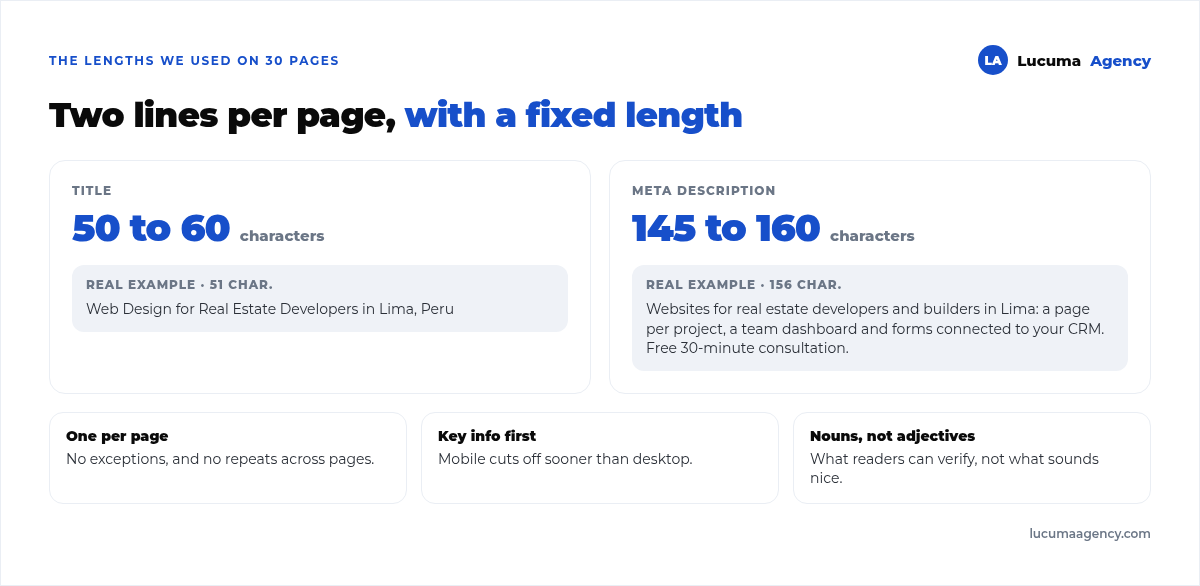
Title: 50 to 60 characters. Above 60, Google cuts it off and you lose the ending, which is usually where the brand or the city goes. Below 50, you waste space you could use for one more word.
Meta description: 145 to 160 characters. Same logic. All of ours are between 146 and 160, and that's no accident: it's a check we run every time we publish something. On October 5 we found three that had been cut short when pasted, and we pasted them back in full the same day.
One per page, no exceptions and no repeats. The most common mistake we find in audits isn't bad descriptions: it's the same one on twenty pages, because the theme generated it automatically from the site name.
The meta description doesn't rank, but it decides
Let's be clear: Google doesn't use the meta description as a ranking factor, and sometimes it doesn't even show it, because it picks a snippet of your text instead. So why work on it? Because when it does show it, it decides the click. And the click, unlike the description, does end up mattering.
The four-part formula
When we write a service page title, we put together four pieces in this order.
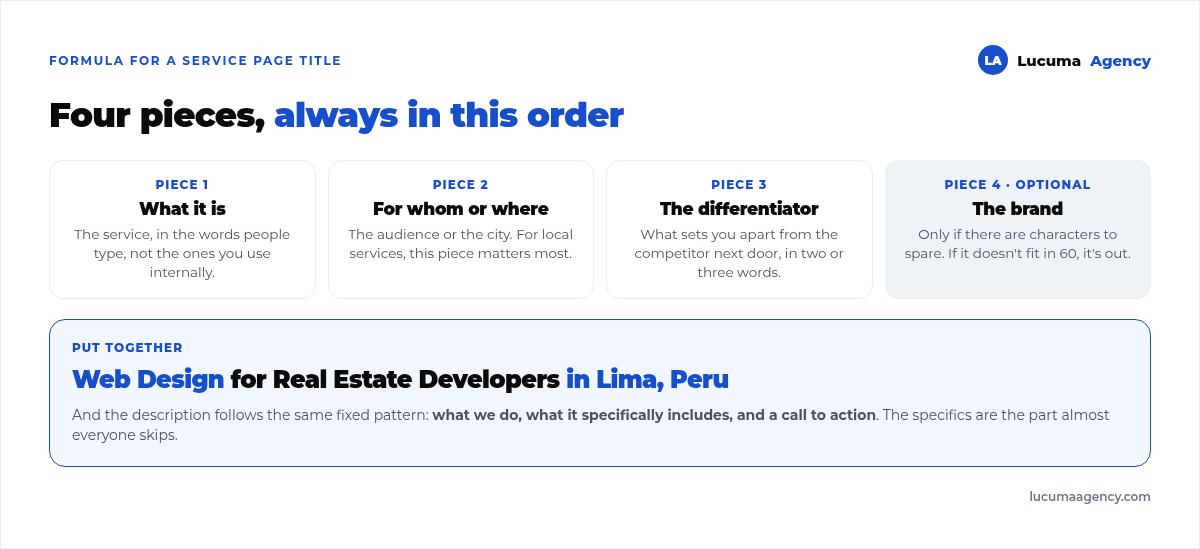
For the meta description, the pattern is fixed too: what we do, what it includes specifically, and a call to action. The specifics are the part almost everyone skips. “Mejoramos tu presencia digital” (we improve your digital presence) says nothing to anyone. “Ficha por proyecto, panel para tu equipo y formularios conectados a tu CRM” (a page per project, a dashboard for your team and forms connected to your CRM) does, because readers recognize their own problem in the sentence.
A real example of ours
Our page on websites for real estate developers uses this 44-character title: “Diseño Web para Inmobiliarias en Lima y Perú” (web design for real estate developers in Lima and Peru). What it is, who it's for, where. And this 158-character description: “Webs para inmobiliarias y constructoras en Lima: ficha por proyecto, panel para tu equipo y formularios conectados a tu CRM. Consultoría gratis de 30 minutos” (websites for real estate developers and builders in Lima: a page per project, a dashboard for your team and forms connected to your CRM. Free 30-minute consultation).
No adjectives. Just nouns the reader can verify.
The change that moved us up ten positions
In October we went through Search Console and found something we didn't expect: two queries, “freelance wordpress marca blanca” and “diseñador wordpress marca blanca” (white-label WordPress freelancer and designer), added up to a hundred impressions a month and sat at position 16. Our page for that service had a correct but generic title that didn't contain either of the two words people were typing.
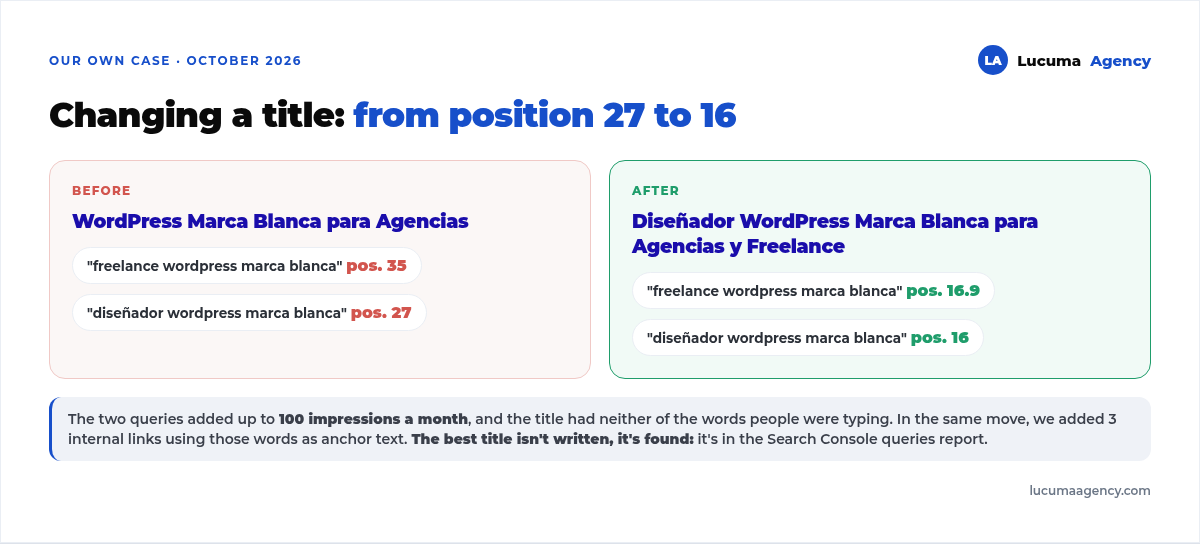
We changed the title so it said exactly what people were searching for, and in the same move we added three internal links using those words as anchor text. The two queries went from positions 27 and 35 to 16 and 17 in the following period. It isn't magic: it's not making Google guess anymore.
That's the practical lesson of all this. The best title isn't written, it's found: it's in the Search Console queries report, in the searches where you already show up between positions 10 and 30. We explain how to read that report in what Google Search Console is for.
The five mistakes we always see
- The same description across the whole site. It usually comes from the WordPress theme. It's the first thing we fix in any website & SEO audit.
- The company name at the start of the title. Unless you're a well-known brand, the first characters are too valuable to spend on your name.
- Lists of words separated by dashes. “Diseño web – SEO – Marketing – Lima – Perú” is read by no one and rewarded by Google even less.
- Promising what the page doesn't deliver. If the title says “precios” (prices) and the page has no prices, the visitor leaves in three seconds, and that does show.
- Writing them and never looking at them again. They're the easiest part of SEO to fix. Review them every three months against the queries report.
Frequently asked questions
How many characters should a meta description have in 2026?
Between 145 and 160. Google cuts it off around 160 on desktop and a little earlier on mobile, so the important part goes first. If yours has 300 characters, it isn't badly written: half of it just doesn't show.
Does the meta description affect rankings?
Not directly. It affects the percentage of people who click once you already show up, and that does end up mattering. Working on it is cheap, and the return shows up in weeks, not months.
Why does Google show a different description from mine?
Because it decided that a snippet of your text answers that specific search better. It's normal and it isn't an error. It happens more when the description is generic: if yours is specific, it's more likely to be kept.
Can I use the same keyword in the title of several pages?
Better not. If two pages compete for the same search, Google picks one and the other gets no traffic. When that happens, the right move is to merge them, not optimize both.
How often should you review them?
Every three months, and whenever a page has had lots of impressions and few clicks for a while. That pattern, many impressions and few clicks, is almost always a title problem, not a content problem.
Conclusion
Titles and meta descriptions are the SEO work with the best effort-to-results ratio there is: two sentences per page, known lengths, a repeatable formula and the chance to fix what isn't working in five minutes. We keep them in a single document for our 30 pages and 41 articles precisely so that none goes live without them and none gets repeated.
If you want to see this method applied to your case, at Lucuma Agency we work on it as part of any SEO in Limaplan, and we also review your full catalog of digital marketing services so every page competes for a different search. Book a free consultation and we'll go over it in 30 minutes.
Other posts you might like
At almost every real estate developer we work with, the lead takes the same absurd trip: it comes in through the form...
Switching servers is scary for a sensible reason: you rarely do it, and when it goes wrong, it goes wrong in public....
The question always comes the same way: “which payment gateway do you recommend?” And the useful answer doesn't start with a name, because the...
There's a moment, in quite a few projects, when the search for the right plugin becomes the problem. You tried three,...
Almost every online complaints book we audit complies on the outside and fails on the inside. They have the notice,...
The message came in like this: “the complaints book is throwing an error.” The Proba Inmobiliaria website, a page required by law,...
“Top 50 plugins” lists don't help you decide. They help you install fifty plugins. This is ours,...
Almost every business we ask has backups. Almost none has ever restored one. Those two sentences together are...
Almost every hosting conversation starts with price and ends up in the wrong place. The useful question is...
When a business wants to sell outside its country, the conversation almost always starts off wrong: with translation. And the...
Structured data is the piece of code that explains to Google, in a language that leaves no room for interpretation,...
The question comes up in almost every meeting: “if I use AI to write, will Google penalize me?” The short answer...