White-label WordPress for freelancers: how to resell development without a team
You're a designer. You created the brand identity for a café, it turned out beautiful, and they ask you: “can you build our website too?”. You know how to design it, but you don't know how to set up hosting, configure a domain email, or what to do when the form stops sending. So you say no, or you say yes and spend three weeks wrestling with tutorials.
There's a third option: resell development under white label. Someone builds it under your name, you deliver and invoice, and the client stays yours. In this guide we explain how it works in practice as a freelancer, what you should and shouldn't delegate, how to set your price and the mistakes that eat your margin on the first project.
If you want the full picture of the model, it's in our white-label WordPress guide for agencies and developers.
How it works in practice
Every freelancer wonders how much more complicated their day-to-day gets. The short answer: barely, because your vendor only steps into one of five steps.
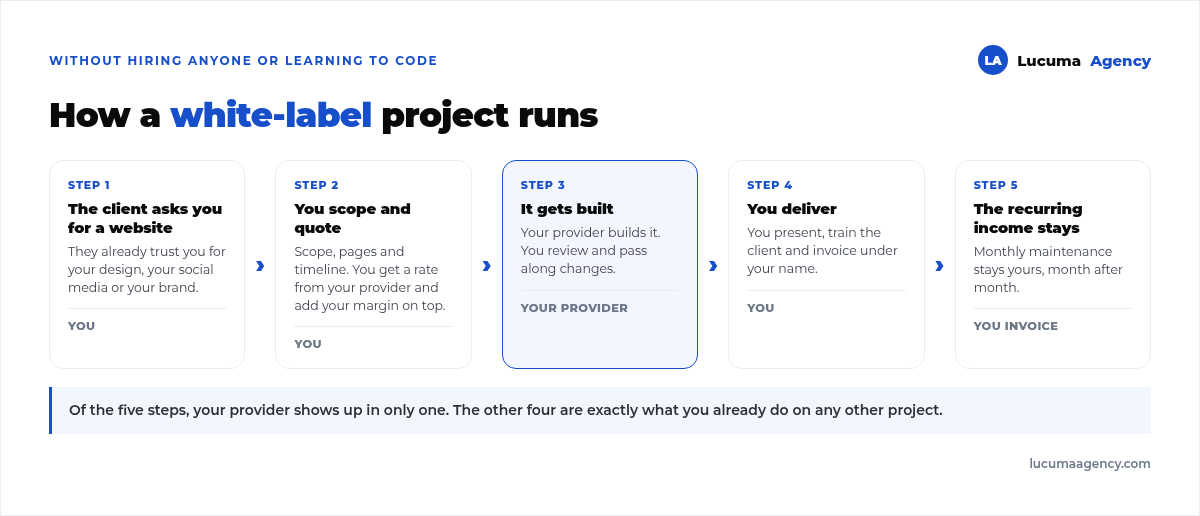
The other four steps are exactly what you already do with any job: understand what the client needs, quote, present and get paid. The only thing that changes is who does the typing.
What to delegate and what to keep
This is the line that decides whether the model makes you stronger or makes you expendable. You delegate the technical execution, never the judgment or the relationship:
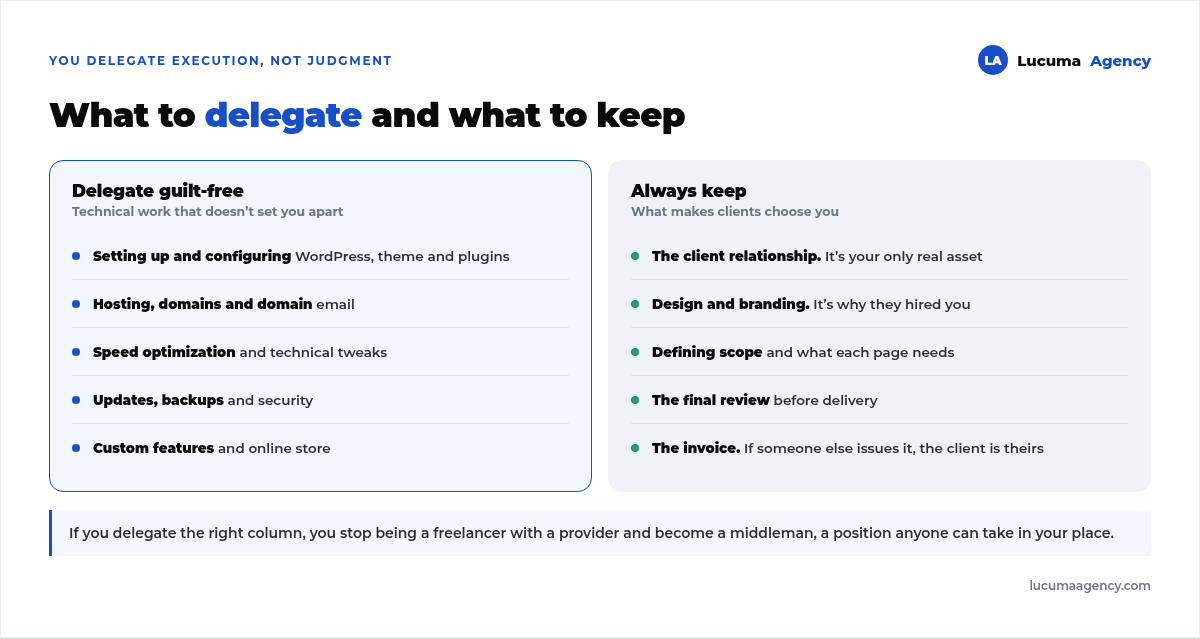
The invoice is the most important point and the most neglected one. If your vendor invoices the client directly “to keep things simple”, that client is no longer yours: they're the vendor's, and you're the one who introduced them.
How to set your price without giving your work away
The first-job mistake is quoting the vendor's rate plus a percentage, as if you were a middleman. You're not: you bring the trust the client already has in you, the design, the scope definition and the guarantee that someone answers when something fails.
Price based on what the project is worth to your client, and only then check whether your vendor leaves you enough margin. Websites in Peru fall within a wide range, and placing your project in it is a separate exercise from the cost of executing it.
Three line items that always exist and almost nobody includes:
Your management time. Briefs, meetings, reviews and emails. They're real hours even if you don't code. And part of those hours, the repetitive briefs and emails, can be cut: we cover it in five ways to use AI in your marketing work.
The change buffer. Every client asks for out-of-scope tweaks. If you didn't plan for it, it comes out of your margin.
Maintenance. Include it from the initial proposal. It's the revenue that turns a one-off job into a client who pays you every month, and we cover it in detail in WordPress maintenance.
The mistakes that eat your margin
It's always the same five, and all of them can be avoided before you talk to the client:
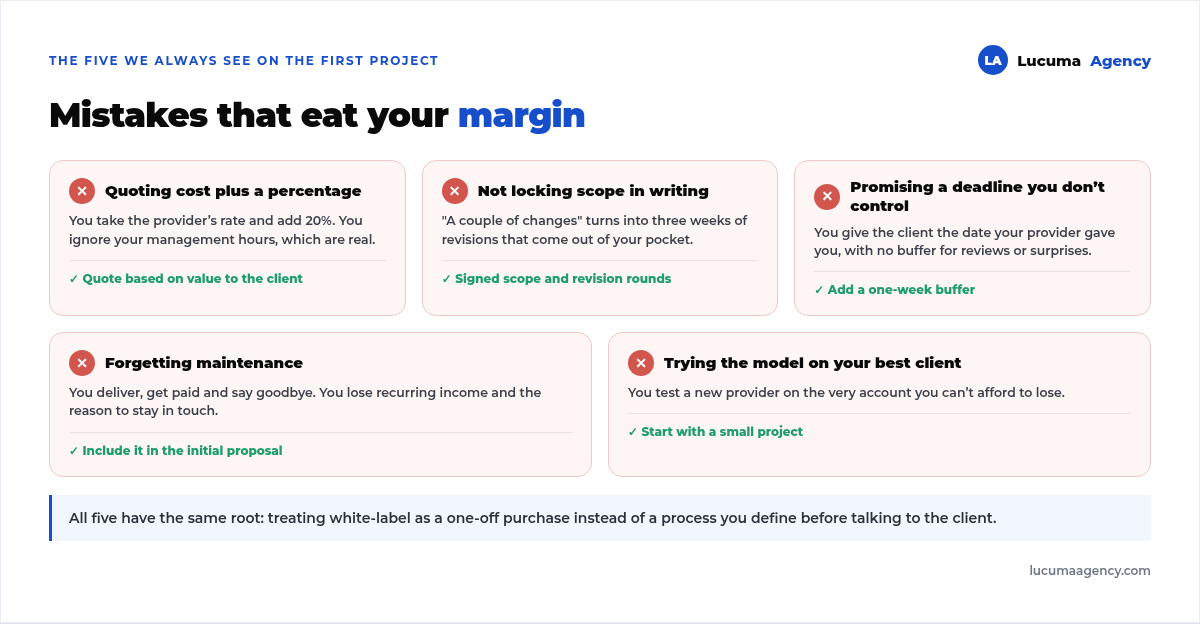
The timeline mistake deserves a note. If your vendor tells you four weeks, don't promise your client four weeks. You need time to review, pass along tweaks and review again. Always add a one-week buffer: it's the difference between looking good and spending that last Friday apologizing.
What you need to know, even if you don't code
You don't need to know how to develop, but you do need enough to price well and avoid promising the impossible:
What hosting and a domain are, and that both are paid every year.
Why speed matters and what ruins it. You'll find it in how to speed up your WordPress website.
That a website doesn't show up on Google by itself. If your client assumes it does, the frustration will land on you: make it clear from the proposal that ranking is separate work, as we explain in what SEO is.
That it needs maintenance. An abandoned website breaks or gets infected, and the client is going to call you.
What to tell the client when they ask who builds it
This is the doubt that holds most people back: you feel that delegating is cheating and that if the client finds out, you lose authority.
It isn't, and it's worth taking that weight off your shoulders. An architecture firm doesn't manufacture the windows. An ad agency doesn't print the billboards. They hire whoever does it best and they answer for the result. Your client hires you for your judgment, not your hands.
That said, there's a line you shouldn't cross: don't lie if they ask you directly. The honest and sufficient answer is that you work with a trusted technical team and that responsibility for the project is yours. Nobody asks for more.
What's truly yours: the design, the relationship, the decision about what gets built and the guarantee that it works. That doesn't get delegated.
How to choose who you delegate to
This is where margin is won or lost, and where most freelancers get burned the first time. Five things worth asking before you send a client to anyone.
Whether they'll contact your client. The right answer is no, never, unless you ask them to. If the vendor puts their brand in the footer or emails the client on their own, it isn't white label.
What happens when something breaks. Ask for the response time in writing. A website that goes down on a Monday morning is your problem, not theirs, and the client is going to call you.
Whose name the logins are under. Domain, hosting and analytics should be in your client's name or yours. If they're in the vendor's name, you're tied down.
How many rounds of changes are included. Without a number, the project drags on and the margin evaporates. Three is usually reasonable.
Whether they'll support you after delivery. Maintenance is where the recurring revenue is. If your vendor doesn't offer it, you won't be able to either.
Frequently asked questions
Will my client notice?
Not if the agreement is done right. Your vendor doesn't appear in the footer, in the WordPress dashboard or in system emails, and never contacts your client for any reason.
Do I need to invoice as a company?
No. You can work white label as an individual issuing a recibo por honorarios (professional fee receipt). What you should have is the scope in writing with your client and the agreement in writing with your vendor.
What if the project gets complicated and I don't know the answer?
That's why the agreement includes a direct channel with whoever is executing. You pass the question along and you answer the client yourself. What you should never do is put your vendor in direct contact with them.
Can I resell SEO and content too?
Yes, and it's the natural add-on to maintenance. Before you sell it, understand what you're selling and on what timelines, so you don't promise results in 30 days.
Which project should I start with?
A small one, with a client who isn't your most important account. Trying out a new vendor on the project you can't afford to lose is the most expensive mistake on the list.
Can I offer websites if I only know how to design in Figma?
Yes, and it's the most common case. You deliver the design and the call on what the client needs; the development is done by someone who knows how. What you do need to understand is what can and can't be built, so you don't promise the impossible in a meeting.
What if the vendor disappears halfway through the project?
That's why logins matter. If the hosting, the domain and the repository are in your name or your client's, switching vendors is a hassle but not a catastrophe. If they're not, it's a catastrophe.
Conclusion
White label solves a freelancer's age-old problem: being able to take on the whole project without hiring anyone or being forced to become a developer. You're still the face, the judgment and the invoice; someone else provides the hands.
It works when you delegate the technical side and keep what makes clients choose you: the relationship, the design and the responsibility for everything turning out well.
In Lucuma Agency we develop in white-label WordPress for freelancers and agencies, without ever appearing in front of your client. Have a job you can't deliver? Book a call and we'll tell you whether we can do it under your name.
Other posts you might like
At almost every real estate developer we work with, the lead takes the same absurd trip: it comes in through the form...
Switching servers is scary for a sensible reason: you rarely do it, and when it goes wrong, it goes wrong in public....
The question always comes the same way: “which payment gateway do you recommend?” And the useful answer doesn't start with a name, because the...
There's a moment, in quite a few projects, when the search for the right plugin becomes the problem. You tried three,...
Almost every online complaints book we audit complies on the outside and fails on the inside. They have the notice,...
The message came in like this: “the complaints book is throwing an error.” The Proba Inmobiliaria website, a page required by law,...
“Top 50 plugins” lists don't help you decide. They help you install fifty plugins. This is ours,...
Almost every business we ask has backups. Almost none has ever restored one. Those two sentences together are...
Almost every hosting conversation starts with price and ends up in the wrong place. The useful question is...
When a business wants to sell outside its country, the conversation almost always starts off wrong: with translation. And the...
Structured data is the piece of code that explains to Google, in a language that leaves no room for interpretation,...
The question comes up in almost every meeting: “if I use AI to write, will Google penalize me?” The short answer...