White-label WordPress: the complete guide for agencies and web developers
A branding studio in Miraflores went through the usual story: they wrapped up a restaurant's brand identity, the client loved it and asked for the website too. They had no developer. They referred the project to a well-known agency and, eight months later, that client wasn't even asking them for design anymore: the other agency was doing everything for them.
Losing a project hurts. Giving away a client hurts a lot more. The model known as white-label, also called private label, exists for exactly that reason: so you can say yes without hiring anyone and without introducing your client to your competition.
In this guide we explain how the model works, what you can resell beyond “build me a website”, when it makes sense compared to building your own team and, above all, what to demand from a vendor before you put your brand on their work.
What the white-label model is
white-label WordPress means hiring a team that builds websites under your brand, without ever appearing in front of your client. You quote, you present, you invoice and you're accountable. They execute.
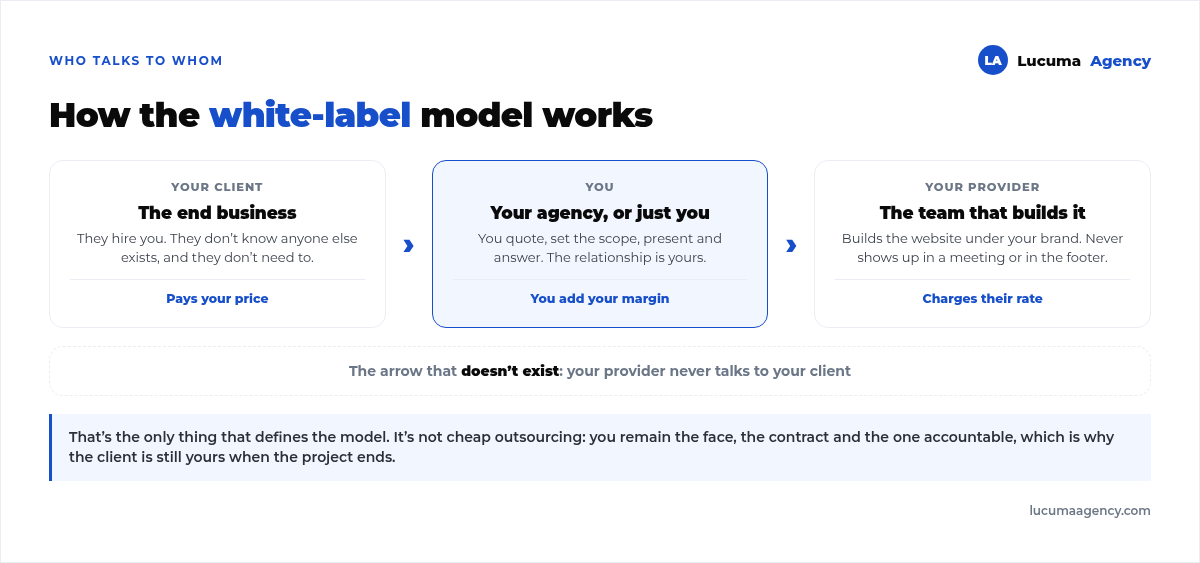
What defines the model isn't price or technology: it's that missing arrow between your vendor and your client. If your vendor talks directly to your client, that's no longer white label, it's a referral, and sooner or later you get cut out.
Marca blanca, white label and private label
The three terms are used as synonyms and in practice they are: a product or service someone makes so that someone else can sell it under their own brand. “White label” is the English term, “marca blanca” is the one used in the Peruvian market and “private label” is the one that shows up in contracts and consulting. It doesn't matter which one you hear: the relevant question is always the same, who is accountable to the client.
Who it really works for
Marketing agencies that sell campaigns and find that the client needs a decent landing page for that traffic to land on.
Branding and design studios that deliver the identity and watch someone else walk away with the web project, which is the most expensive one.
Freelance designers who can build layouts but don't want to deal with hosting, security or updates.
Agencies with a maxed-out team that need extra capacity during a peak without hiring anyone permanently.
The pattern is the same for all four: you already have the client and the trust. What you're missing is hands, and hiring them full-time for irregular demand is the worst possible economics.
What you can resell
This is the most expensive mistake almost everyone makes when entering the model: reselling only the project.
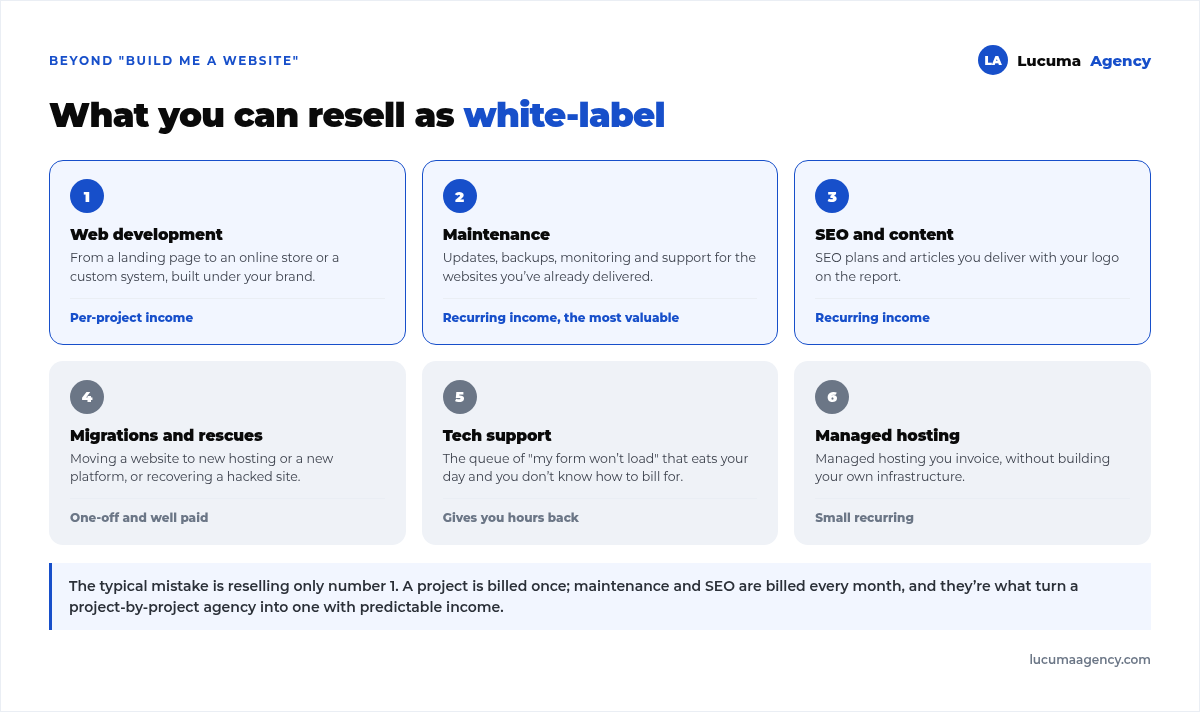
Development gets billed once. Website maintenance and SEO get billed every month, and they're what turn an agency living off one-off jobs into an agency with predictable revenue.
If you deliver ten websites a year and none of them stays on a maintenance plan, every January you start from zero again. If all ten stay on a monthly fee, in three years you have a base that covers payroll before you sell anything.
White label vs. hiring a team
The honest comparison isn't “white label, yes or no”, but what you do when a web project comes in and you have no one to execute it. There are three paths:
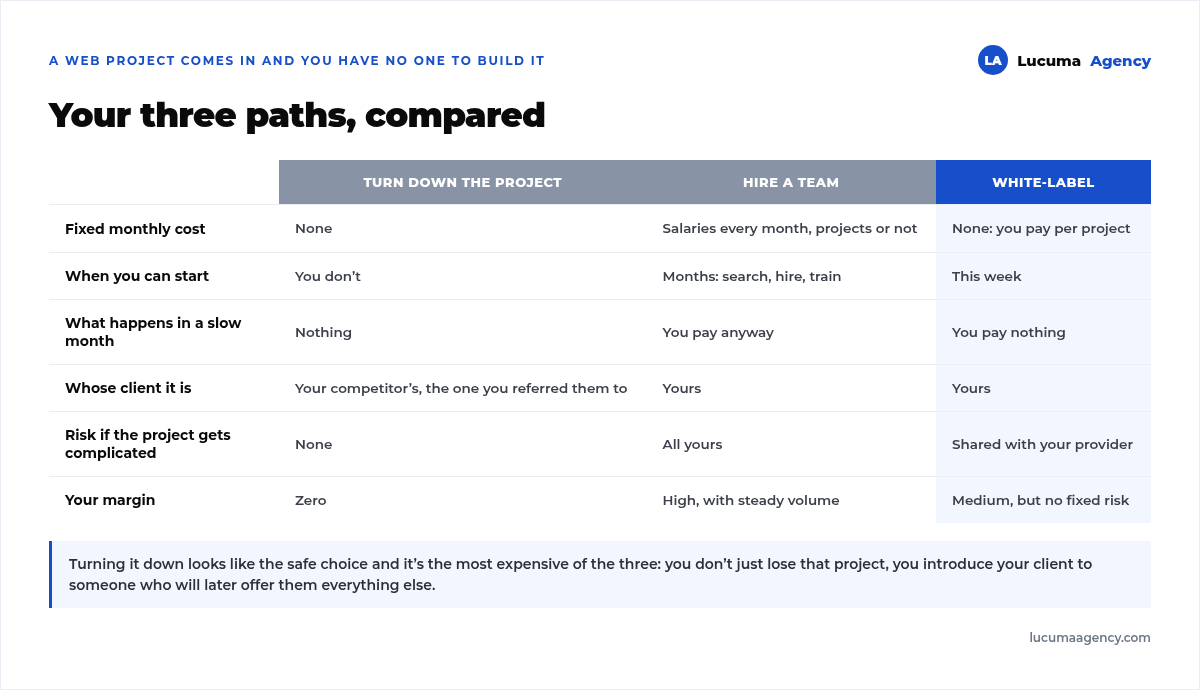
Hiring a team makes sense when volume is steady and predictable. A developer on payroll costs the same in a month with three projects as in a month with none, so the question isn't whether you can afford it, but whether you can afford it in January.
Turning it down looks like the prudent option and is usually the most expensive one: you don't just lose a project, you introduce your client to someone who will later offer them branding, campaigns and everything else.
What to demand from a white-label vendor
This is where the model breaks or works. You're putting your brand and your reputation on work someone else does, so the terms have to be clear before you sign, not when a client is already waiting:
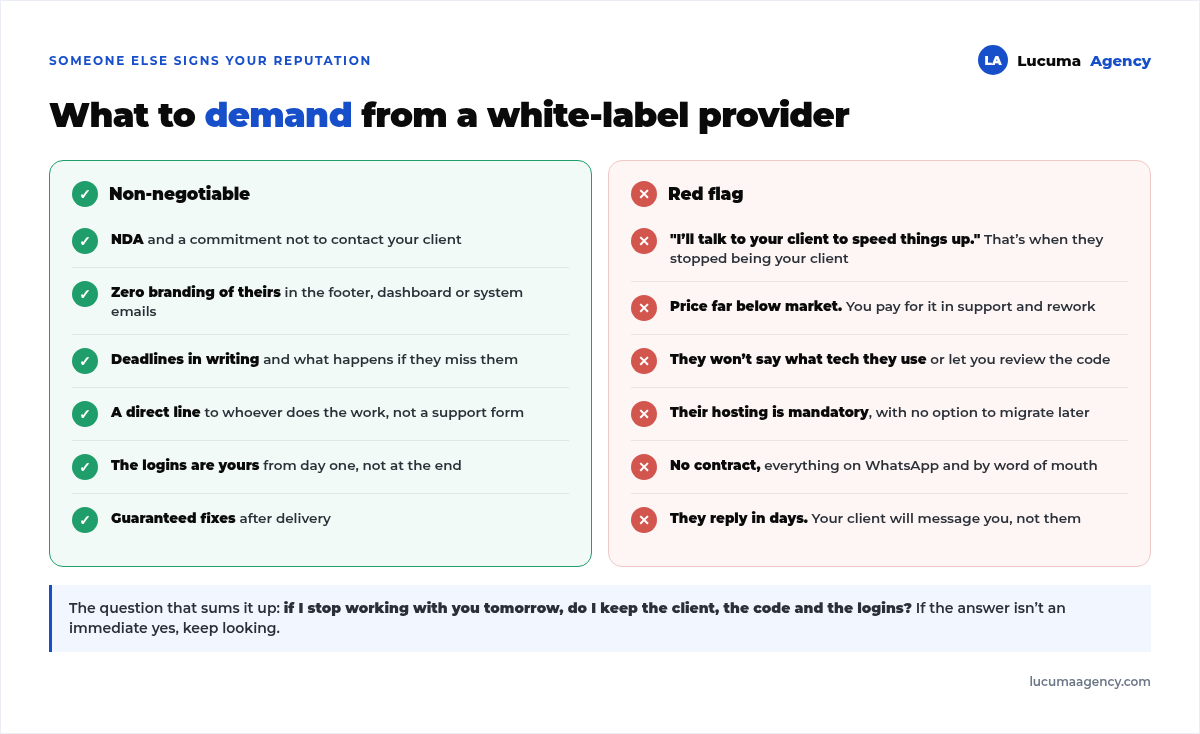
One question sums up all the others: if I stop working with you tomorrow, do I keep the client, the code and the logins? If the answer takes a while or comes with caveats, keep looking.
And the very low price red flag deserves attention. A vendor charging half the market rate didn't discover a trick: they're cutting corners on testing, security or support. You're the one who will pay for it, in hours of rework and in an annoyed client who writes to you, not to them.
How to price a white-label project
The practical question everyone entering the model has is how much to charge. And the most common mistake is quoting the vendor's rate plus a percentage, as if you were a middleman.
You're not. You bring the client relationship, an understanding of their business, the scope definition, the presentation, project management and the guarantee that someone is accountable. All of that has value, and it's what the client is buying when they choose you instead of looking for a developer online.
The healthy way to price is the other way around: start from the project's value to your client, not from the cost of executing it. A website in Peru ranges from S/ 1,000 for something simple to S/ 30,000 for a system with integrations, and we break it down in our guide to how much a website costs in Peru. Place the project within that range based on what it solves, and only then check whether your vendor leaves you enough margin.
Three line items almost nobody includes and that always exist:
Your management time. Meetings, briefs, reviews, back-and-forth on content. They're real hours even if you don't write a single line of code. Part of that management work is repetitive and can be automated, which also lowers your cost per project.
The change buffer. Every client asks for out-of-scope tweaks. If you didn't plan for it, it comes out of your margin.
First-year maintenance. Include it in the initial proposal. Selling it later, when the client already feels “the website is done”, is much harder.
What you should never delegate
The model works when you delegate execution, not judgment. There are four things that, if you let go of them, turn you from an agency into a replaceable middleman.
The client relationship. It's your only real asset. The moment someone else sits in that meeting, your position becomes expendable.
Defining the scope. You know your client's business; your vendor doesn't. If you let the person executing write the scope, they'll describe what they know how to do, not what your client needs.
The review before delivery. Open the website, test it on your phone, submit the form. Your client can't tell your work from your vendor's: to them, it all carries your name.
The strategy. Which pages are needed, what each one should say and what their customers search for on Google is a business decision, not a technical one.
The real risks, no sugarcoating
You depend on someone else's timelines. If your vendor falls behind, you're the one who looks bad. That's why deadlines go in writing and with a buffer.
Your margin is smaller than if you did it in-house. In exchange, you have no fixed costs and no risk in slow months.
You need to understand what you sell. You don't need to code, but you do need to be able to explain to your client what hosting is, why speed matters and what maintenance includes. Otherwise, you'll price it wrong.
Quality control is on you. Review before delivering. Your client won't tell your work apart from your vendor's: to them, it's all yours.
Why WordPress and not something else
Almost the entire white-label web development market revolves around WordPress, and there's a business reason behind it: it's what lets your client edit their website without depending on anyone, and what lets you switch vendors without rebuilding the site. We explain it in why build your website on WordPress and in WordPress.com vs WordPress.org vs custom code.
A custom build in proprietary code ties you to the vendor who wrote it. In white label, that's exactly what you don't want.
How to get started without risking a good client
1. Test with a small project. A landing page, not your best account's e-commerce store.
2. Ask to see previous work and, if possible, talk to another agency that already works with them.
3. Price with a real margin. Add your management time, meetings and reviews to the vendor's rate. That time exists even if you don't code.
4. Lock in maintenance from the proposal. It's easier to include it at the start than to sell it six months later.
5. Document the logins in your name on day one: domain, hosting, WordPress and Search Console.
Frequently asked questions about white-label WordPress
Will my client find out I didn't build it?
Not if the agreement is done right. The vendor doesn't appear in the footer, in the dashboard or in system emails, and never contacts your client for any reason.
How much margin can I add?
It depends on how much you bring: the relationship, strategy, design, management and the guarantee are worth money. Price based on the project's value to your client, not your vendor's rate plus a percentage.
Does it work if I'm a freelancer and not an agency?
Yes, and it's one of the cases where it pays off most: it lets you take on projects you turn down today because you have no team. We cover it in depth in our white-label WordPress guide for freelancers.
Who's responsible if the website breaks in six months?
In your client's eyes, you are. That's why your agreement with the vendor has to include a guarantee on fixes and a fast response channel, and why it pays to have maintenance under contract.
Can I resell SEO too?
Yes, and it's usually the natural add-on. If you're going to do it, first understand what you're selling: what SEO is and how long it takes to deliver results, so you don't promise impossible timelines.
Conclusion
The white-label model solves a very specific problem: being able to say yes to a web project without hiring anyone and without handing your client to another agency. It isn't magic and it isn't cheap: it's trading margin for flexibility, and for most small agencies that trade comes out ahead.
What decides whether it works isn't your vendor's price, but the agreement: that they never touch your client, that the logins are yours and that they respond fast when something breaks.
In Lucuma Agency we work white-label WordPress for agencies and freelancers, as well as white-label marketing. Have a project you can't deliver? Book a call and we'll tell you in 30 minutes whether we can do it under your brand.
Other posts you might like
At almost every real estate developer we work with, the lead takes the same absurd trip: it comes in through the form...
Switching servers is scary for a sensible reason: you rarely do it, and when it goes wrong, it goes wrong in public....
The question always comes the same way: “which payment gateway do you recommend?” And the useful answer doesn't start with a name, because the...
There's a moment, in quite a few projects, when the search for the right plugin becomes the problem. You tried three,...
Almost every online complaints book we audit complies on the outside and fails on the inside. They have the notice,...
The message came in like this: “the complaints book is throwing an error.” The Proba Inmobiliaria website, a page required by law,...
“Top 50 plugins” lists don't help you decide. They help you install fifty plugins. This is ours,...
Almost every business we ask has backups. Almost none has ever restored one. Those two sentences together are...
Almost every hosting conversation starts with price and ends up in the wrong place. The useful question is...
When a business wants to sell outside its country, the conversation almost always starts off wrong: with translation. And the...
Structured data is the piece of code that explains to Google, in a language that leaves no room for interpretation,...
The question comes up in almost every meeting: “if I use AI to write, will Google penalize me?” The short answer...