WordPress agency in Peru: what it does and when to hire one
"Agencies are way too expensive, I can get it done with a freelancer for a third of the price." We hear it a lot, and often they're right. The problem is that the comparison is almost never done properly: people compare the price of building the website, not the cost of keeping it running for three years.
A WordPress agency isn't a pricier developer. It's a different model, one that's sometimes worth it and sometimes money down the drain. In this guide we explain what an agency really does, how it compares with the alternatives, and how to choose one without settling for the cheapest or the smoothest talker.
What a WordPress agency does
The obvious answer is "websites," but that's only the first third of the job:
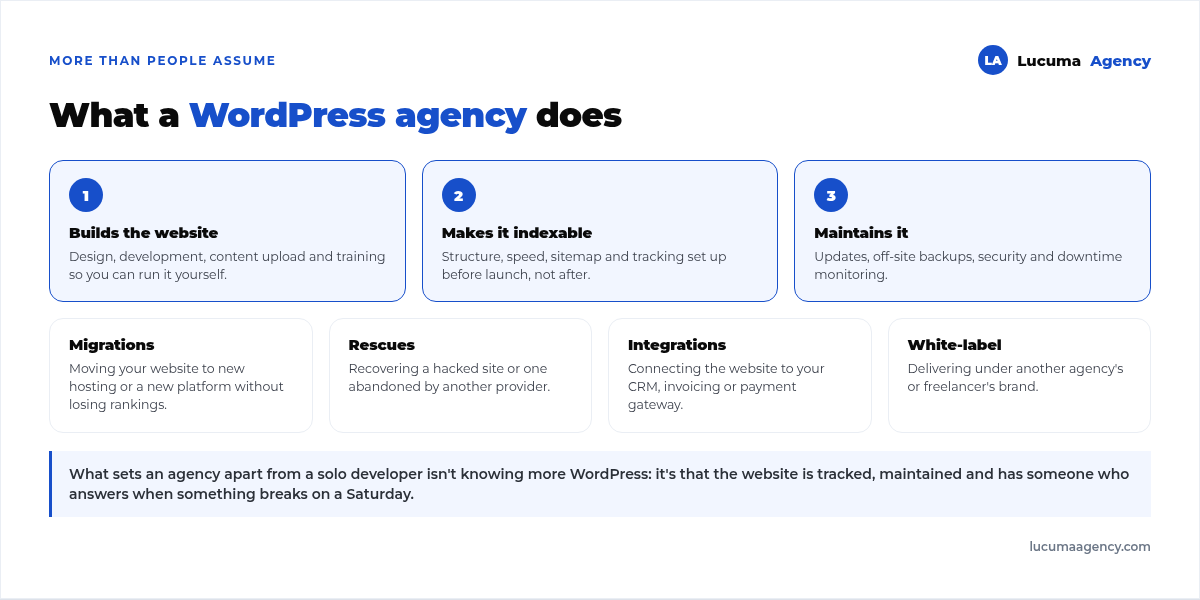
What sets an agency apart from a solo developer isn't knowing more WordPress. It's that the website ends up tracked, with analytics and Search Console set up before launch; maintained, with updates and backups; and with someone who answers when the form stops sending on a Saturday.
Those three things don't show up in the proposal, and they're what explain the price difference. What you can see are the websites they've already built: ours are on our work, with a screenshot of each one.
Agency, freelancer, template or platform
There are four reasonable ways to get a website, and none of them is always the right one:
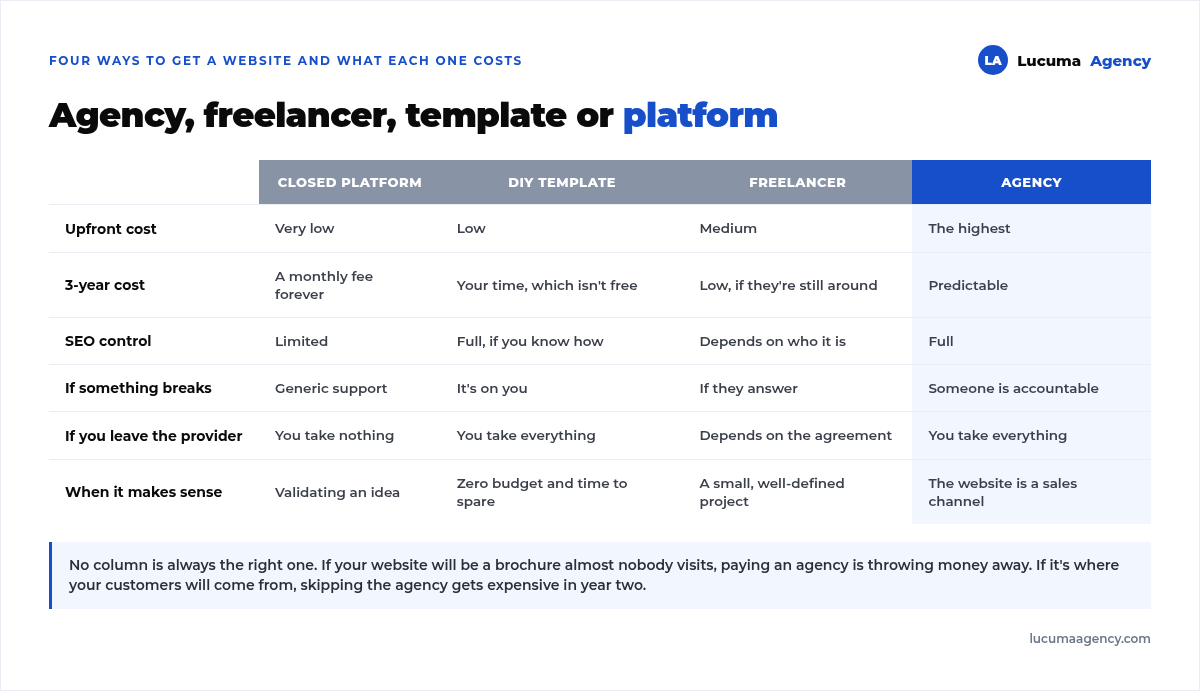
A closed platform works for validating an idea quickly and cheaply. The problem shows up when you want to rank, integrate something or move: you find out that what you saved in year one you pay for in year two, and that you take nothing with you when you leave.
A template you set up yourself makes sense with a zero budget and plenty of time. You keep everything and have full control, if you know what you're doing. The cost isn't money: it's your hours.
A freelancer is the best option for a well-defined project with a clear scope. The known risks are availability and what happens when they change jobs or get overloaded.
An agency costs more upfront and is justified when the website is a sales channel, not a brochure. If clients come to you through it, skipping the agency usually turns out expensive in year two.
When it makes sense and when it doesn't
Let's be specific, because this is where an agency should tell you no.
You don't need one if your website is going to be a business card that hardly anyone visits, if you're validating an idea that could change in three months, or if you have the time and desire to learn to do it yourself.
You do need one if you sell through your website or get leads from it, if your website has to connect with other systems, if two vendors have already let you down and you're tired, or if you can't afford to have the website down for a weekend. Real estate developers and construction companies usually meet all three conditions at once; that's why we have a dedicated service for web design for real estate developers.
There's a very common in-between case: you already have a website, it half works, and you don't know whether to fix it or rebuild it. The first step there isn't hiring anyone, it's running a diagnosis with an honest checklist whether to fix it or rebuild it.
How to choose without getting it wrong
Everything below can be checked before you sign, and none of it requires you to know about technology:
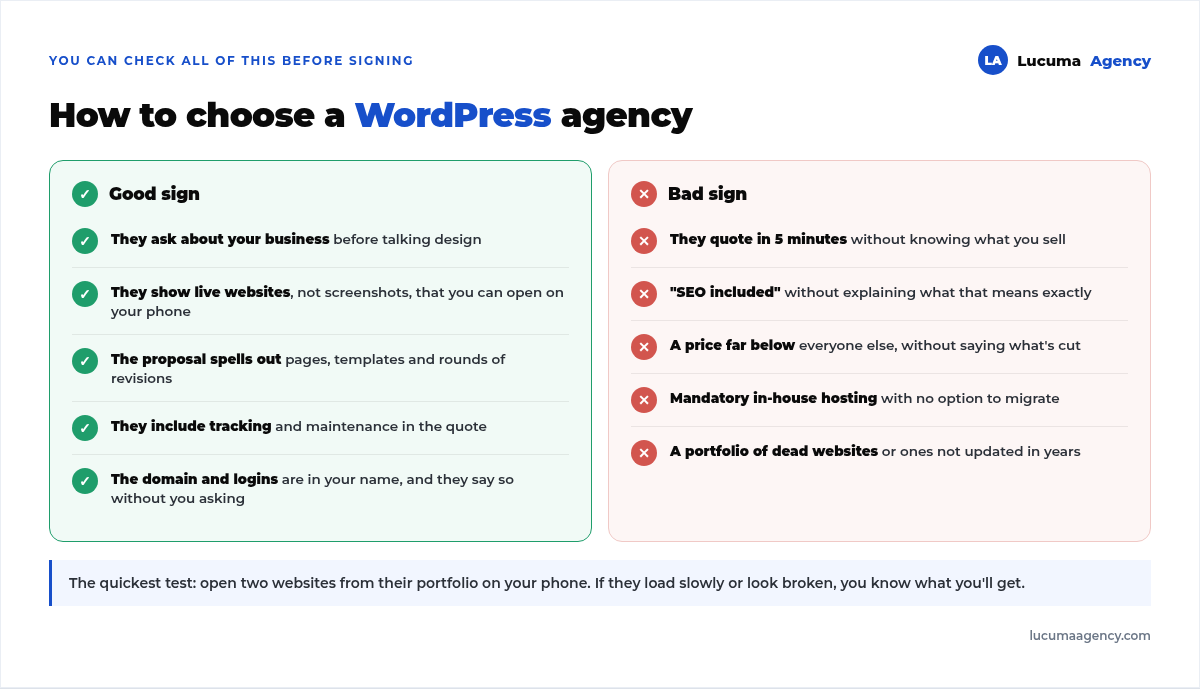
The fastest and most honest test: open two websites from their portfolio on your phone. If they're slow to load or the layout breaks, you already know what you're going to get. The speed is what gives away the most about how someone works.
And be wary of "includes SEO" with no further detail. It could mean they installed a plugin, or that they're going to work on your rankings for months. Those are very different things, and it's worth getting in writing which one it is, as we explain in what SEO is.
What should be in writing
No matter who you hire, these five lines prevent almost every conflict:
The domain in your name. Not the agency's. It's the point that causes the most problems later.
Access handed over to the hosting, the WordPress dashboard and the tracking accounts.
The rounds of changes included and what happens if you go beyond them.
Maintenance: who, how often and for how much. We break it down in WordPress maintenance.
What happens to your current URLs if you already have a website. Rebuilding it without redirects wipes out the rankings you already had, and we explain it in how to migrate without losing rankings.
Frequently asked questions
Why does an agency charge more than a freelancer for the same thing?
Because it usually isn't the same thing. Compare what each proposal includes in tracking, maintenance, training and response when something breaks. If both include exactly the same, the freelancer is usually the better choice.
Can I start with a freelancer and switch to an agency later?
Yes, as long as the work is done on self-hosted WordPress and you have the access and the domain. That way you're not locked in with anyone, which is what we talk about in WordPress.com vs WordPress.org vs custom code.
Do agencies only work with large companies?
No. In Peru most web projects are for SMBs and local businesses. What does change is the scope: a five-page website is not the same as a system with integrations.
Can an agency guarantee I'll show up on Google?
Nobody can guarantee rankings, and anyone who promises that is selling smoke. What can be guaranteed is leaving the website indexable and tracked, which is the starting point.
What if I'm not happy with the result?
That's why rounds of changes are agreed on and the design is approved before development. If the design arrives as an image, the process has one more step; we cover it in how to turn a JPG design into a pixel-perfect website. And that's why it's smart to start with a small, well-scoped project before commissioning the big one. And if what you have is a website that already works but has gotten outdated, the right job is to redesigning your website without losing rankings, not start from scratch.
Conclusion
Hiring a WordPress agency isn't the right choice by default, and any honest agency will tell you so: if your website is a brochure, there are cheaper routes that work well.
An agency is justified when the website is part of how you sell, because then what you're buying isn't the design but having it tracked, maintained and with someone who answers. And whatever you choose, what's non-negotiable is that the domain is in your name and that you have all the access from day one.
In Lucuma Agency we do web development in WordPress, and we also work white-label for other agencies. If we're not what you need, we'll tell you. If you're an agency or freelancer and want to see how that model works, it's in our white-label WordPress guide for agencies. Book your free consultation and we'll review it in 30 minutes.
Other posts you might like
At almost every real estate developer we work with, the lead takes the same absurd trip: it comes in through the form...
Switching servers is scary for a sensible reason: you rarely do it, and when it goes wrong, it goes wrong in public....
The question always comes the same way: “which payment gateway do you recommend?” And the useful answer doesn't start with a name, because the...
There's a moment, in quite a few projects, when the search for the right plugin becomes the problem. You tried three,...
Almost every online complaints book we audit complies on the outside and fails on the inside. They have the notice,...
The message came in like this: “the complaints book is throwing an error.” The Proba Inmobiliaria website, a page required by law,...
“Top 50 plugins” lists don't help you decide. They help you install fifty plugins. This is ours,...
Almost every business we ask has backups. Almost none has ever restored one. Those two sentences together are...
Almost every hosting conversation starts with price and ends up in the wrong place. The useful question is...
When a business wants to sell outside its country, the conversation almost always starts off wrong: with translation. And the...
Structured data is the piece of code that explains to Google, in a language that leaves no room for interpretation,...
The question comes up in almost every meeting: “if I use AI to write, will Google penalize me?” The short answer...