My website isn't showing up on Google: 7 causes and how to check them
You paid for a website, launched it two months ago and it's nowhere to be found. You search for your service and your competitors come up. You search for your business name and its Facebook page comes up, but not your website. It feels like you threw your money away.
It almost never is. In most of the cases that reach us, the cause is one of three things, none of them needs a developer and several can be fixed in ten minutes. In this guide we go step by step: first a test that splits the problem in two, then the seven causes and where to check each one.
First: the 10-second test
Before you check anything, go to Google and type this, with your domain and no space after the colon:
site:tudominio.com
That search asks Google to show you only pages from your site. Whatever comes up splits the problem into two completely different paths:
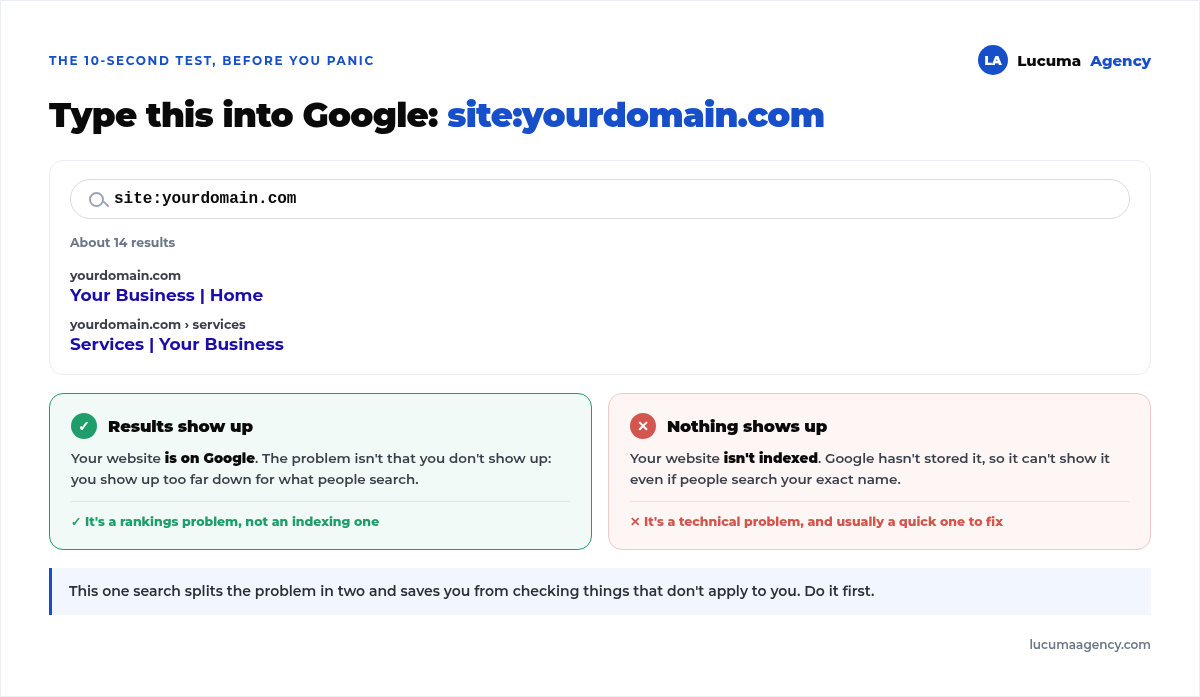
If results come up, your website is on Google. Your problem isn't showing up: it's showing up at the top. That's ranking, and it's solved with sustained SEO work.
If nothing comes up, your website isn't indexed. Google doesn't have it stored, so it can't show it even if people search for your exact name. It's a technical problem, and it's usually one of the quick ones to fix.
Run this test before anything else: it saves you from going through half a guide that doesn't apply to your case.
The seven causes, from most to least common
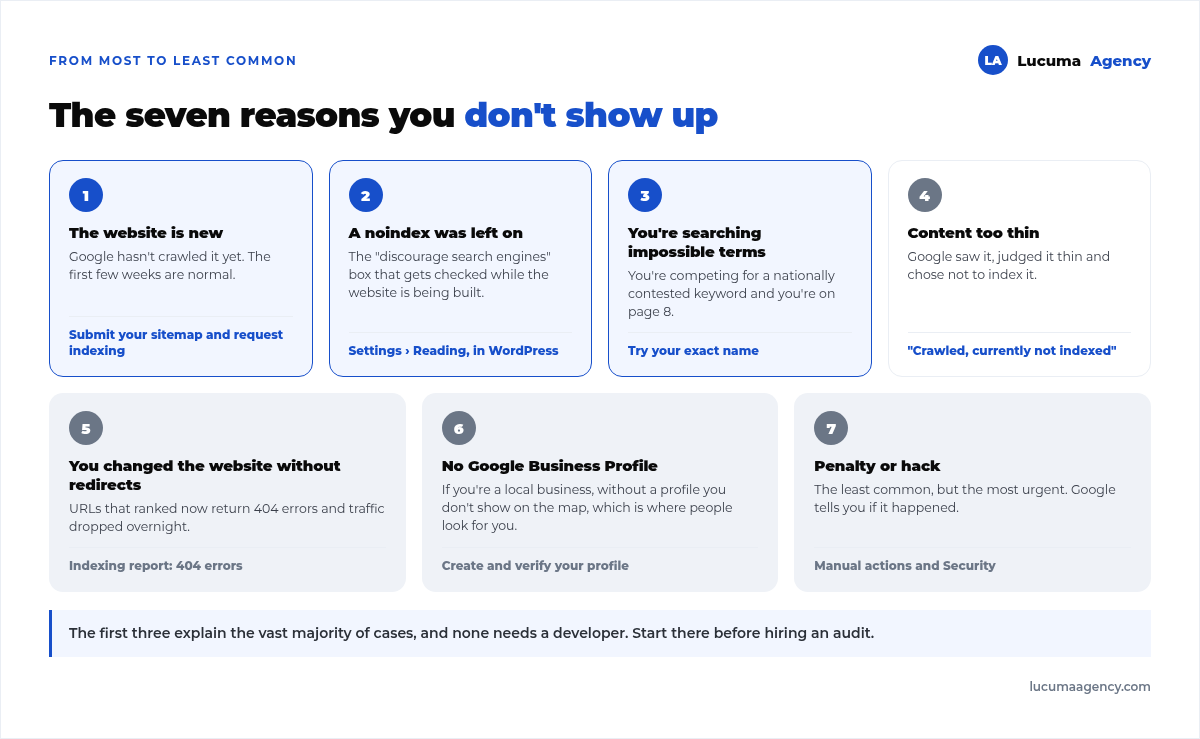
1. The website is new
Google needs to discover it, crawl it and decide to index it. The first few weeks without showing up are normal. What speeds this up is submitting your sitemap in Search Console and requesting indexing for your main pages, instead of waiting for Google to find them on its own.
2. A noindex was left on
This is the cause we've found most often, and the most absurd. In WordPress there's a checkbox under Settings › Reading that says "Discourage search engines from indexing this site." It gets turned on while the website is being built, and someone has to turn it off at launch. When nobody does, the website stays invisible for months.
Check it. It takes ten seconds and explains a surprising number of cases.
3. You're searching for impossible terms
Sometimes the website does show up, but you're measuring wrong. If you search for “agencia de marketing” (marketing agency) and you're on page 8, you conclude "I don't show up," when in reality you do, just very far down.
The fair test is to search for your business's exact name. If you show up there, you're indexed and what you need is ranking. And the shortest path to that is Local SEO: “gasfitero en Surco” (plumber in Surco) is won much sooner than “gasfitero”. And if you can't wait for SEO to mature, for example with a project in pre-sale, district-targeted search ads bring in inquiries from the very first week: we cover it in Google Ads for real estate projects.
4. The content is too thin
Google came in, read it, found it lacking and decided not to store it. In Search Console it shows up as "Crawled: currently not indexed". It's common on three-paragraph service pages that don't answer anything.
The solution isn't to make it longer for the sake of it, but to truly answer what the visitor is looking for. We cover it in On-page SEO.
5. You changed your website without redirects
If you used to show up and suddenly stopped right after a redesign, this is almost certainly your cause. The old URLs that were already ranking now return a 404 error, and Google gradually drops them from the index.
It's fixed with a 301 redirect map from each old URL to its new equivalent, and we explain it step by step in how to migrate your website without losing rankings.
6. You don't have a Google Business Profile
If you're a local business, a good share of your customers don't look for you in the web results: they look for you on the map. Without a business profile that's created and verified, you won't show up there, no matter how good your website is. It's free and it's what delivers results the fastest: the complete guide is here.
7. Penalty or hack
The least common and the most urgent. If your website was hacked, Google may remove it from the results or flag it as a dangerous site. It warns you in Search Console, under Manual actions and in Security issues. If that's the case, the first step is to clean it up: WordPress security.
Where to check each cause
Everything below is free and you don't need anyone's help to check it:
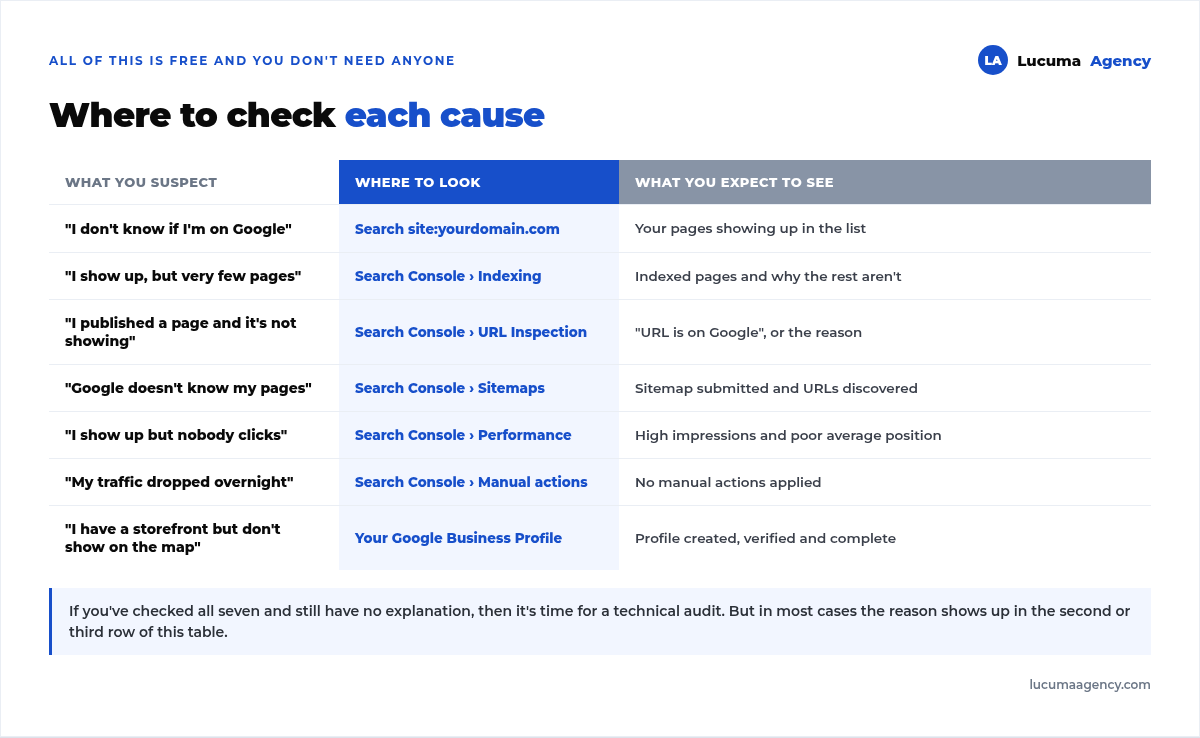
If after checking all seven you still have no explanation, that's when a technical audit makes sense. But in most cases the answer shows up in the first two rows of that table. And if everything is fine and it's just a matter of time, here are the real timelines: how long it takes for a website to rank.
If after going through this list you still don't know what's wrong, it pays to look at it in an organized way. That's exactly what you get from a website & SEO audit: findings prioritized by impact and a plan, not 400 warnings from a tool.
Frequently asked questions
How long should I wait before I start worrying?
If your website is less than a month old and the sitemap has been submitted, wait. And if what you have is a single campaign page, it's normal for it not to show up: we explain why in landing page or full website. If it's more than two months old and site:tudominio.com returns nothing, there's a real problem to check today. If you'd rather have us check it, it's part of our SEO in Lima.
I show up when I search for my name, but not for my services. Is that normal?
Yes, and it's the most common situation of all. It means you're indexed but not ranking. It's not a technical failure: you just haven't done the work to compete for those searches yet. If you want to fully rule out technical issues first, follow the 10 points in how we audit a website before doing SEO.
My website used to show up and stopped. What should I check first?
In this order: if there was a recent redesign, look at the 404 errors; then manual actions; then security issues. One of those three almost always explains a sudden drop.
Can I pay Google to index me?
No. Indexing is free and can't be bought. Google Ads puts you at the top by paying for each click, but that's advertising and it doesn't fix your indexing problem or rank you in the regular results.
Is it more expensive to fix it or to rebuild the website?
Almost always fixing it, by far. Rebuilding the website without taking care of the URLs is also cause number 5 on this list, so the remedy often makes the problem worse. And if your problem is the opposite, too much content that Google ignores, check out how we relaunched a media outlet with 1,486 posts and zero traffic.
Conclusion
Your website not showing up on Google is almost never a mystery or a life sentence. Start with the search site:tudominio.com, which separates a technical problem from a ranking problem, and then go through the first three causes: a new website, a forgotten noindex and poorly measured expectations. That's where most cases are.
And if it turns out you are indexed, the good news is that the problem has a known solution: it's called doing SEO work, and you'll find it in what SEO is and how it works.
In Lucuma Agency we check this every day and put it in writing before we propose anything. Want to know why you're not showing up? Book your free consultation and we'll give you a diagnosis in 30 minutes.
Other posts you might like
At almost every real estate developer we work with, the lead takes the same absurd trip: it comes in through the form...
Switching servers is scary for a sensible reason: you rarely do it, and when it goes wrong, it goes wrong in public....
The question always comes the same way: “which payment gateway do you recommend?” And the useful answer doesn't start with a name, because the...
There's a moment, in quite a few projects, when the search for the right plugin becomes the problem. You tried three,...
Almost every online complaints book we audit complies on the outside and fails on the inside. They have the notice,...
The message came in like this: “the complaints book is throwing an error.” The Proba Inmobiliaria website, a page required by law,...
“Top 50 plugins” lists don't help you decide. They help you install fifty plugins. This is ours,...
Almost every business we ask has backups. Almost none has ever restored one. Those two sentences together are...
Almost every hosting conversation starts with price and ends up in the wrong place. The useful question is...
When a business wants to sell outside its country, the conversation almost always starts off wrong: with translation. And the...
Structured data is the piece of code that explains to Google, in a language that leaves no room for interpretation,...
The question comes up in almost every meeting: “if I use AI to write, will Google penalize me?” The short answer...